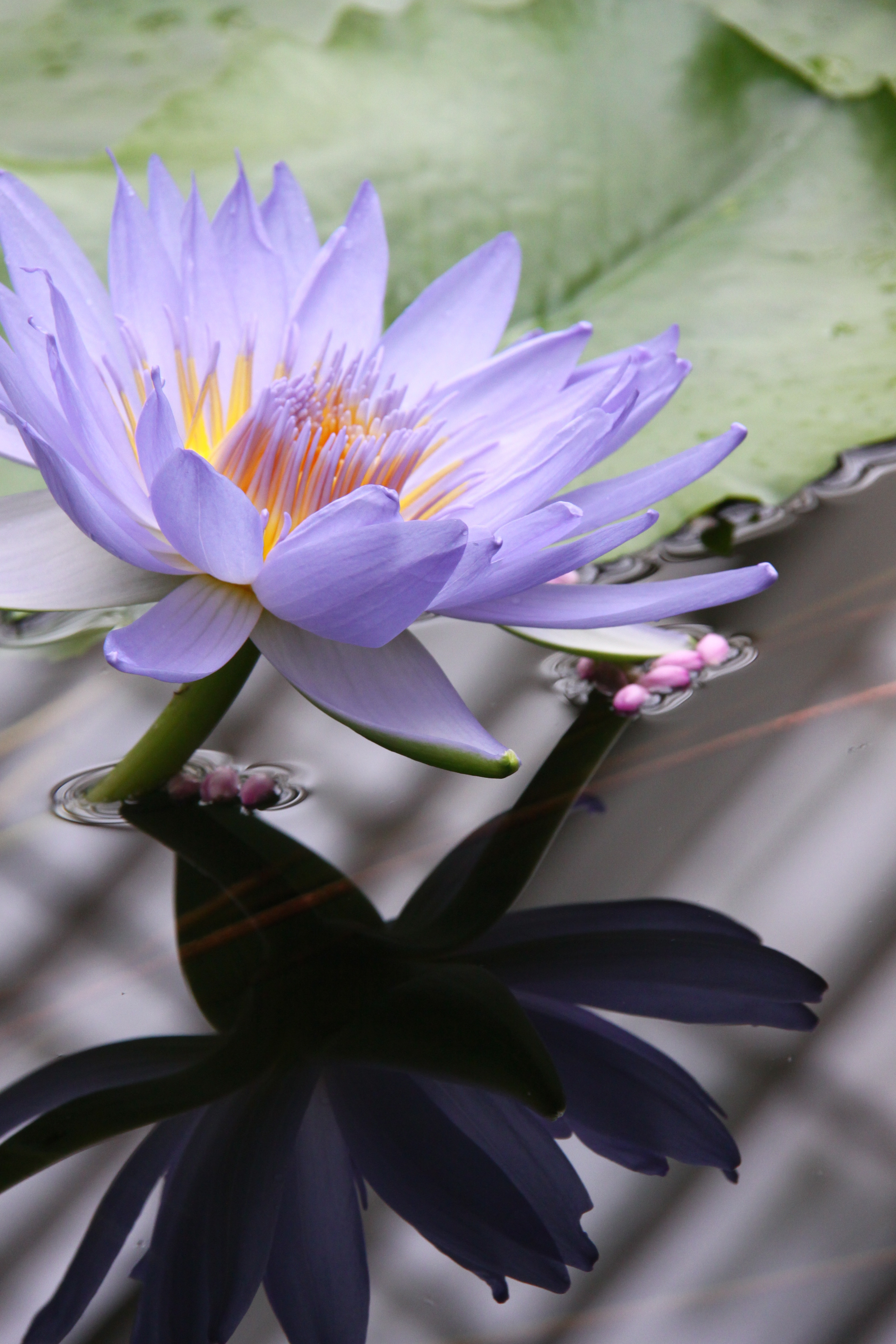
Water and stones alone do not make a healthy pond. It needs plants, which provide habitat for animals and filter nutrients out of the water, keeping it clearer and resistant to algal blooms. Plus, when you fill a pond with plants, you can call it a “water garden,” conjuring images of fragrant blossoms nodding at their reflections in limpid pools. Ideally, a pond will have both plants that live fully in the water—submerged plants rooted to the bottom as well as floating ones—and marginal (or “emergent”) plants that live on the banks in perpetually damp soil.
So, I’d done my homework. I’d read and re-read the “Water Plants” chapter of Gardening with Native Plants of the South by Sally and Andy Wasowski, as well as lots of online guidance. All these teachers agreed: I must assemble the emergent-submerged-floating trio. But, short of raiding local ponds, how to get these plants? Far fussier than their landlubber counterparts, they’re seldom sold by general plant stores. Of the few that are available, most are exotics.
Many aquatic plants are naturally aggressive growers that can become invasive outside their native range. For example, water hyacinths and water lettuce, popular aquascaping choices thanks to abundant flowers and foliage, are considered pests in Florida, where they outcompete native species. While it would take a catastrophic storm to move plants out of our isolated pond into local waterways, I didn’t want to take chances.
The one native marginal I found in Auburn was a swamp milkweed (Asclepias incarnata), which I purchased before we built the pond, placing it in my experimental clay-bottomed mini-pond (glorified puddle, that is). As it entered dormancy in late fall, dropping its leaves, its increasingly pathetic figure seemed to beg me for a new home.
With my heart set on creating an ecosystem as faithful to the Southeast as possible—requiring more than a single skinny milkweed—I searched online for native plant nurseries within 100 miles. The search yielded Nearly Native Nursery, which is near Atlanta, and Recreative Natives, near Birmingham. Both offer marginal plants.
In early January, Sergey and I took the trip to Nearly Native, bringing one of my coworkers on the outing. The co-owners, Jim and Debi, gave the three of us an enlightening, hands-on lesson on ecology.

Jim suggested we keep mosquitofish in the pond. These tiny fish (Gambusia affinis) are native to North America and renowned for eating mosquito larvae. In fact, Nearly Native has several ponds on the property, and Jim took us to one to catch some fish! He netted a few dozen, as well as several Southern leopard frog tadpoles, aquatic snails, golden club seedlings, and American crinum lily fruit. Depositing the lot into a bucket, he warned us we’d need to keep the water oxygenated.
Now, I have never kept a pet fish. In fact, back in college, a friend asked me to look after her betta fish while she was traveling, and he died on my watch. I put the unfortunate creature in my roommate’s mini-fridge so he could get a proper burial upon my friend’s return.
Given my track record, I was jittery about the two-hour journey with the fish and tadpoles. The humans on the trip also had needs: we were all famished. Into a crêperie came the bucket! In between bites of lunch, I used a straw to blow bubbles into the water and added ice cubes, as I’d been instructed by Jim. Thankfully, the restaurant didn’t have a “no fish” policy, nor were mosquitofish-stuffed crepes on the menu.

Throughout the drive home, I stirred the water with my finger and plunked in more ice cubes, prompting Sergey to warn me that I’d shake and freeze the piscine passengers to death! While a few went belly-up, most were still active by the time I deposited them in their new home. Over the next few months, I grew to enjoy feeding the mosquitofish fish flakes, tiding them over until the pond filled up with bugs. The shy, nocturnal tadpoles revealed themselves infrequently.
Within the next month, an event in Birmingham gave me the excuse I needed to stop at Recreative Natives, bringing home another haul of plants. The water garden began to grow.
 Layli Maria Miron
Pingback: Wildness and Pets | Layli Maria Miron
Pingback: Frog Pond at Half a Year | Layli Maria Miron