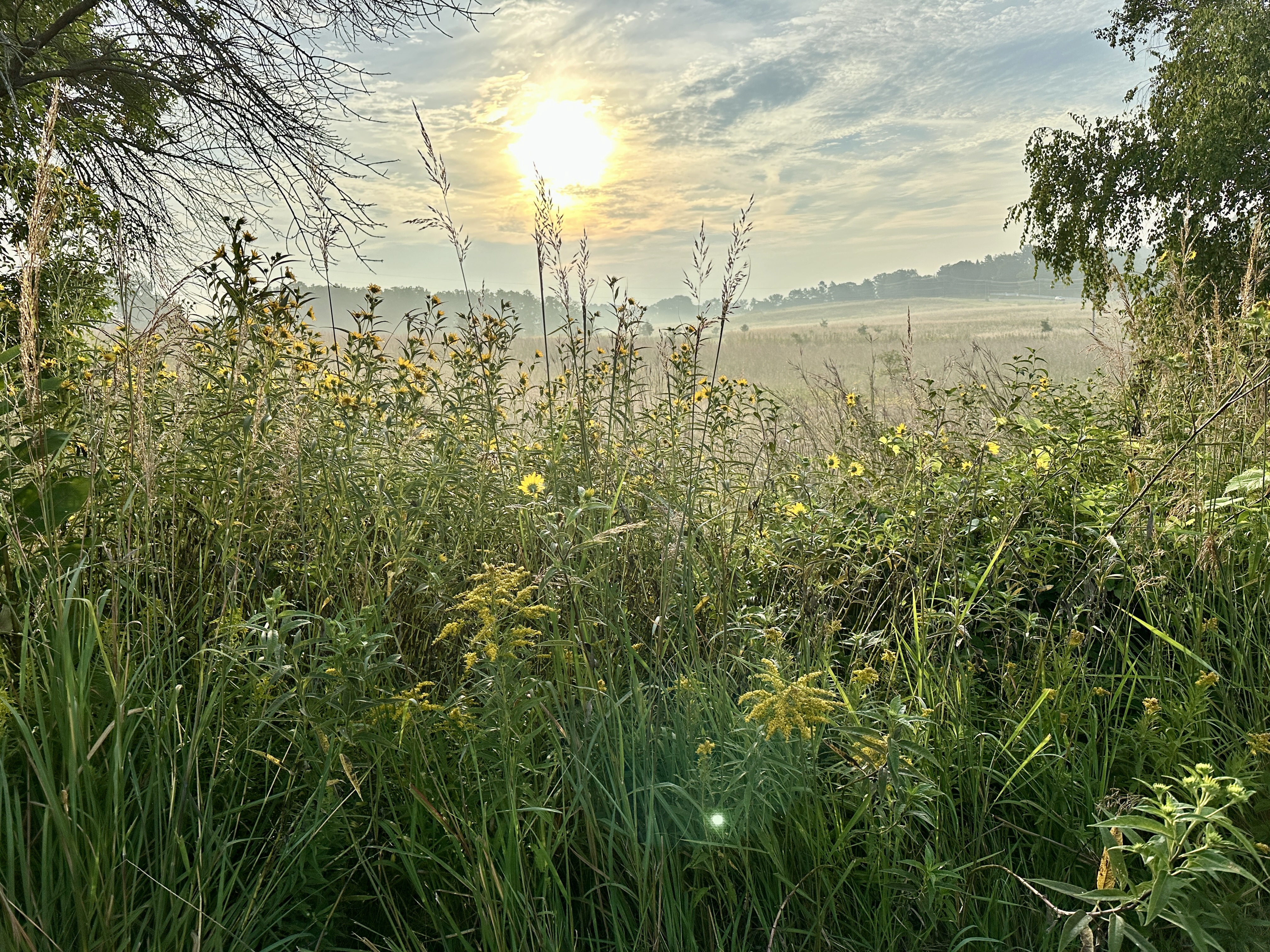
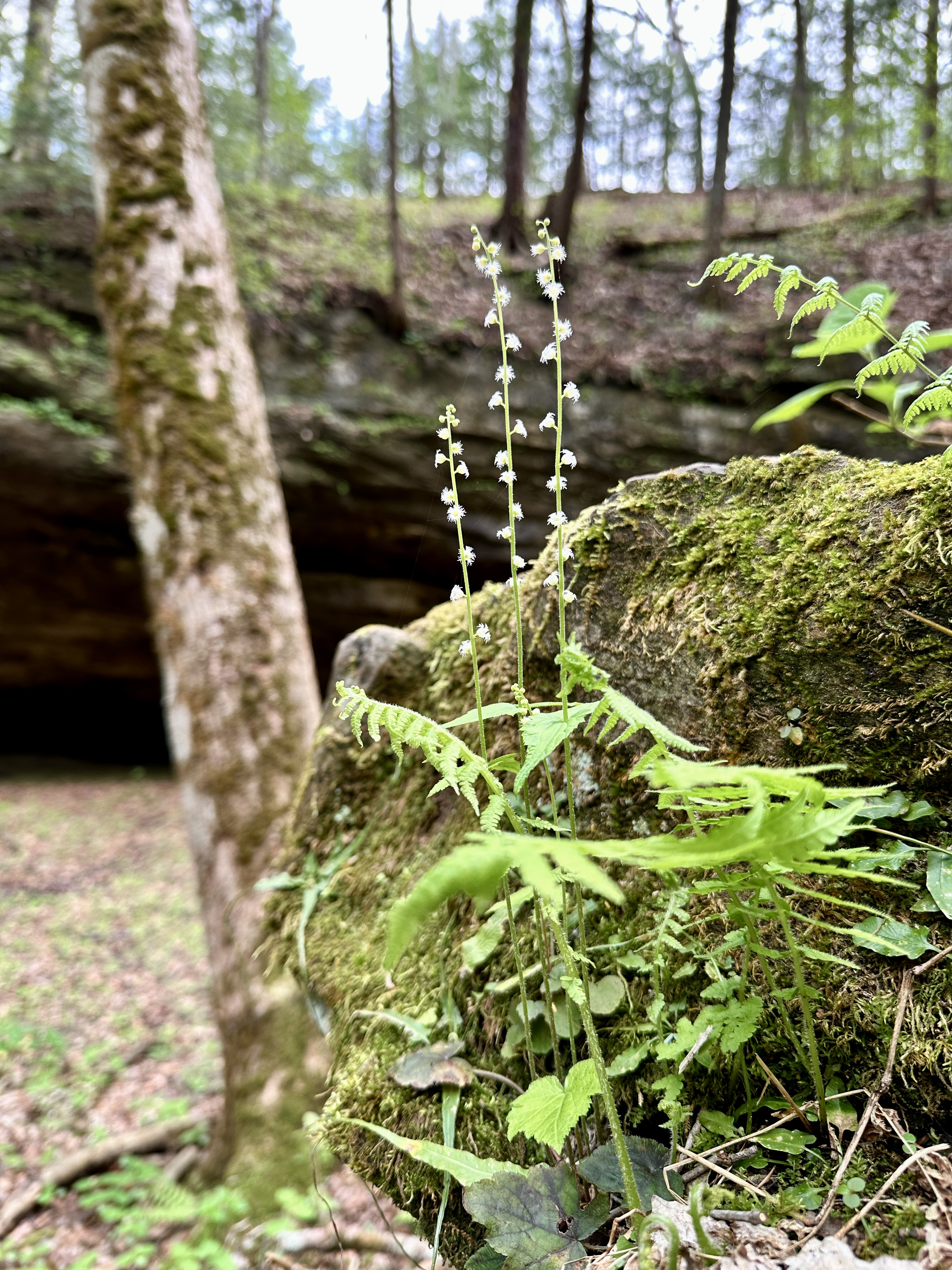
A cascade of goldfinches pours from walnut to thistle and back. A beetle explores the harlequin collars of spotted beebalm. Crickets pop through tallgrasses as I pass. A garter snake and I startle each other under pines. Nine wild turkeys march single file. Severed turkey legs on a path startle me far more than did the snake, signaling the presence of coyotes.
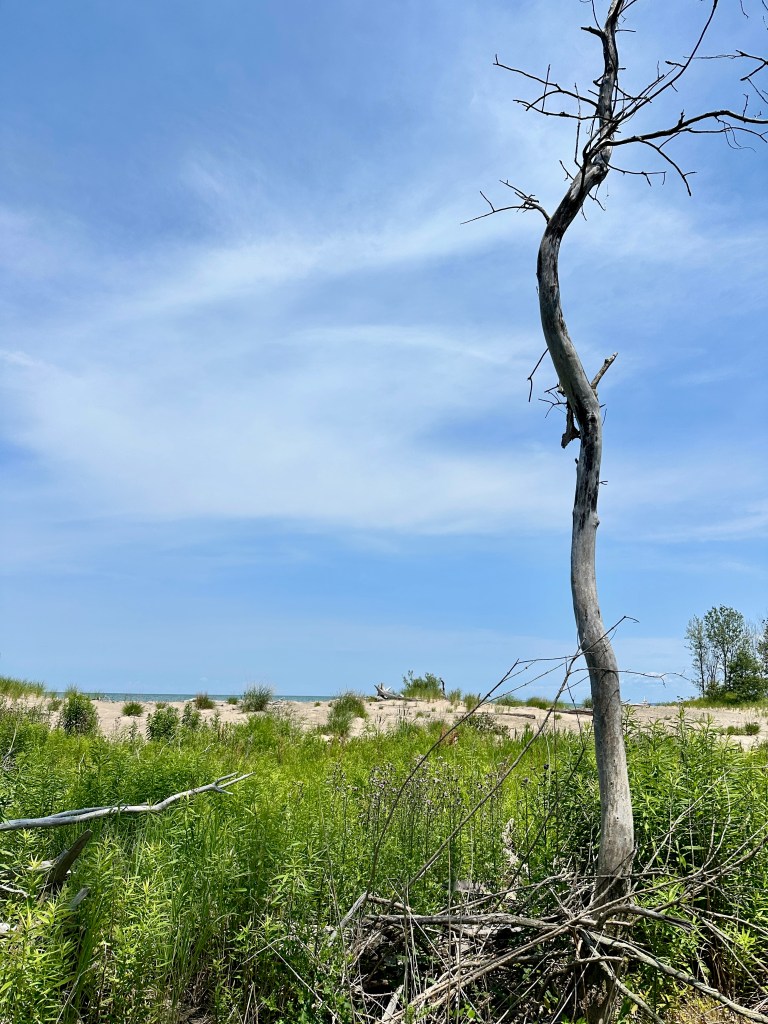
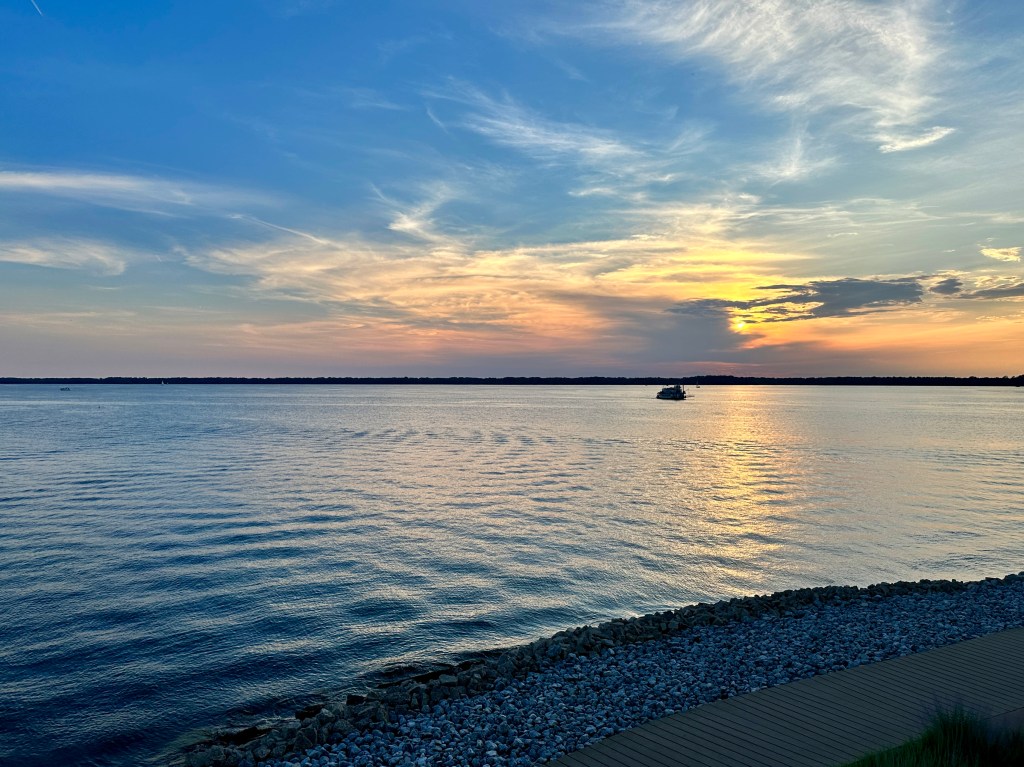
With heat advisories looming, we set off on our summer road trip. A stop, first, in Erie, Pennsylvania: a ride on a paddlewheel boat across the bay. A visit to Presque Isle, a skinny peninsula sheltering the bay from the waves of the great lake. Temperatures rose as we attempted a hike to the tip of the isle. On the sweltering sand, birders flocked to see a very lost, presumably very hot, ptarmigan. Tiny toads hopped across the beach from lakeshore nursery to inland pond.
On Presque IsleSunset on Presque Isle Bay
We waded into Erie, the shallowest of the Great Lakes, and then headed toward another gift of the glaciers, the long, thin Finger Lakes.
Miron, Layli, and Amy Cicchino. “Prioritizing Accessibility in Writing Program Administration.” Disability, Access, and the Teaching of Writing, edited by Stephanie K. Wheeler et al. Conference on College Composition and Communication, 2026, pp. 217–225.
My contribution with my former colleague Amy Cicchino appears as Chapter 20 in this edited collection. The editors include this note on the chapter explaining its impetus:
“Miron and Cicchino argue that WPAs [writing program administrators] have a deep responsibility to prioritize accessibility and that this prioritization is possible, even with the many competing responsibilities that come with administrative work. Their conclusion offers ways to undertake this work, starting by articulating why accessibility is important to your program. The authors also share the impressive Accessibility and Inclusion Guide they created for their program, which can be adapted for other contexts. Drawing from Miron and Cicchino’s suggestions and model, make an action plan for prioritizing accessibility in your program.” (page 225)
Over thousands of years, much of what we now call Indiana was flattened by glaciers, and when they left, they buried the land’s topography under massive deposits as they gave up the earth they’d dragged under their bellies. Gradually, vegetation returned, then forests arose.
When, millennia later, settlers felled Indiana’s forests, they created the contemporary landscape, where endless farm fields stretch their monocultures to the horizon. But the land still holds surprises.
From the rural heartland to the populous coasts, American Bahá’í communities are building and maintaining archives, preserving the legacies of spiritual ancestors for present-day and future learning.
Iowa Bahá’í History Project
The Iowa Bahá’í History Project takes a unique approach: it encompasses materials from across the entire state, and it lives online. In 2022, a group of friends decided to create a repository of stories, interviews, newspaper articles and photographs to trace the growth of the Bahá’í Faith in Iowa.
I am doing one of my favorite wintertime activities: watching the snow fall, gradually erasing the yard, from my sofa nest. As the white accumulates, the frenetic dance of juncos and titmice comes into sharper relief as they search for the seeds I sprinkled and sip from the heated birdbath (an extravagant gift to myself to attract more birds).
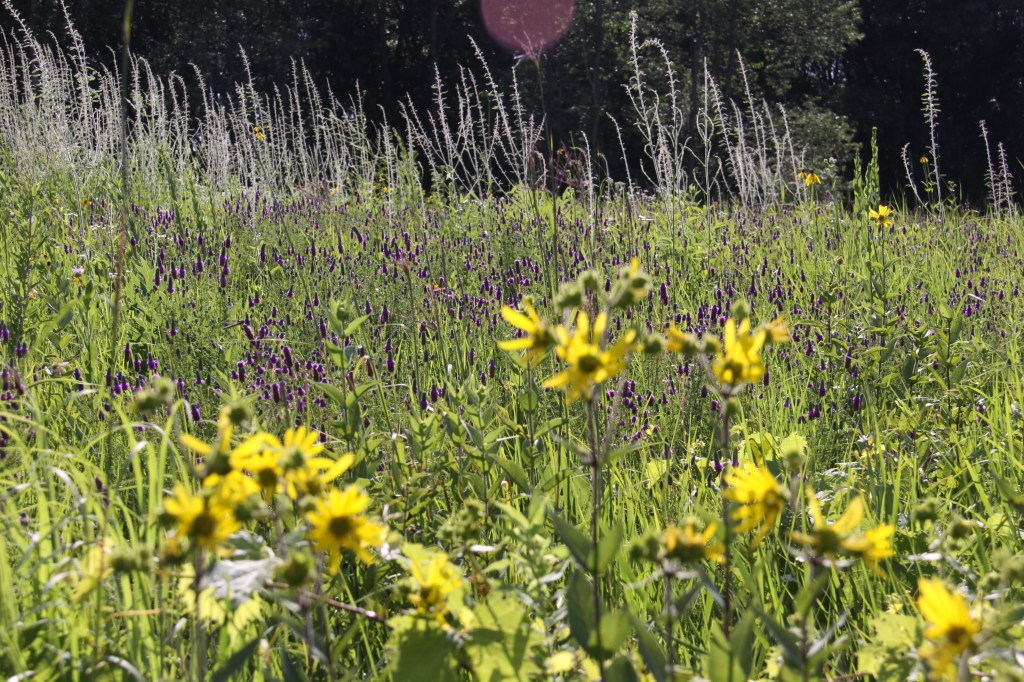
I wanted to try growing native prairie plants from seed. While planting nursery-raised flowers gives more immediate satisfaction, it would take a huge budget and great labor to rival the variety of a seed mix like the one I chose, which contains the possibility of 100 species of grasses and wildflowers.
A lovingly tended prairie in Wisconsin.
Entelechy is a word I learned the first year of grad school from a classmate who studied ancient Greece. It means potentiality, as a huge oak tree lies metaphorically bundled into an acorn, or a teeming meadow waits within a packet of seeds.
This year marked the final road trip Dan Geiger undertook to deliver his report as delegate to the Bahá’i National Convention, the annual gathering that elects the National Spiritual Assembly of the United States. After serving on and off for 30 years, Geiger is retiring.
For most of his life, Geiger has lived in Billings, Montana. Montana and northern Idaho belong to a single electoral unit, which currently encompasses eight Local Spiritual Assemblies and 16 registered groups. “It’s actually bigger than California land wise,” Geiger says.
Nearly two million people of Chinese descent call California home. In Southern California, Bahá’ís and their friends are learning how to accompany Chinese populations, including newly arrived immigrants, with activities tailored to local needs in the San Diego, Orange County and San Gabriel Valley areas.
Collaborators from these three localities regularly connect to share insights, challenges and advancements with each other. From their conversations emerged an idea to host a Chinese family camp that would bring together participants from across Southern California.
Wise eyes under stern brows watch us. Those eyes are made to inspect sun-dazzled waves, but here, they look out into the dim interior of the Monterey Bay Aquarium. Makana is a Laysan albatross, unreleasable. After her handlers finish their presentation, they invite us to step closer, which I do. Two different employees ask me if I have questions, but my questions are for the albatross, not them: what’s it like to be an elegant, permanently landlocked seabird? But mostly I just want to look at this bird, as I’ve never seen an albatross in real life before.
Humans have hung so many interpretations on the albatross. To see this individual right in front of me feels like encountering a celebrity: here is the actual being, breathing and fidgeting, unswaddled by what others have said.
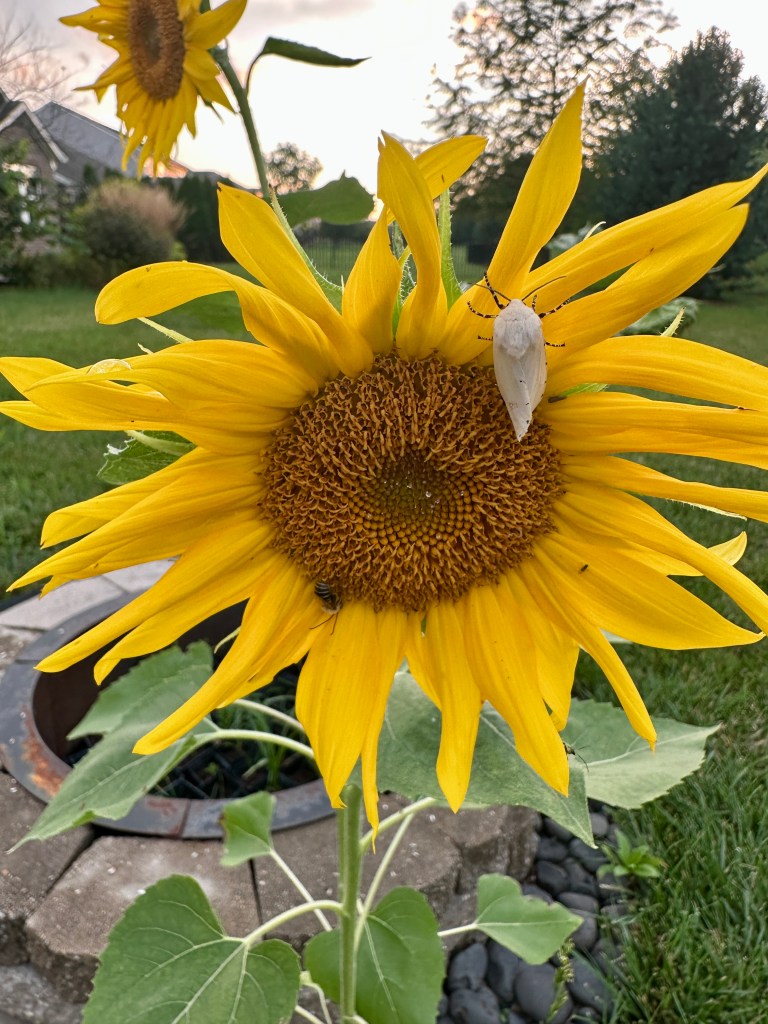
Salt marsh moth caterpillar feeding on mistflowerSalt marsh moth resting on sunflower
October. It’s been a couple weeks since I’ve seen my summertime favorites, hummingbirds and monarchs, which have no doubt departed on their southward migrations.
Looking back on the warmer months, watching caterpillars enjoy my plantings was a highlight—with one exception.