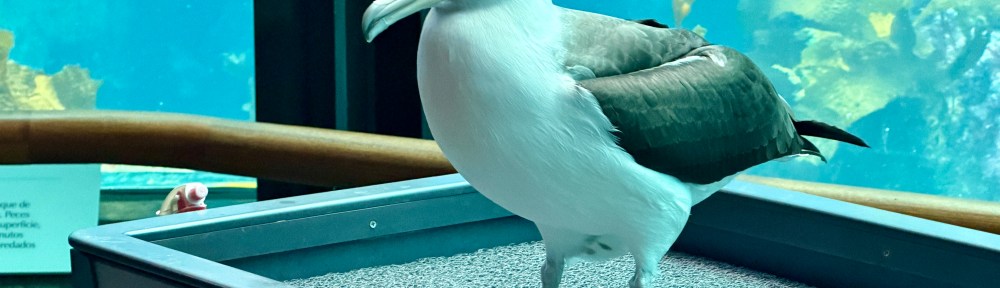
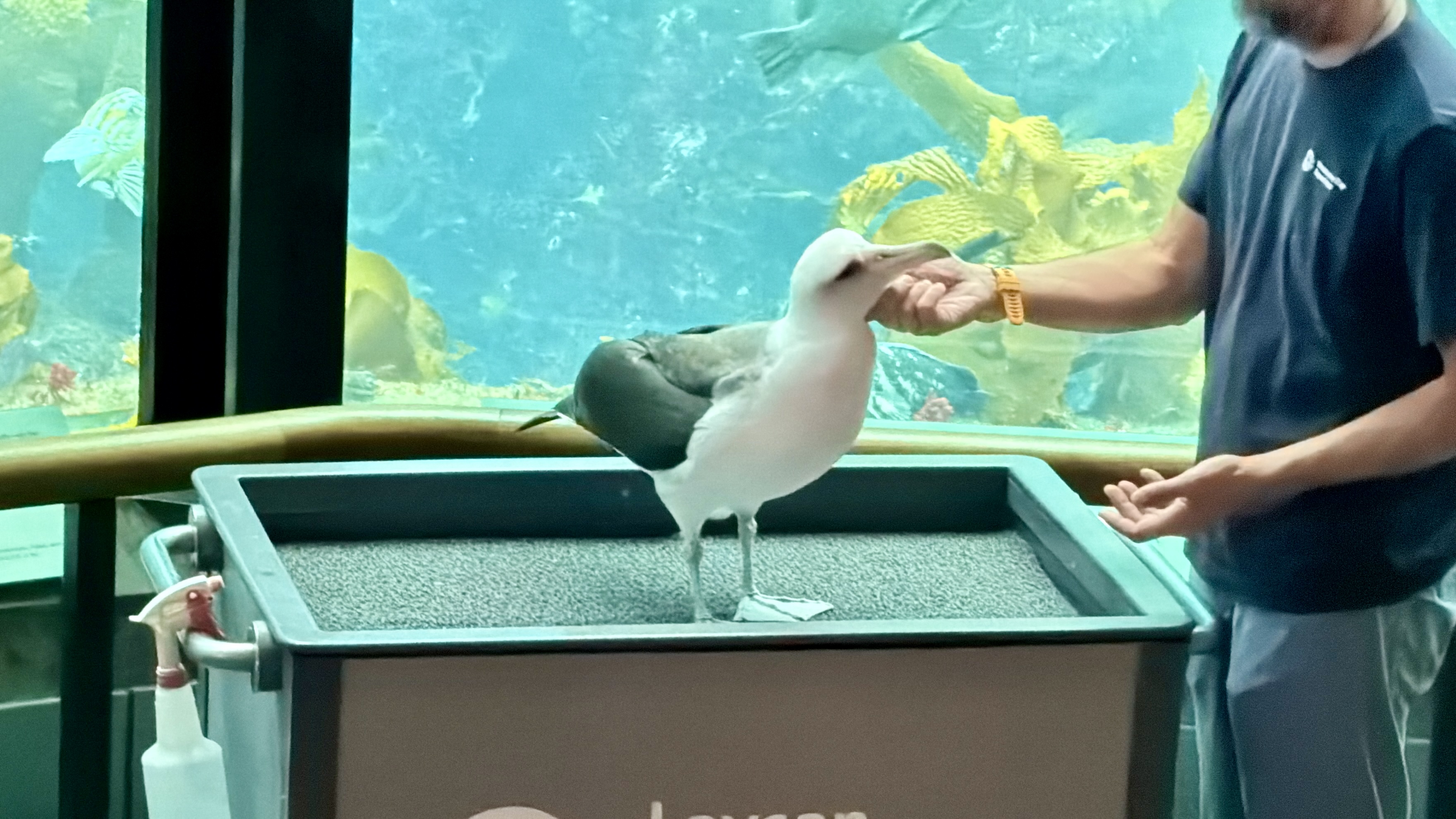
Wise eyes under stern brows watch us. Those eyes are made to inspect sun-dazzled waves, but here, they look out into the dim interior of the Monterey Bay Aquarium. Makana is a Laysan albatross, unreleasable. After her handlers finish their presentation, they invite us to step closer, which I do. Two different employees ask me if I have questions, but my questions are for the albatross, not them: what’s it like to be an elegant, permanently landlocked seabird? But mostly I just want to look at this bird, as I’ve never seen an albatross in real life before.
Humans have hung so many interpretations on the albatross. To see this individual right in front of me feels like encountering a celebrity: here is the actual being, breathing and fidgeting, unswaddled by what others have said.

I blame a poet for the reduction of albatross to metaphor. In Samuel Taylor Coleridge’s “Rime of the Ancient Mariner,” the titular sailor recounts how an albatross followed his ship, apparently releasing it from ice and bringing a breeze to fill the sails: albatross as benevolent sea spirit. Then, for reasons “hellish” but unexplained, he kills it. His crewmates force him to wear the albatross’s body around his neck: albatross as guilt and burden, a meaning that persists in common usage more than two hundred years after Coleridge wrote his poem.
Many of the nature documentaries I’ve watched include segments on albatrosses, now as tragic symbols of the consequences of our species’ throwaway culture. As the saying goes, there is no “away” for all the plastic we use. At best, it is recycled into products like my living room carpeting, made of plastic bottles. At worst, it is washed into streams, rivers, and eventually the oceans. Albatrosses mistake floating trash for prey, feeding it to their chicks, which eventually starve.
The camera zooms in on an adorable fluffy chick, just one per couple, then cuts to the beach, which is littered with trash—jetsam carried to this remote island from origins thousands of miles away. The camera now cuts to a dead chick, body still, feathers blowing in the wind. In its stomach: the effects of profit hunger.
These images have had the intended effect on me, making me hyper-conscious of single-use plastic. The plastics that the city accepts for recycling pickup go into the bin at home. Plastic films (e.g., shopping bags, cereal bags, some wrappers) go to another bin at the grocery store.
Will these plastics actually get recycled into other products? Hard to say. Extracting oil and turning it into new plastic is “cheaper” than turning used plastic into new things. So, I also try to focus on reducing my plastic use, ordering consumables from companies focused on minimizing waste. These small actions are my talismans against despair, my penance for the poisoned albatrosses.
Back to Makana. She is beautiful, and her human caretakers are too. They feed the birds, clean up after the birds, and generally adore the birds. They are among the healers and the prophets of a kinder, wiser world.
“It is the Hermit good!
He singeth loud his godly hymns
That he makes in the wood.
He’ll shrieve my soul, he’ll wash away
The Albatross’s blood.”
—Samuel Taylor Coleridge
 Layli Maria Miron
Very powerful, I cried. I seem to cry every day now. Trying to find some balance in this world.
Thank you for the story and a close-up of a legendary bird.