Day 3: Boating down the Bosphorus

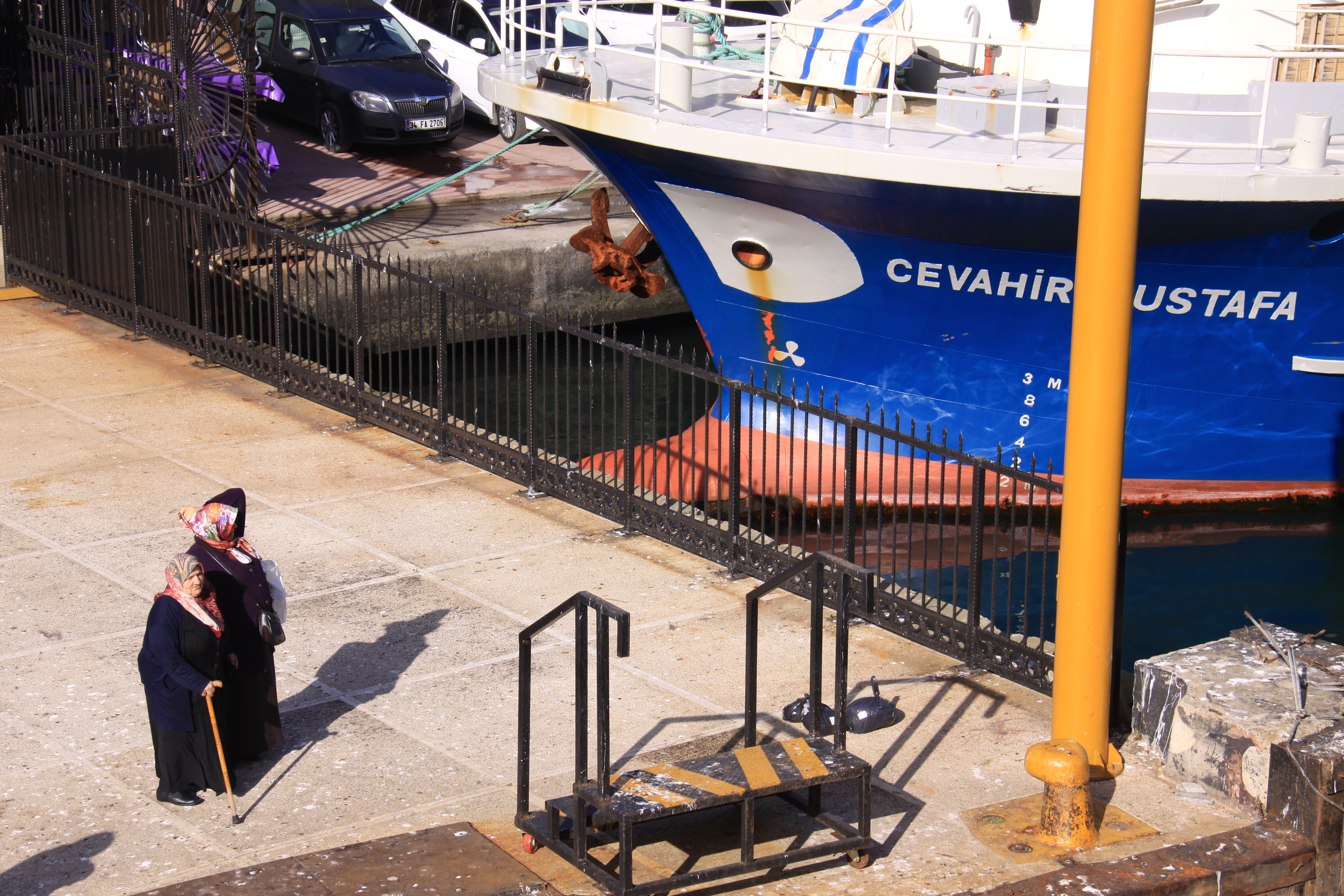
Turkish women wait at a dock.

Turkish women wait at a dock.

Istanbul straddles Europe and Asia, with the Bosphorus Strait splitting the European side, which has most of the tourist attractions and commerce, from the Asian side, which is largely residential. We decided to devote a day to seeing more of this important strait, which offers the nations around the Black Sea their sole path of entry and exit to the Mediterranean via the Marmara and Aegean Seas—crucial for trade and navies.

We boarded the ferryboat that would take us on a 1.5 hour journey from the old city up the strait, past the bankside sprawl of Istanbul, to a fishing village called Anadolu Kavağı situated near the mouth of the Black Sea. After claiming seats on the topmost level where we could enjoy the warm sun and chilly wind, we peered down into the waters of the inlet, where cormorants plunged into the depths, and impassive, translucent jellyfish wobbled through the water, almost indistinguishable from the plastic debris that floated on the surface. Seagulls silently swooped above us.
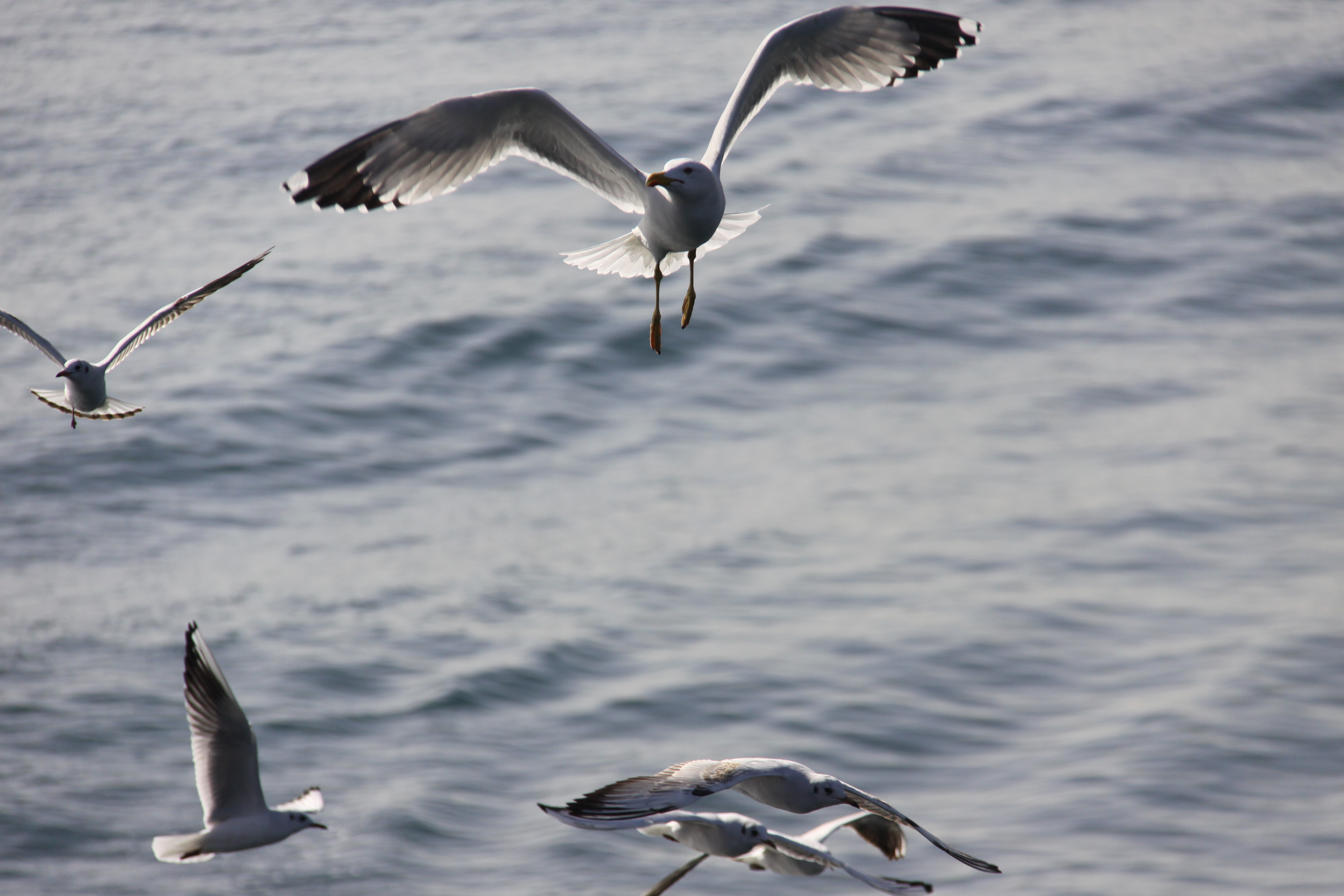
I have way too many photos of seagulls!

I have way too many photos of seagulls…

The boat was docked near the bridge across the Golden Horn, over which the tram passes back and forth to the New District. Below the traffic on the lower, pedestrian level of the bridge, there is a row of seafood restaurants. At 10:00 AM their staff were just starting to clean and prepare for a day of customers, and we watched in amusement as they hauled up water from the strait below to swab the decks of their outdoor seating. In that act, I was reminded of how provident the sea and its estuaries are to coastal cities. Little wonder then that successive empires made this area the focus of their empires, surrounded as it is by a natural moat of generous and protective waters.
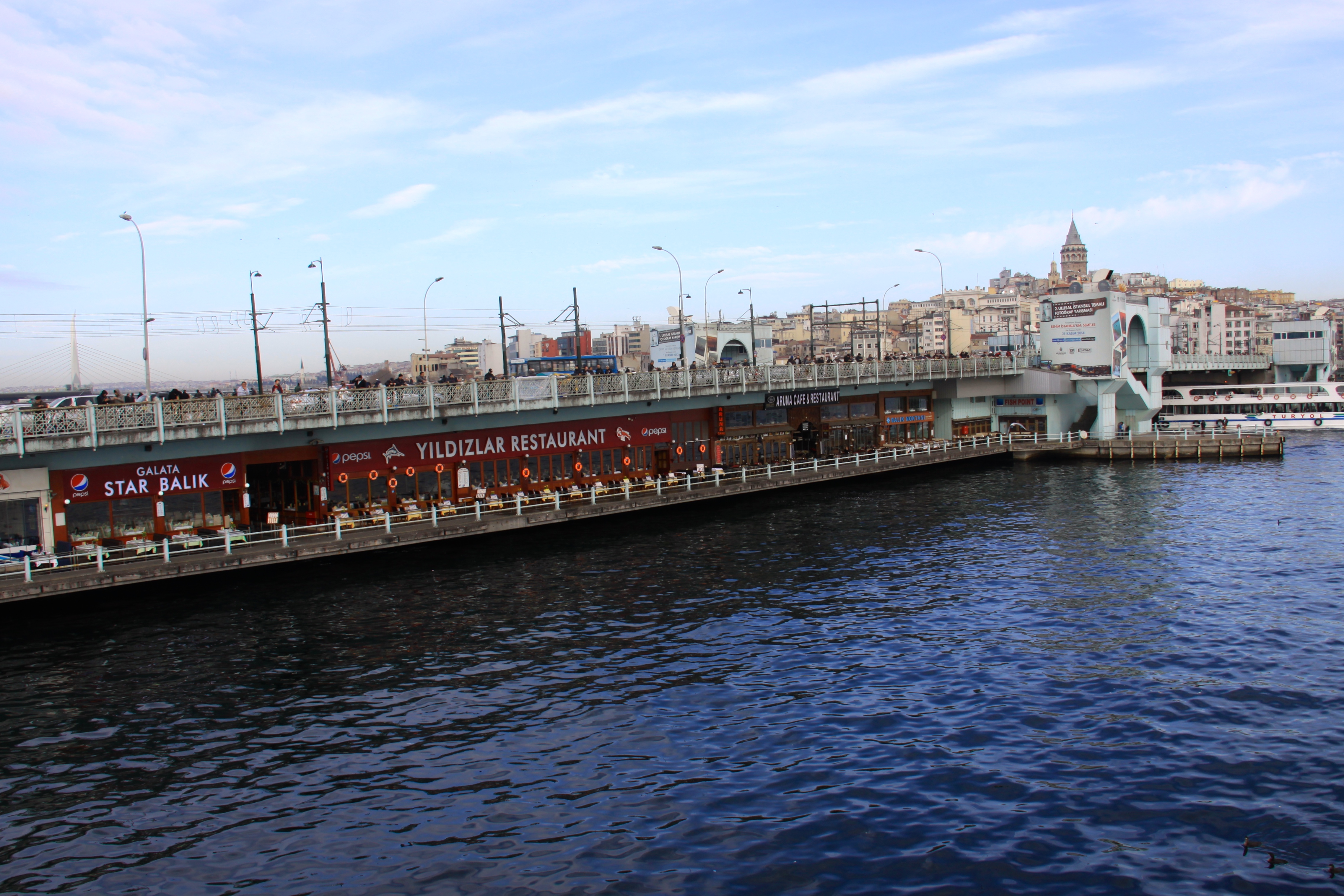
The bridge looks like it is buoyed by restaurants.

The bridge with its undergirding of restaurants.

After some time, the engine started purring and the boat pulled away from the dock. As we moved along, we followed the tour in our guidebook, spotting such sights as the European wannabe Dolmabahce Palace and its nearby mosque and clocktower, the Rumelian fortress dating from the 15th century, and several towering bridges across the strait, one for city traffic and one for “intercontinental transit.”

Eventually, the crowded urban area thinned out into areas of mansions with tall trees. In one such tree we saw a cormorant worshipping the sun, wings outstretched.
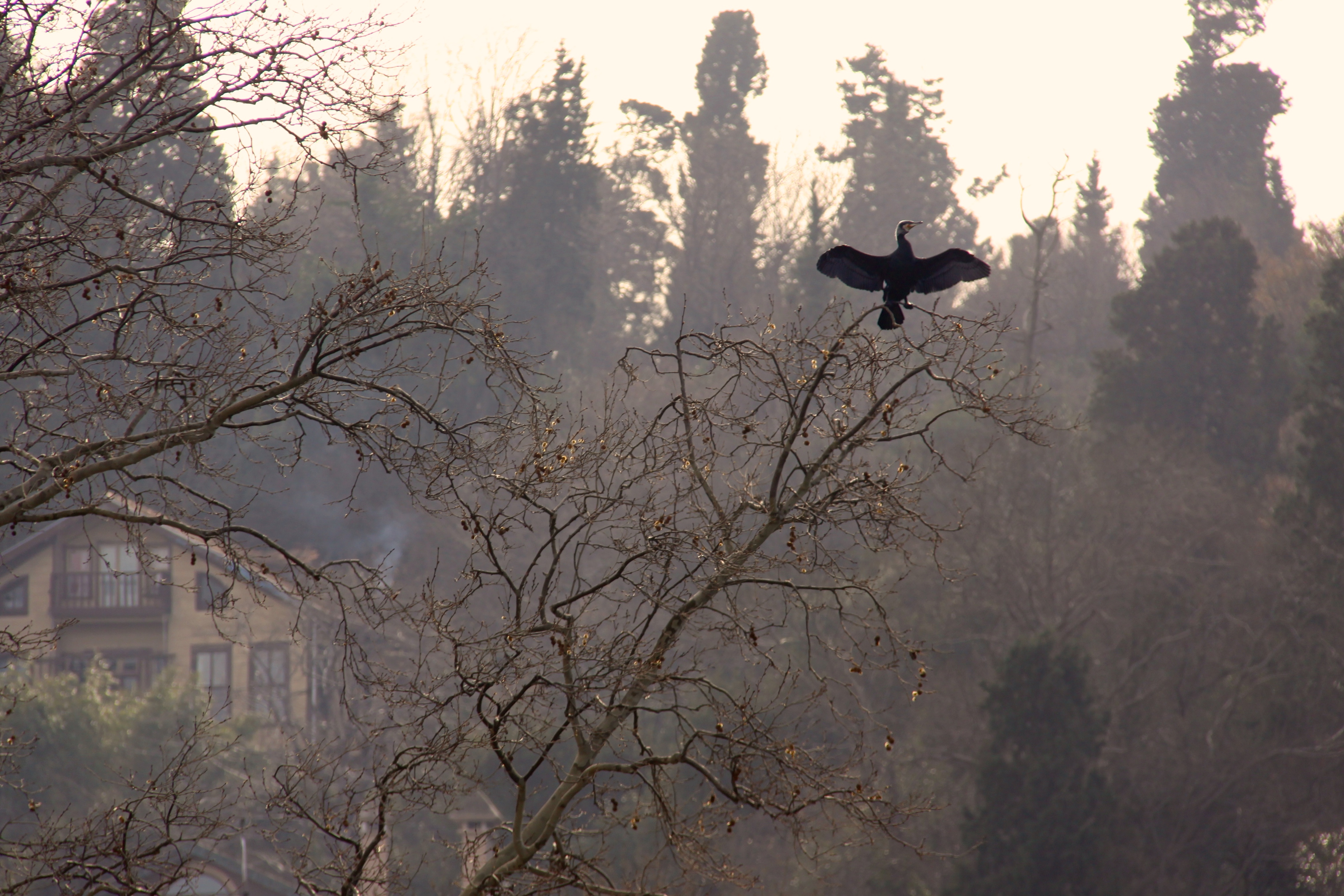
Sunbathing cormorant

Sunbathing cormorant on the bank of the Asian side.

When we would approach the shore to pick up more passengers, flocks of seagulls would attach as if magnetically to our boat and hover around. Perhaps the wake of the boat stirred up small creatures for their lunch, or maybe they hoped we would jettison our own food—in any case, Jasmine encouraged me to get some action shots of these birds. There were, in fact, several species of seagulls, ranging from a long-winged pterodactylesque breed with harsh eyes to a chubbier, smaller variety with the charm of a flying porpoise.

Magnetic seagulls that orbited our boat.

Magnetic seagulls that orbited our boat.

Now that I’ve started on seagulls, I must digress to another scene. Seagulls were not only present above the Bosphorus, but also all over the Sultanahmet. They careened past the eaves of our hotel as we ate breakfast on the enclosed terrace. More hauntingly, one night as we strolled around the park between the Hagia Sofia and the Blue Mosque, we observed scores of gulls weaving like ghosts above the domes—like moths tethered to lights.
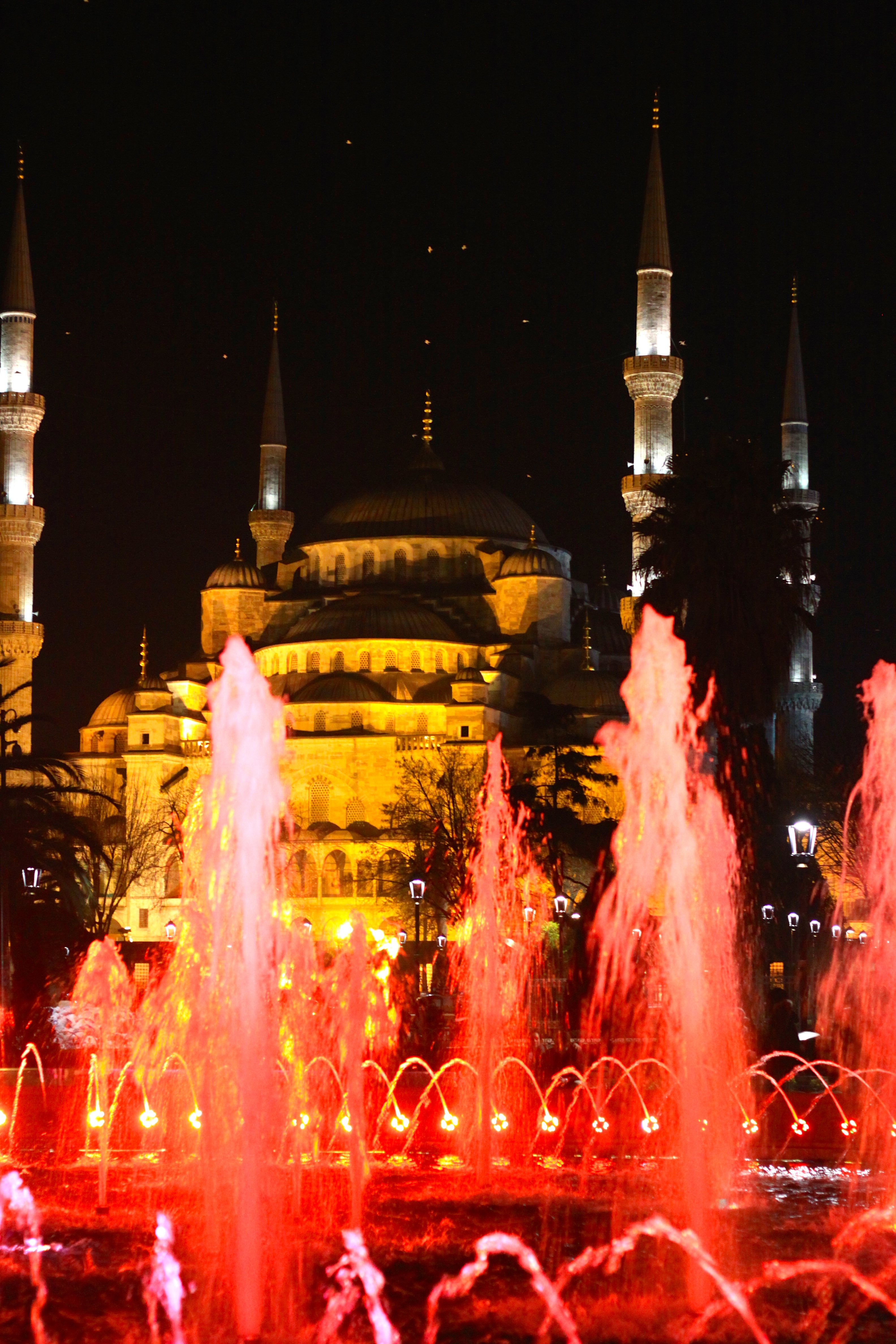
It's hard to see, but the white specks above the dome of the Blue Mosque are seagulls.

The white specks above the dome of the Blue Mosque (which looks like a yellow mosque at night) are seagulls.

Back on the strait, we arrived at the village. As we approached, we noticed two things: the ruins of Yoros Castle, our destination, on the peak of a hill, and the black-and-white clad waiters standing in front of their seafood restaurants flagging us down. As none of us care for seafood, we skipped the daily catch in favor of the village’s other specialty, lokma, which are syrupy balls made of a light dough deep-fried to golden perfection and sprinkled with cinnamon.
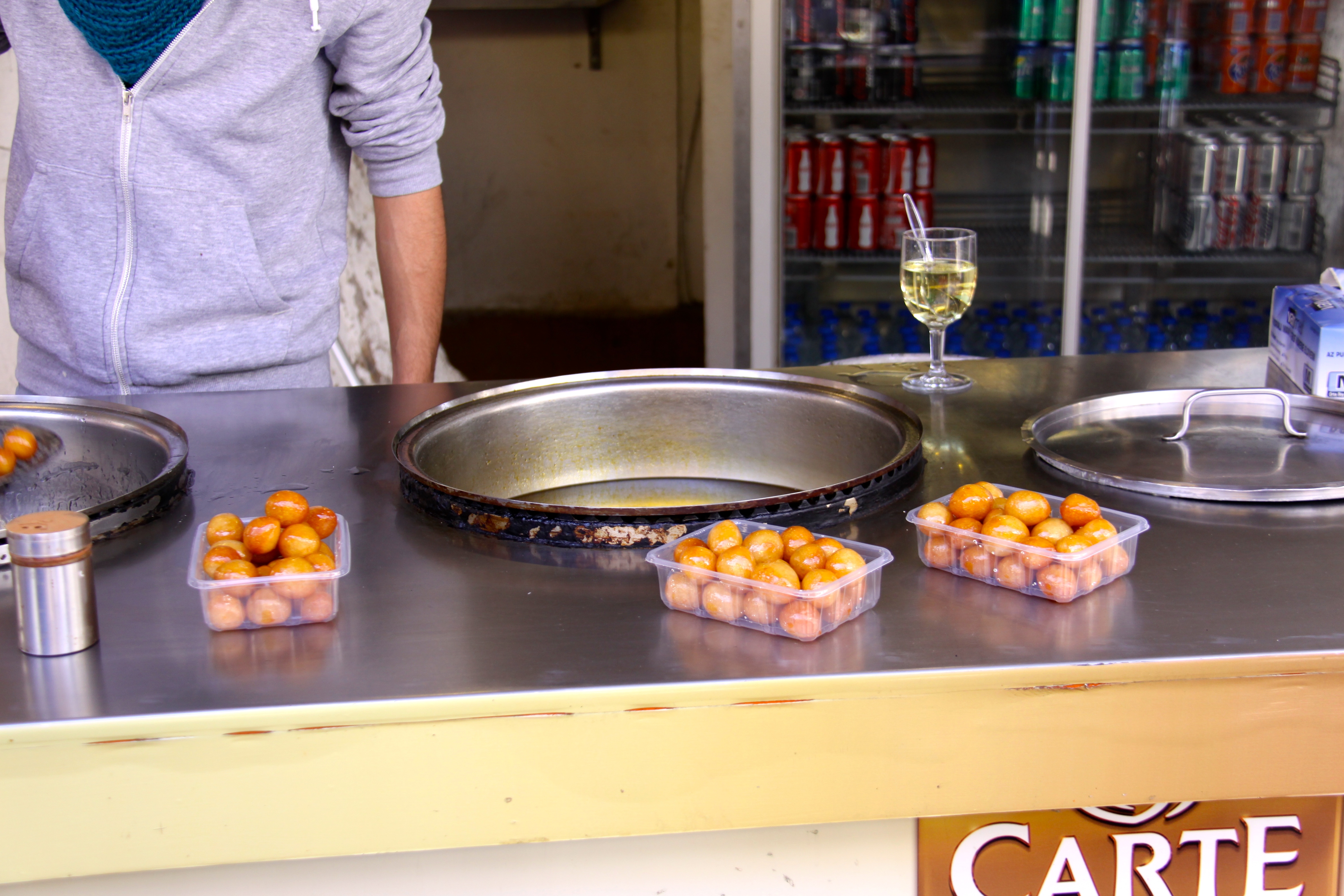
Deep-fried deliciousness.

Sticky and sweet deliciousness.

“Mmmm!” was our unanimous reaction to lokma. Yet this treat soon met a tragic end: as we walked away from the bevy of restaurants and hawkers in pursuit of the castle, I flung out my arm to point at a sign saying “Yoros,” just as Sergey was proffering the container of lokma to me. In the ensuing collision, the lokma scattered over the street like sticky marbles. I felt quite crushed by my role in this accident—as crushed as the lokma were soon to become under the tires of passing cars—but luckily, we were still close to the stand and purchased a refill.
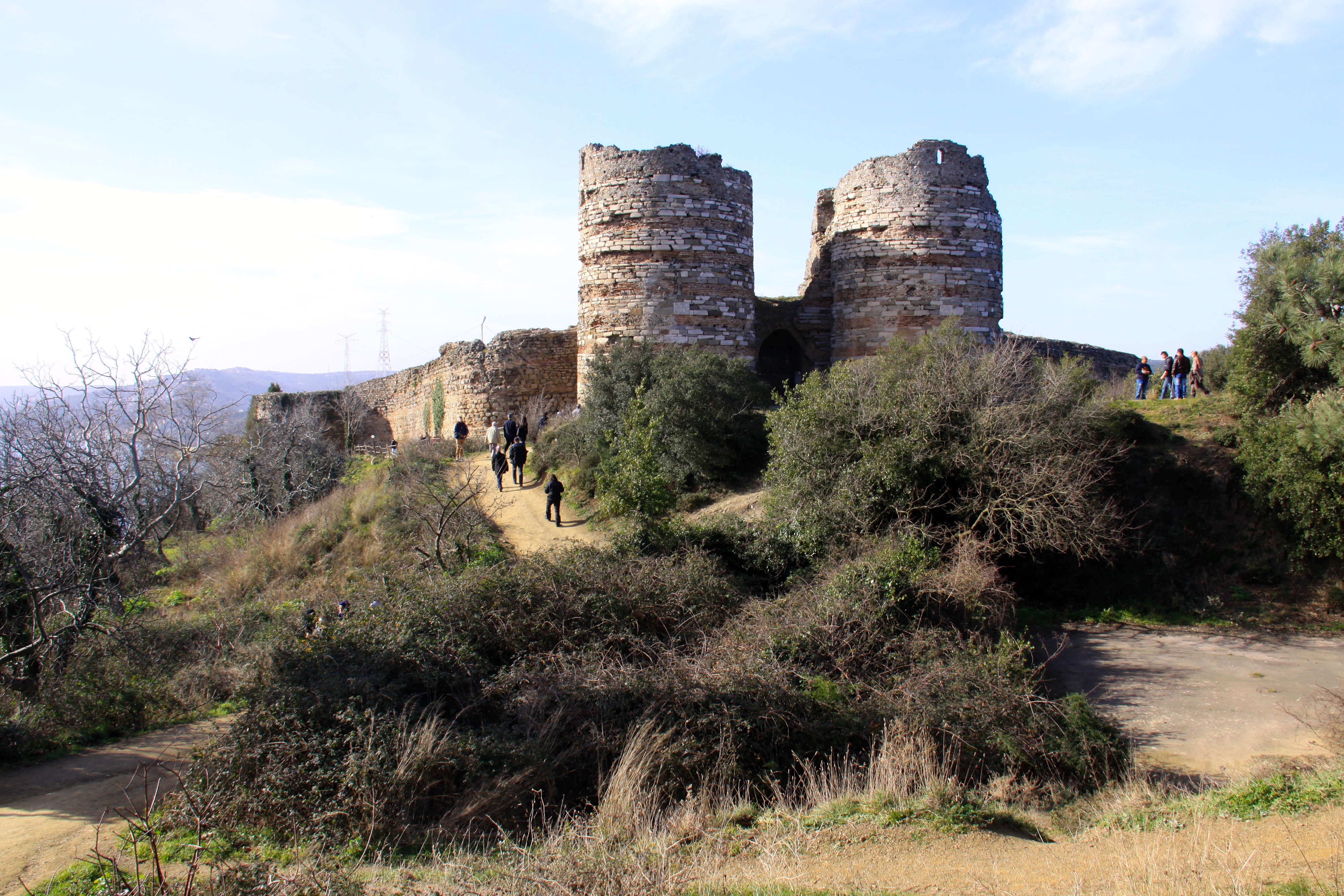
Yoros Castle in Andalu Kavagi

The remains of Yoros Castle.

Up the steep hill we hiked, passing by a military zone protected by a high fence, higher and higher until we reached the surprisingly commercialized ruins of the Byzantine castle. We had to pass by another bevy of restaurants to reach our destination. While the castle was admittedly dull since we could not enter (unless we defied the law and scaled its crumbling walls, which some boys did), the summit of the hill did afford a striking view toward the Black Sea.

“Can you see Moldova from here?” I asked Sergey.
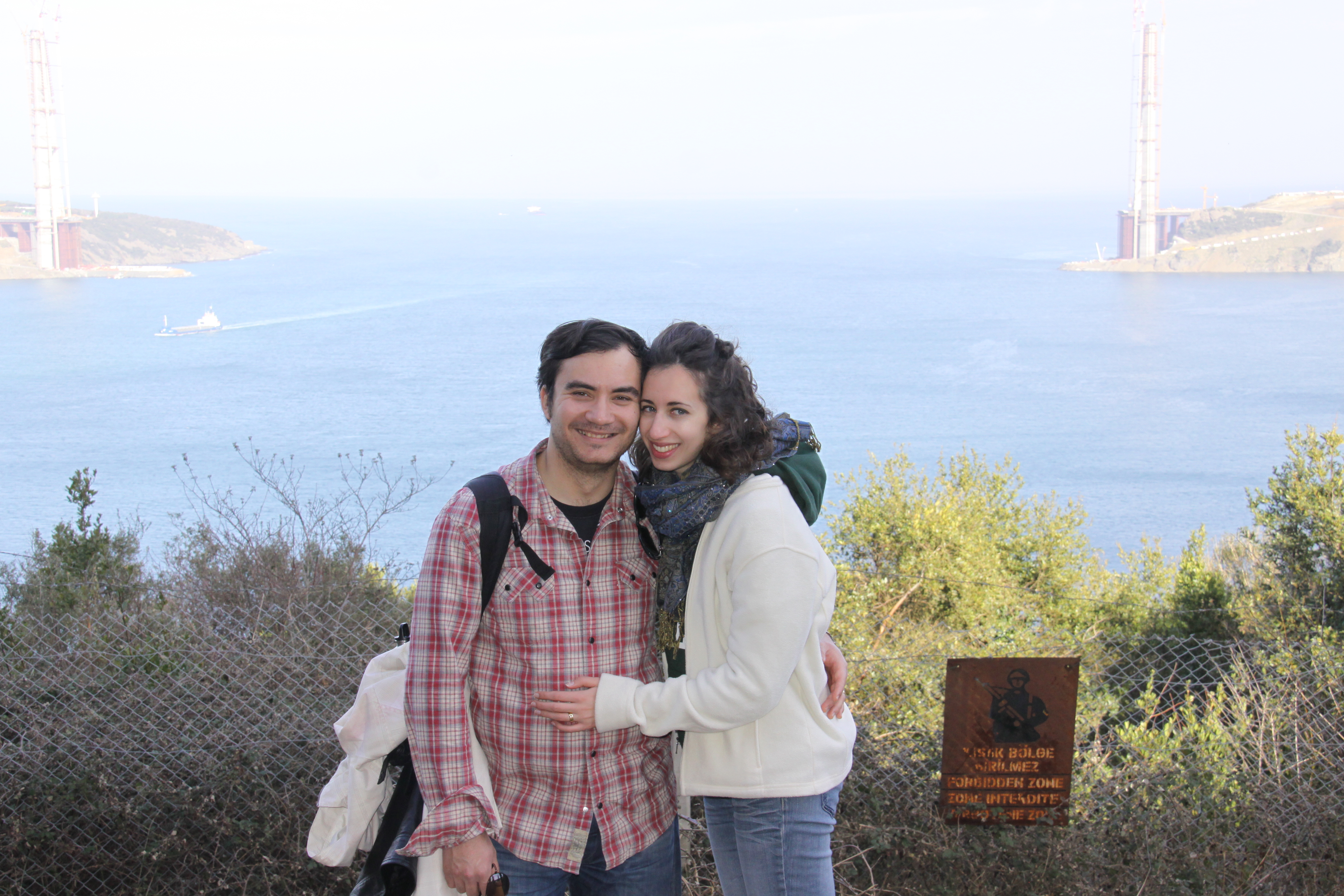
We are posing in front of the mouth of the Black Sea. If you look super hard and use your imagination, you can even spot Sergey's hometown of Chisinau (Kishinev)!

We are posing in front of the mouth of the Black Sea. If you look hard and use your imagination even harder, you can spot Sergey’s hometown of Chisinau (Kishinev) behind us!

Soon enough, our time on the Asian side was over, and we re-boarded our boat, which felt tranquil after our return hike through the surprisingly traffic-congested lanes of the village. We chose indoor seats and spent most of the return voyage in a half-stupor.
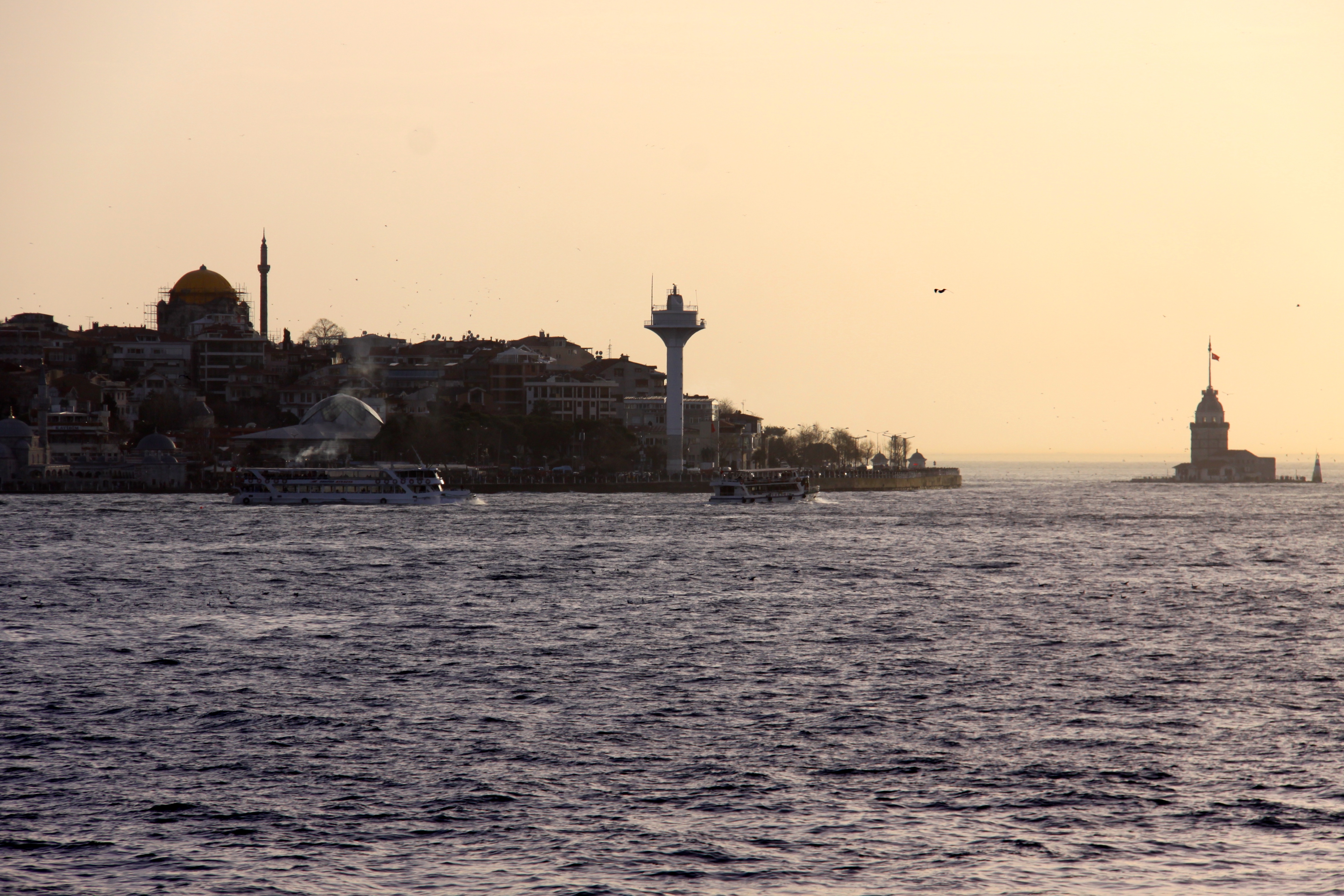
Maiden's Tower seen on the right.

Maiden’s Tower seen on the right.

Towards the end, though, I decided I had to go to the top so I could finally photograph one of Istanbul’s well known sights, Maiden’s Tower, which sits upon a small island. As we neared the European side, the setting sun set the cityscape aglow, smears of saffron light upon the minarets of countless mosques…and neon light upon the signs of countless seafood eateries.
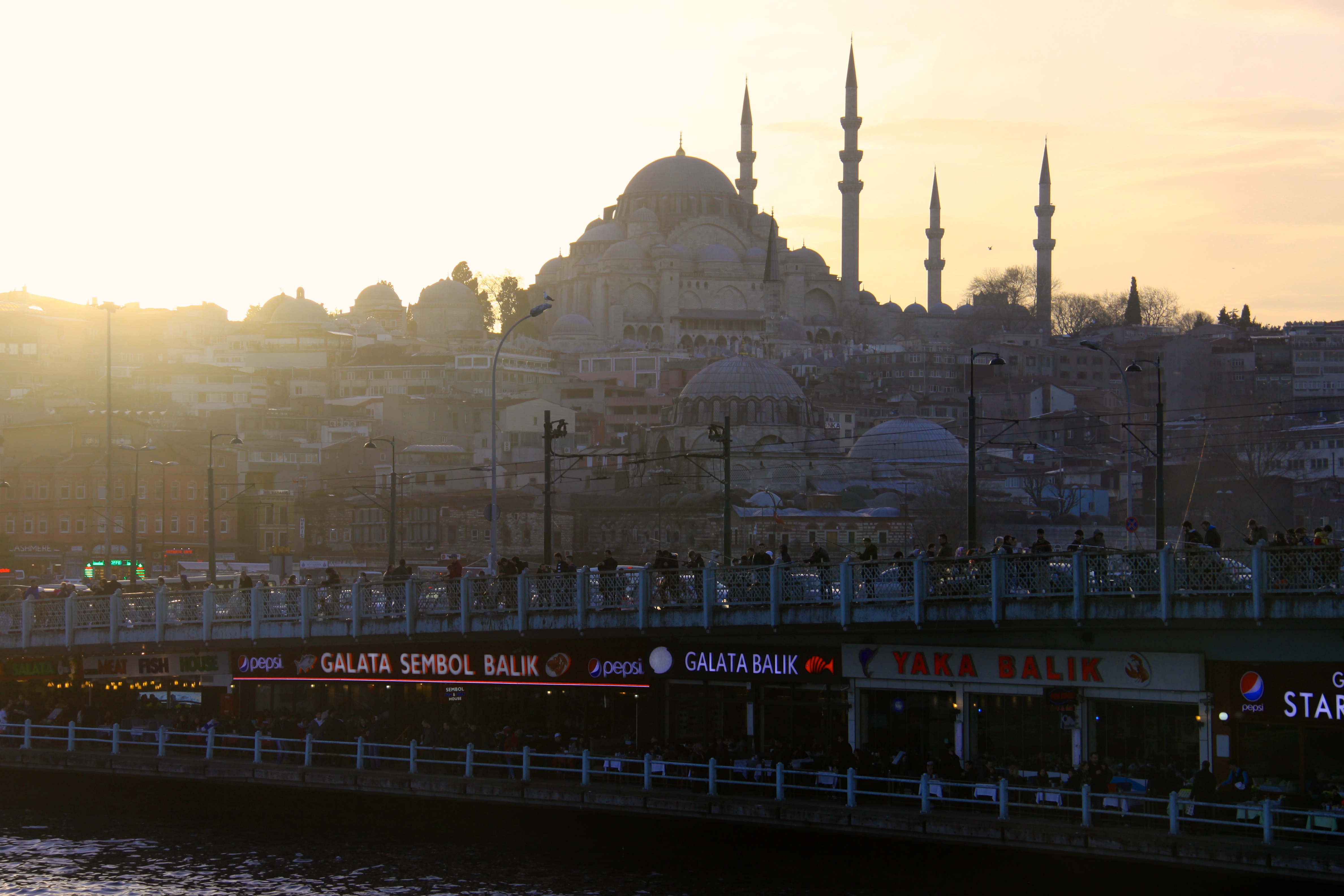
Cityscape centered on Mosque of Suleiman the Magnificent.

Cityscape centered on the Mosque of Suleyman the Magnificent.
Day 2: Time travel

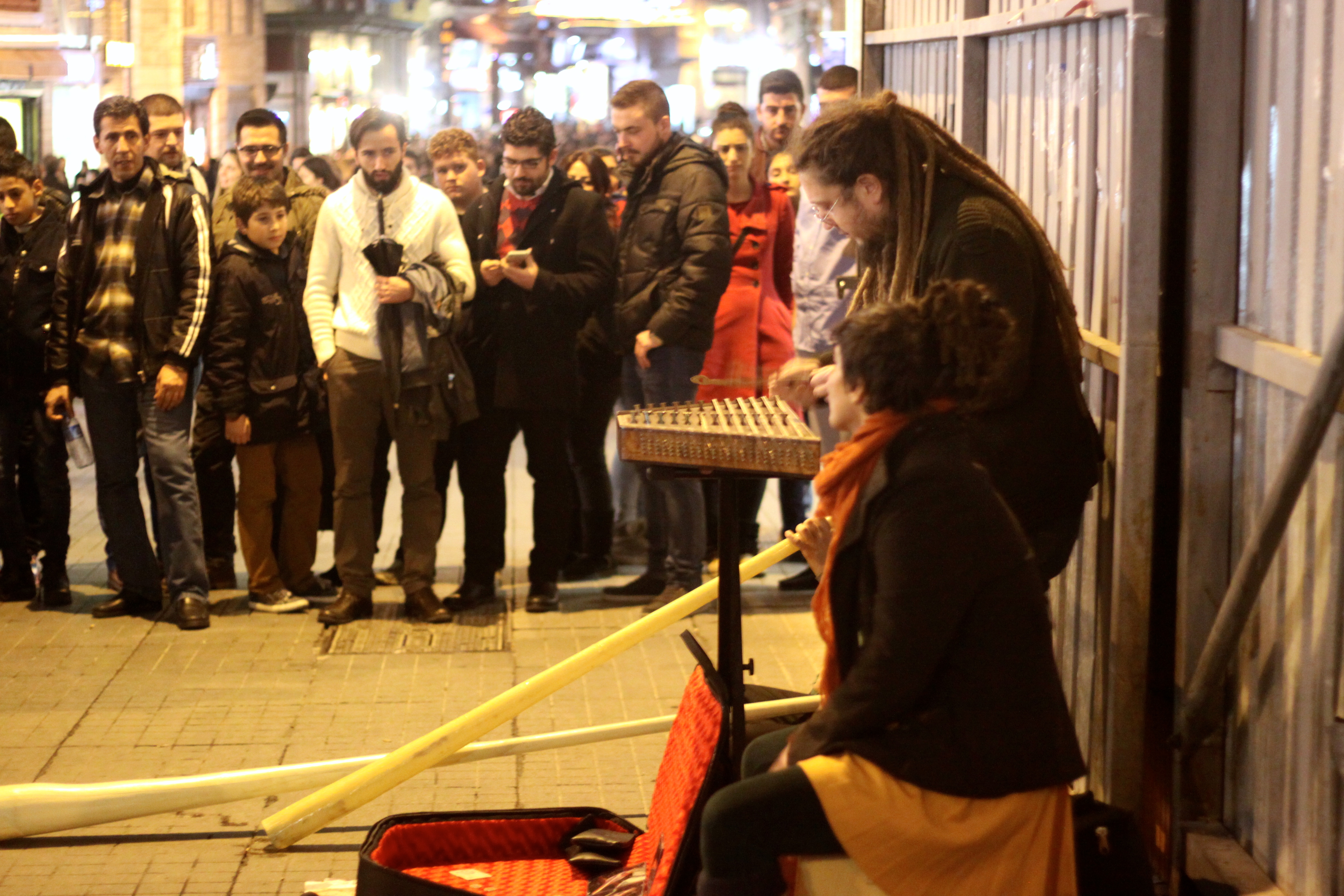
Buskers on Istiklal Street playing percussion, something like a sitar, and of course a didgeridoo.

Dreadlocked buskers on Istiklal Street playing percussion, something like a sitar, and of course some didgeridoos

From the ancient buildings of the Sultanahmet area, we traveled across the inlet called the Golden Horn to the so-called New District. If you recall the protests that rocked Turkey a few years ago, you probably remember that Taksim Square was the site of demonstrations and police crackdowns. That square is at the end of Istiklal Street, where we took our tour of modern Istanbul.

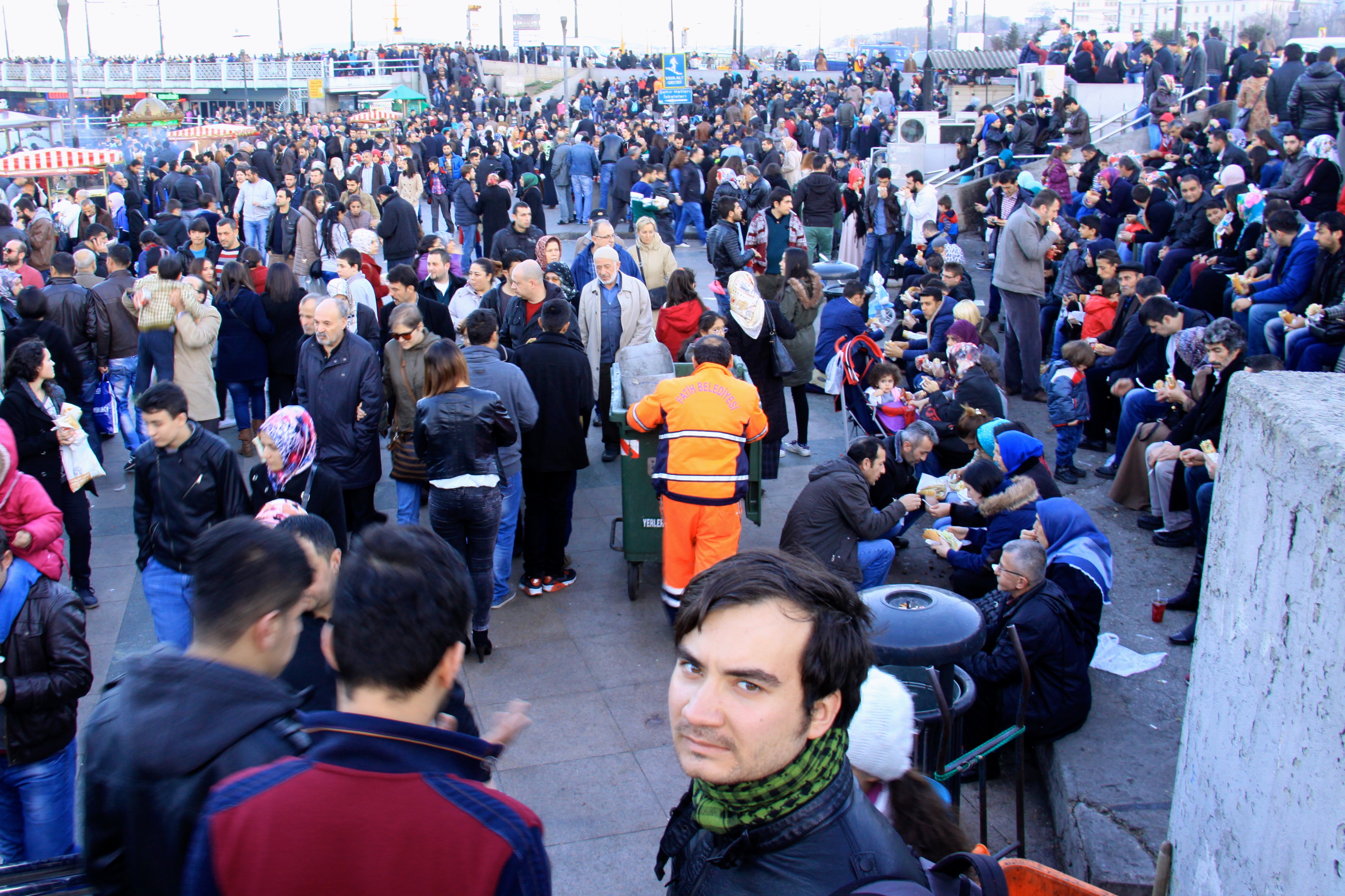
Not actually taken on Istiklal Street, but this is a fair representation of its crowdedness.

Not actually taken on Istiklal Street, but this is a fair representation of its crowdedness.

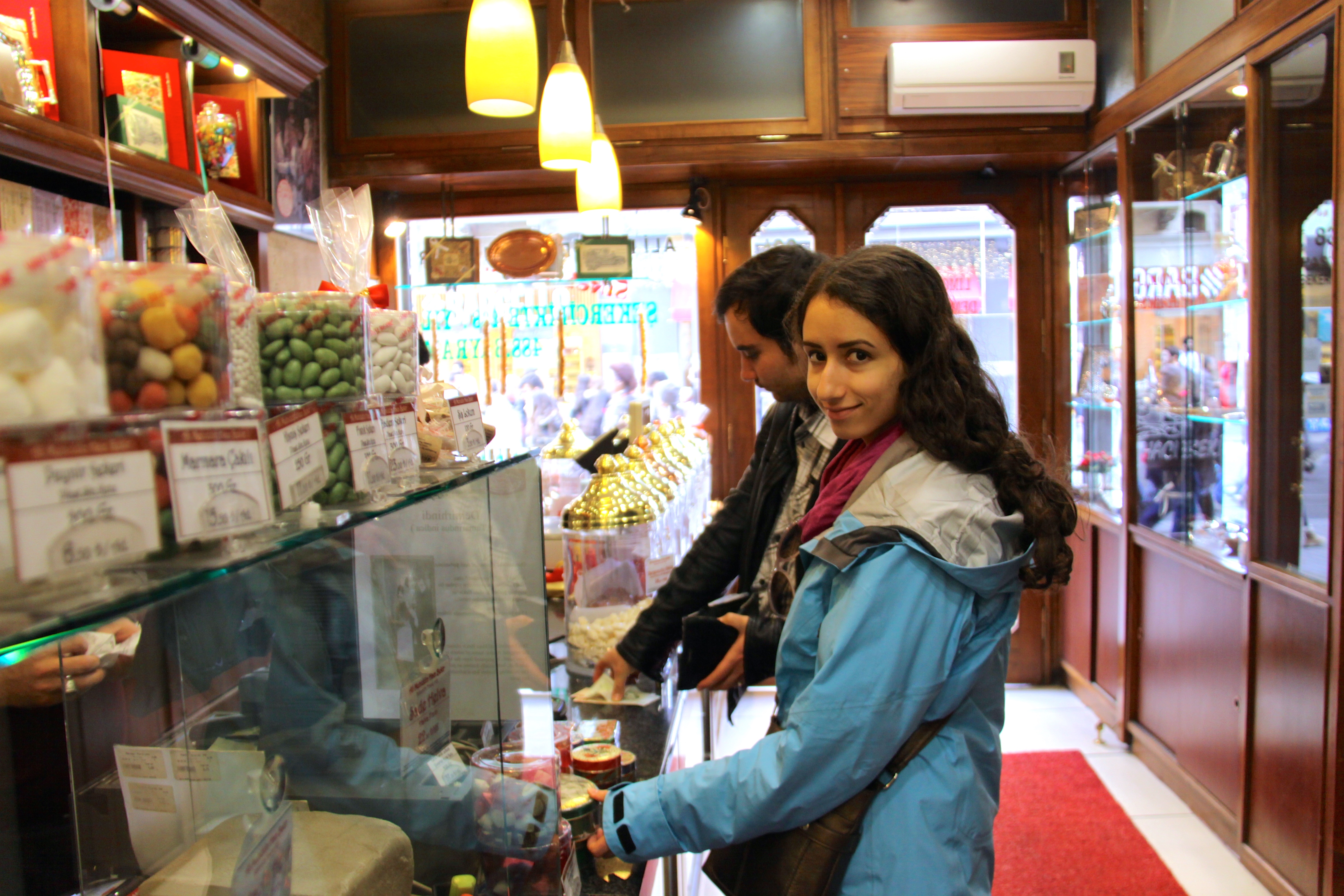
Looking down Istiklal Street from the comparatively quiet square, we saw a river of people. This river only grew denser as the day progressed, reaching flooding point after dark. Occasionally, a trolley would part the crowd, but usually pedestrians packed the entire street. Clearly, Istiklal Street is the place to be on a Saturday. With the exception of a sartorial detour to a silk shop where I ended up with a green shawl, our walk primarily gravitated toward sweet shops, including Haci Bekir, which has apparently been in business for as long as the US has been a nation. There, we sampled pastries and stocked up on mini pizzas and, more importantly, Turkish delight.

Now, I haven’t always harbored much love for this cubic dessert, which has a chewy, gummy texture and traditionally features double-roasted pistachios. But there ain’t nothing like the real thing, and the stuff we get stateside is a mere shadow of actual Turkish Turkish delight, which the Turks call “lokum.”

Choosing lokum at the renowned Haci Bekir patisserie

Choosing lokum at the renowned Haci Bekir patisserie

After that, we tried Turkish ice cream, made with goat milk and some orchid product that is probably the same that goes into salep. Then we sampled almond paste and rose-flavored hard candy. Then we had to go to the dentist (kidding!).

Our healthy lunch completed, we finished Istiklal Street and walked further to see Galata Tower, which was constructed by Genoese merchants to assert their tower-building powers. Finally, we ended up beside the Golden Horn, where fishermen flicked their lines in and out of the dusky water.

Fishing on the New District side of the Golden Horn

Fishing on the New District side of the Golden Horn

The next day, we were able to get to know these waters even better.

Day 1: Hagia Sofia, Hippodrome, Cistern, and Grand Bazaar

Check out that apse!

Check out that apse!


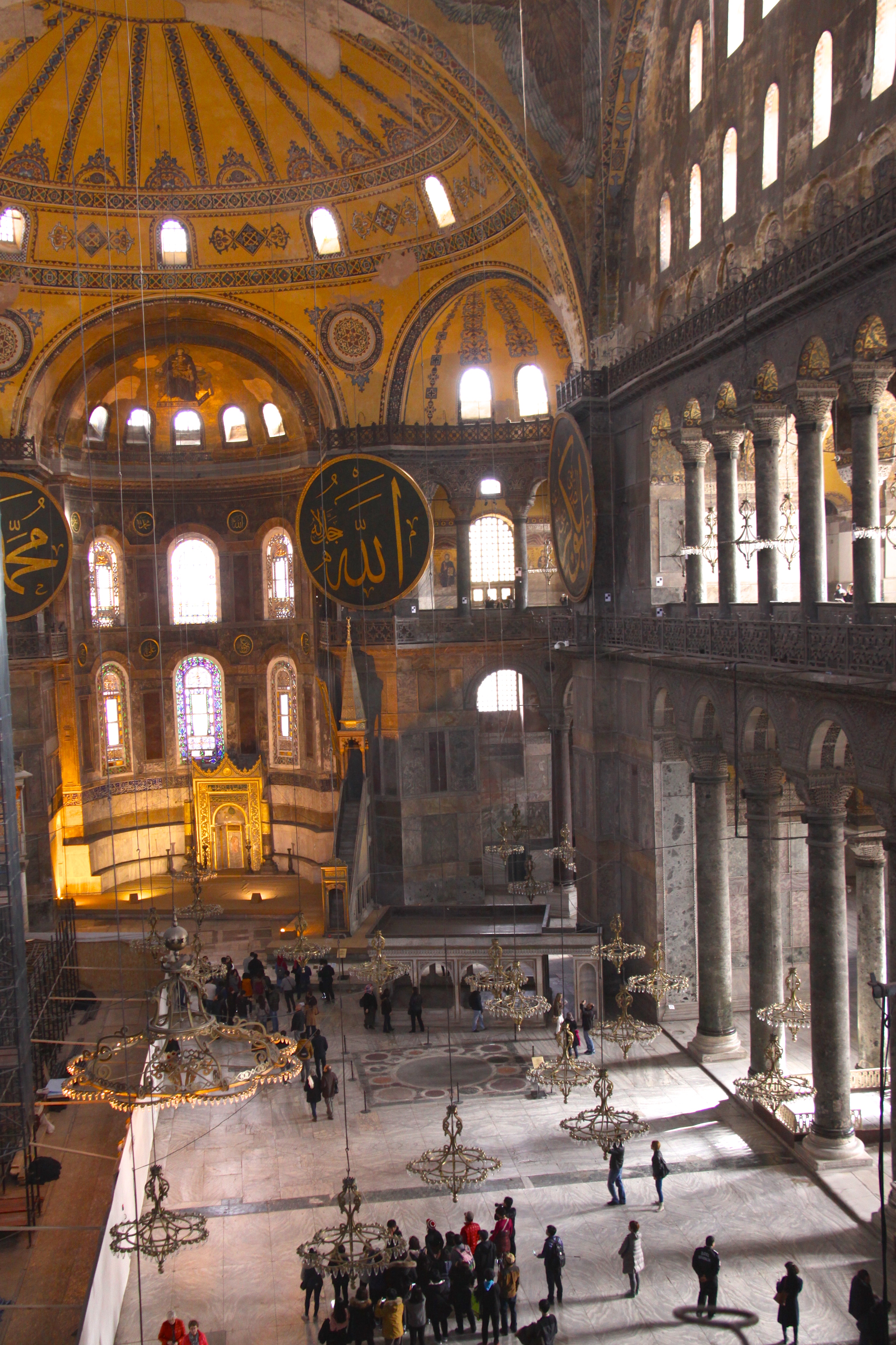
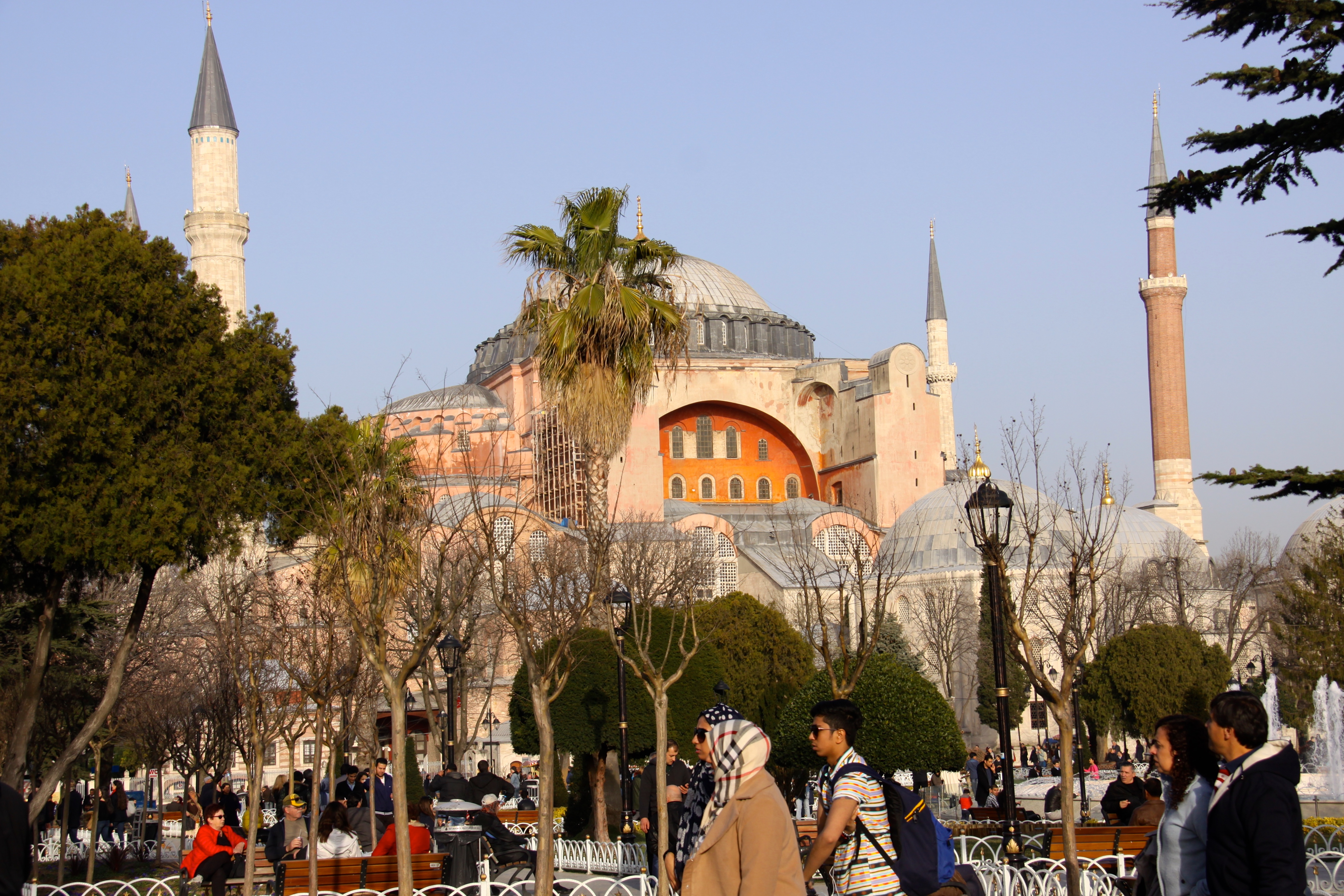
The Hagia Sofia (pronounced “Eye-Ah Sofia”) exemplifies how excellent architecture and sturdy materials can last scores of generations beyond their builders—it has stood tall and proud for nearly 1,500 years. One sign of its age are its enormous front doors through which the emperor would have entered: today, they are frozen in open paralysis, their bottoms locked in place beneath ground level by the buildup of renovations. After the Byzantines fell to the Ottomans in 1453, Hagia Sofia switched over from basilica to mosque, and today it features a pastiche of Christian mosaics and seraphim and huge Islamic calligraphy medallions. All three are visible in the photo above. For many centuries, the Christian art was covered under whitewash due to the Islamic prohibition of figurative depictions in mosques. In some cases, the whitewash actually preserved the artwork underneath.

Exterior view

Exterior view

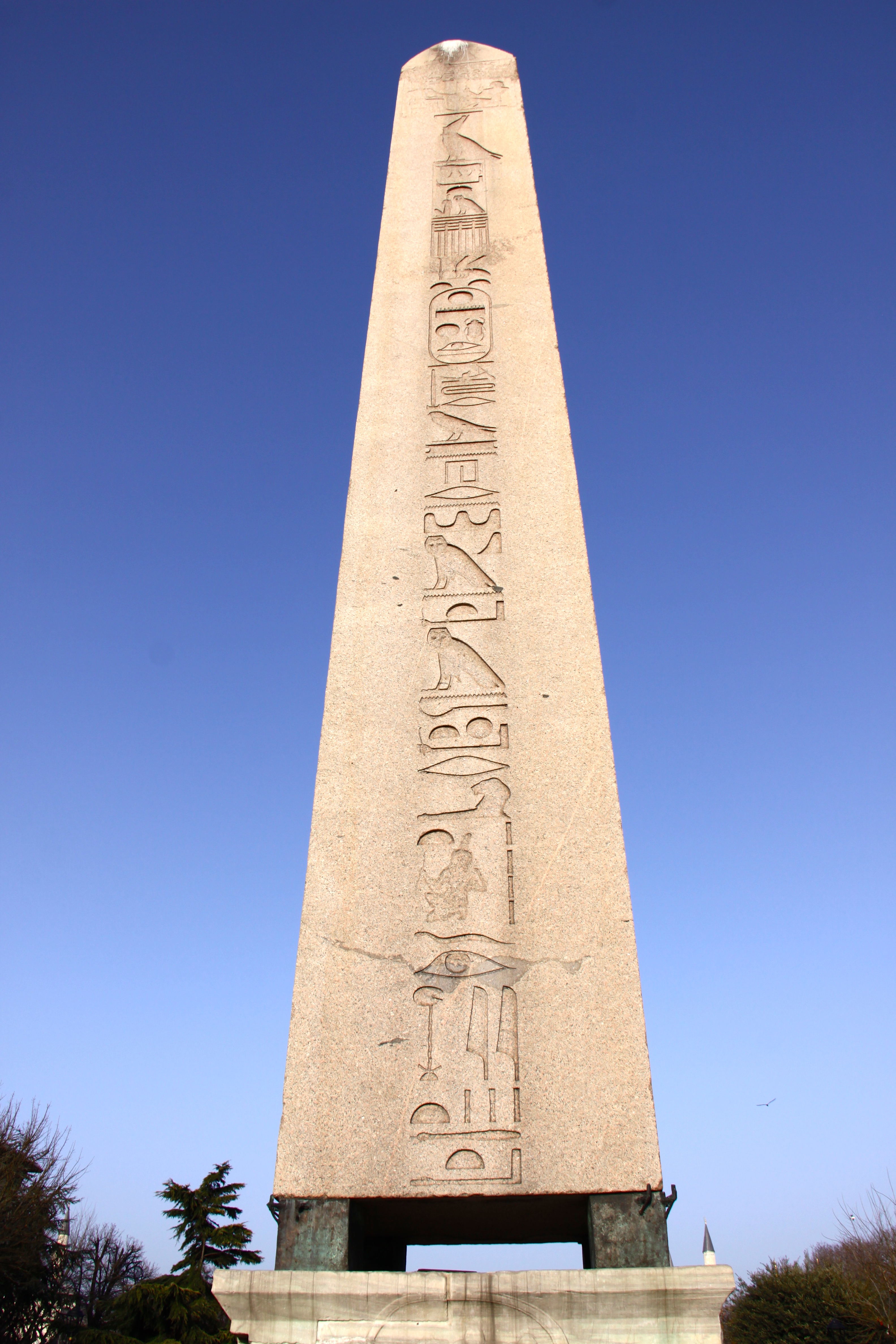
In the Hippodrome, the former stadium where Roman chariots raced and plebeians occasionally rioted, we once again saw the layers of history that characterize the Sultanahmet district. Several obelisks of various origins, including one taken from Egypt eons ago covered with beautifully clear hieroglyphics, were partially sunken into the ground a number of feet. After its glory days, the Hippodrome was demoted to a quarry/dumpsite. The accumulation of dirt raised its level many feet.

A brief side trip to Egypt. Now, who speaks hieroglyph?

A brief side trip to Egypt. Now, who speaks hieroglyph?

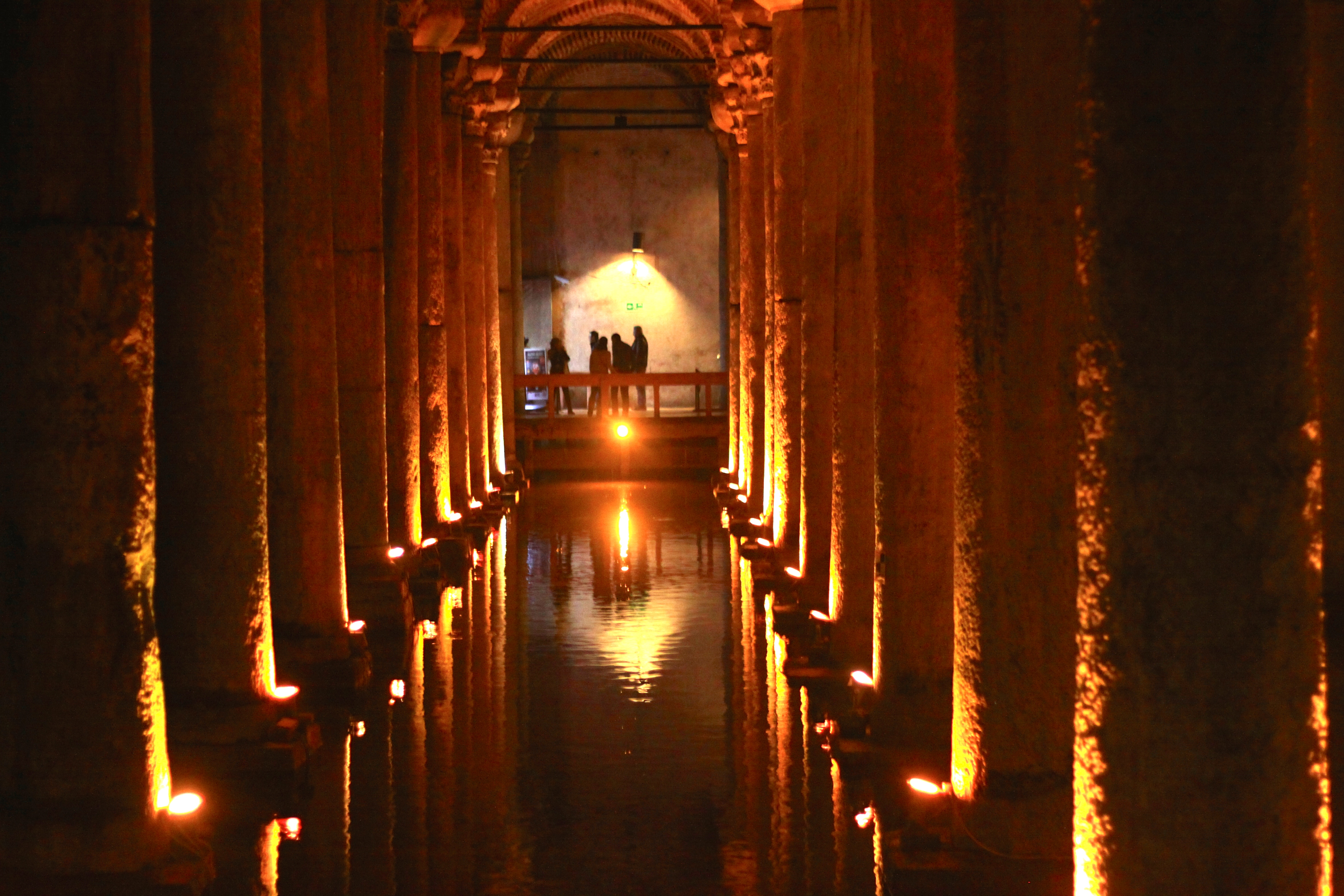
Speaking of glory days, I found the story of the so-called Basilica Cistern rather amusing. The great Byzantine emperor Justinian, who sponsored the construction of Hagia Sofia, also built a huge cistern under the city, supported by hundreds of columns. In later years, the Ottomans somehow forgot that this giant reservoir was there, and concluded that they were simply specially blessed because their wells were mysteriously always full. Today, the cistern is a drippy tourist trap. Just imagine a gigantic flooded basement and you’ll get the general picture!

Basilica Cistern

Or you can look at the specific picture.

Next we headed over to the Grand Bazaar. I felt a peculiar draw toward the place, because it’s half-dream, half-nightmare. Sometimes I’ll awake from wonderful dreams where I’m shopping in a splendid chocolate shop or picking out beautiful clothes from a heavenly Macy’s. Yet, in real life, malls cause me anxiety, and shopping tends to be a chore. In the Grand Bazaar, the tantalizing possibility of finding something rare and exotic meets the stressful reality of pushy merchants and thronging crowds. We found it nearly impossible to navigate so we definitely left some routes unexplored, but we did find a coffeeshop where we tried Turkish coffee (i.e. hot coffee sludge) and also salep, which we received more favorably. This hearty drink combines flour made from starchy orchid tubers with sugar and milk or water and comes dusted with cinnamon. As a winter beverage, it’s a good alternative to hot chocolate for warding off the cold.

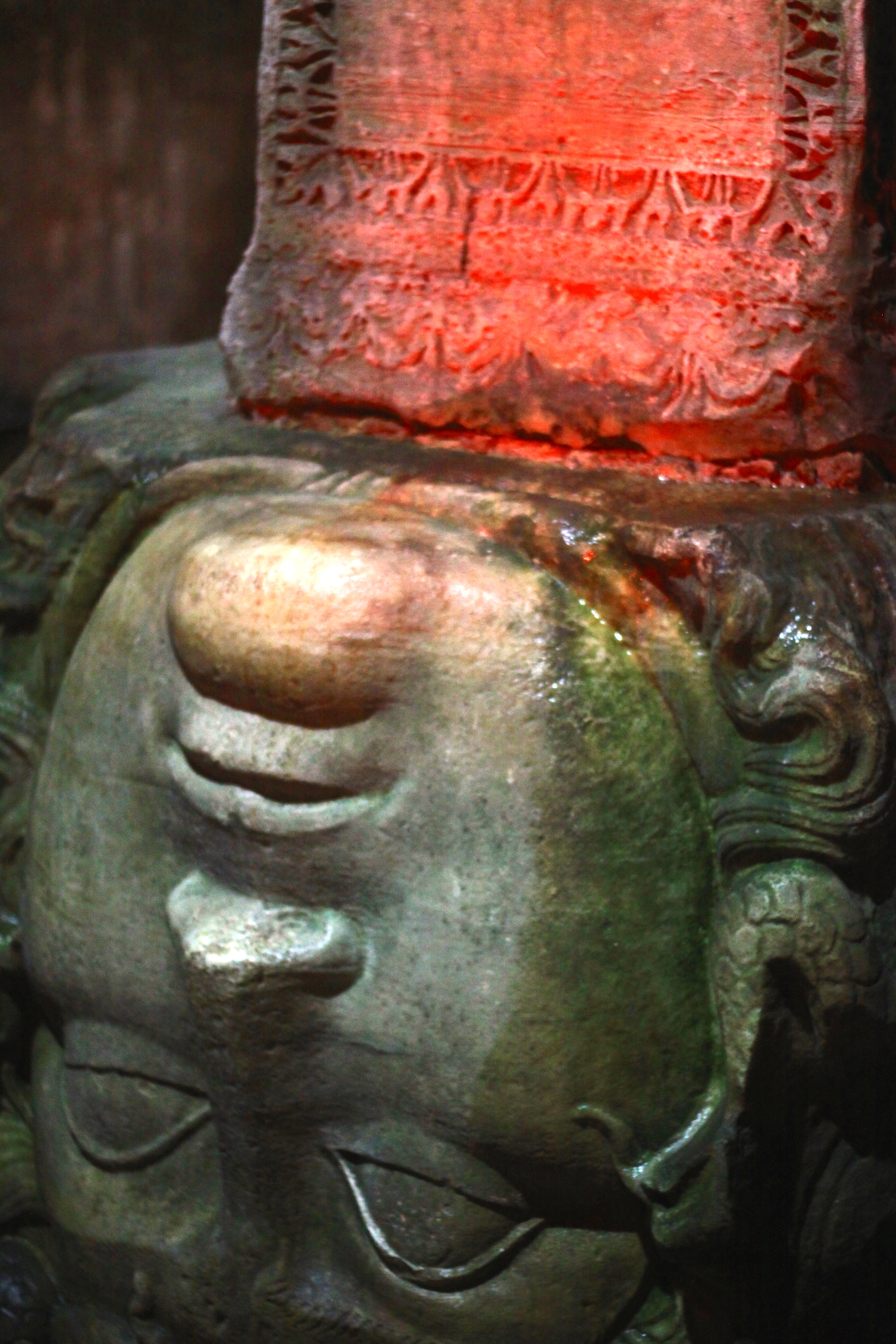
I don't have a photo of Turkish coffee, but I think Medusa is a decent substitute.

I don’t have a photo of Turkish coffee–but here’s Medusa! She looks like she could use some salep…

Well, I’ll see you in day 2!

Turkey for three

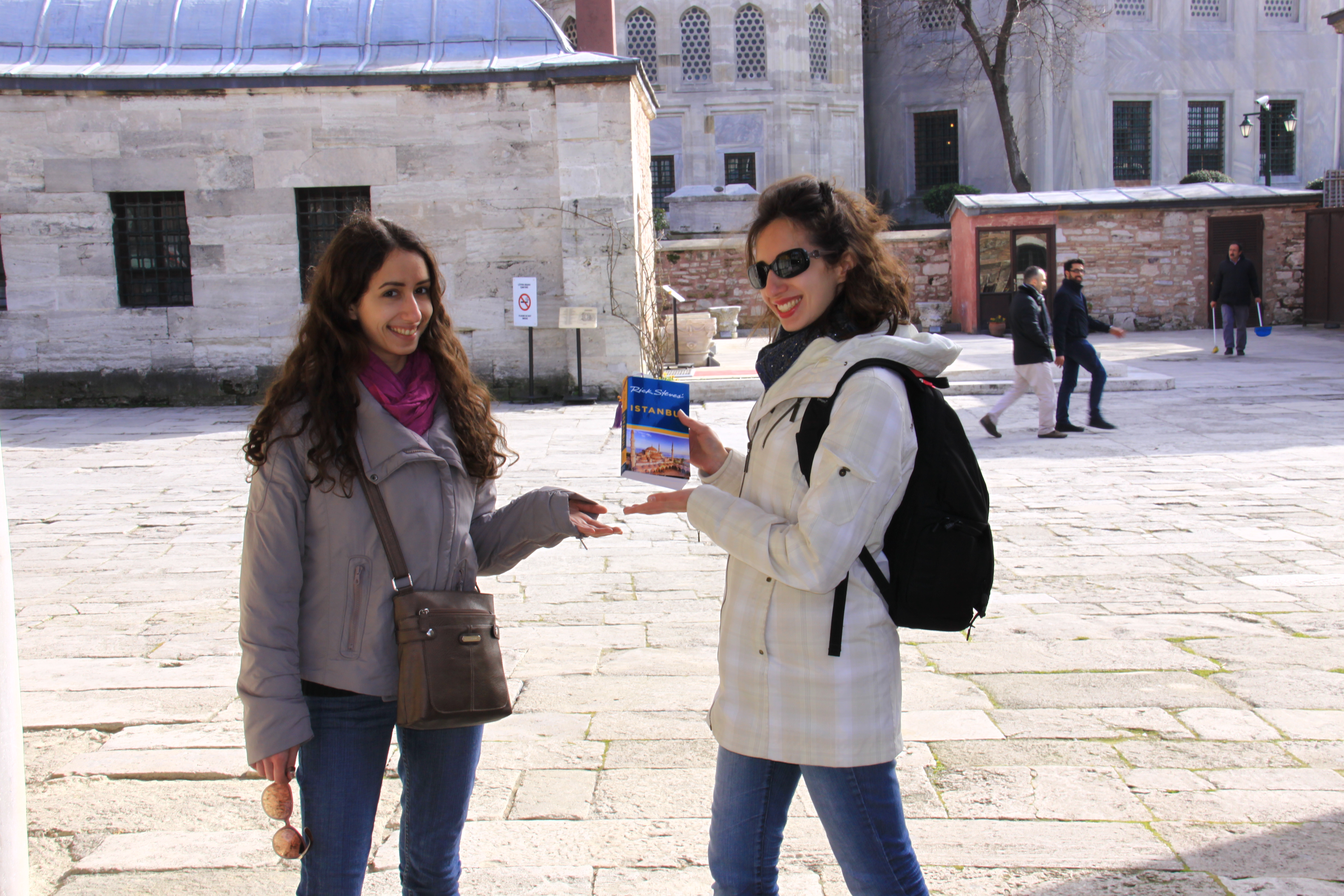
Last month, Sergey, Jasmine, and I set off to Turkey for a whirlwind adventure. After reading Rick Steves’ guidebook nearly cover to cover, I had put together a brutal itinerary that would test anyone’s traveling mettle—there were just so many things to see in so little time! And now so much to write about! If I get a book offer, then I’ll be sure to include every single detail in the manuscript, but for now I’ll stick with the abridged version of our six days in this ancient land, starting with…

Day 0: After a two-hour flight from Tel Aviv, on which we were treated to Turkish Airline’s “gourmet” airplane food, which they even allowed us to preview by passing out menus before serving us as if we were attending a fancy wedding, we arrived in the Istanbul airport. That was when I knew we had officially entered a different country: rather than the drafty buildings of Israel, which apparently chooses to ignore winter rather than react to it, the terminal was heated to the point of discomfort.

We met a person working for the airport transfer company, which manages rides from the airport to hotels, and noticed an apparent typo in his information: we were going to be taken to “Hotel Nomade” rather than the place we’d reserved, “Noah’s Ark.”

“Maybe that’s its Turkish name?” I speculated. Turkish is all Greek to me.

So, after informing him of the mistake, we got into a big van with a silent driver. Well, he was silent aside from phlegmy coughs and wheezes. In the old city, we pulled up in front of the correct hotel, with its “Noah’s Ark” sign, but something was clearly awry as shutters covered its entrance.

Wordlessly, the driver pulled away then backed his giant van all the way down another street, where he got out and removed our luggage.

“I guess that’s our cue?”

We disembarked. No hotel was in sight, just a restaurant packed with night owls, but then a man appeared and helped us with our luggage into a small building beside the restaurant.

“Did Noah’s Ark tell you about the situation?” he asked.

“The…situation?”

“They closed. Out of business—two days ago. They rebooked you in this hotel.”

At this point it was 1:00 AM, and we weren’t about to start researching another hotel, so we accepted the room. The triple was fairly tiny and bare, and one patch of the fake wood floor felt like it was going to collapse every time we stepped on it, but at least there were beds.

Then we noticed the bathroom. It had glass doors. Right in front of the toilet.

We did some research and found that this hotel was recently renovated under the guidance of a French designer. So, apparently this designer valued classy touches like glass doors over boring orthodoxies like privacy. In my humble design opinion, glass doors are good for places where you’d like a clear view, such as a garden or yard—not, you know, the toilet.

(Also, to compound the bathroom problem, through a vent near the sink, we could clearly hear our neighbor’s conversations when they spoke in or near their own bathroom. Nothing scandalous, but still–what did they hear us talking about? …Probably about the bathroom.)

Long story short, we spent nights one and two at this hotel after redesigning the door by draping it with the closet’s curtain, then moved to a better hotel a few blocks away. Never before had we been so happy to behold a blessedly solid, opaque door to the bathroom!

Animal Farm

One weekend, Sergey and I were invited to accompany some colleagues to a place called Hamat Gader. This destination boasts stinky hot springs that fill a giant bathing pool. Now, marinating myself along with flocks of sweaty strangers is not my usual cup of tea, but we figured this was a good chance to see some of the Galilee region.

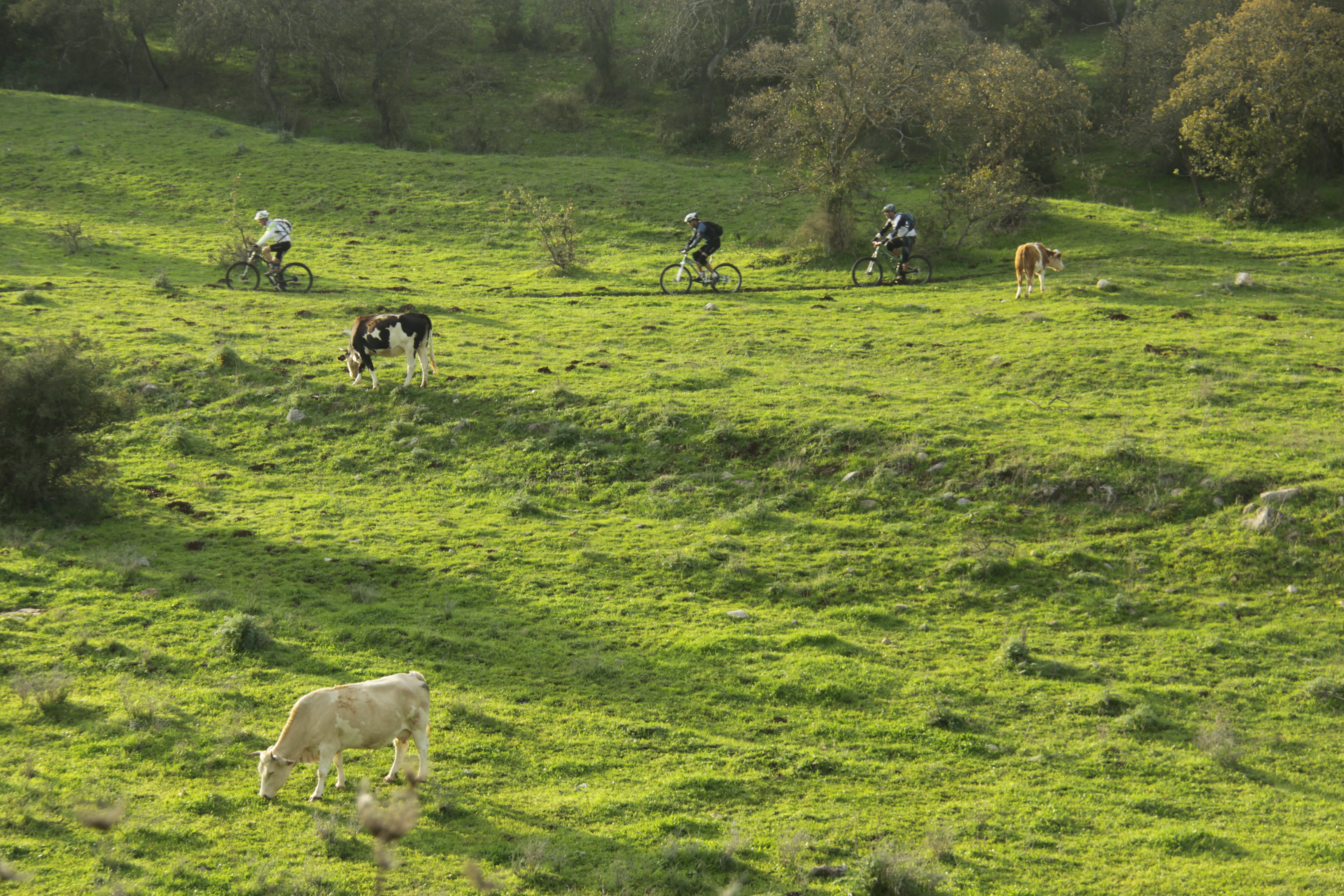
We were right. The winter rains had turned the hills and valleys of Galilee a vibrant green, shining like an emerald in the morning light. En route to our destination, we stopped at the most scenic gas station I’ve encountered. The station overlooked a field where cows grazed peacefully beside white cattle egrets. Occasionally this pastoral scene was interrupted by groups of bikers who zoomed down a path through the field, startling the cattle.

Cows and bikers

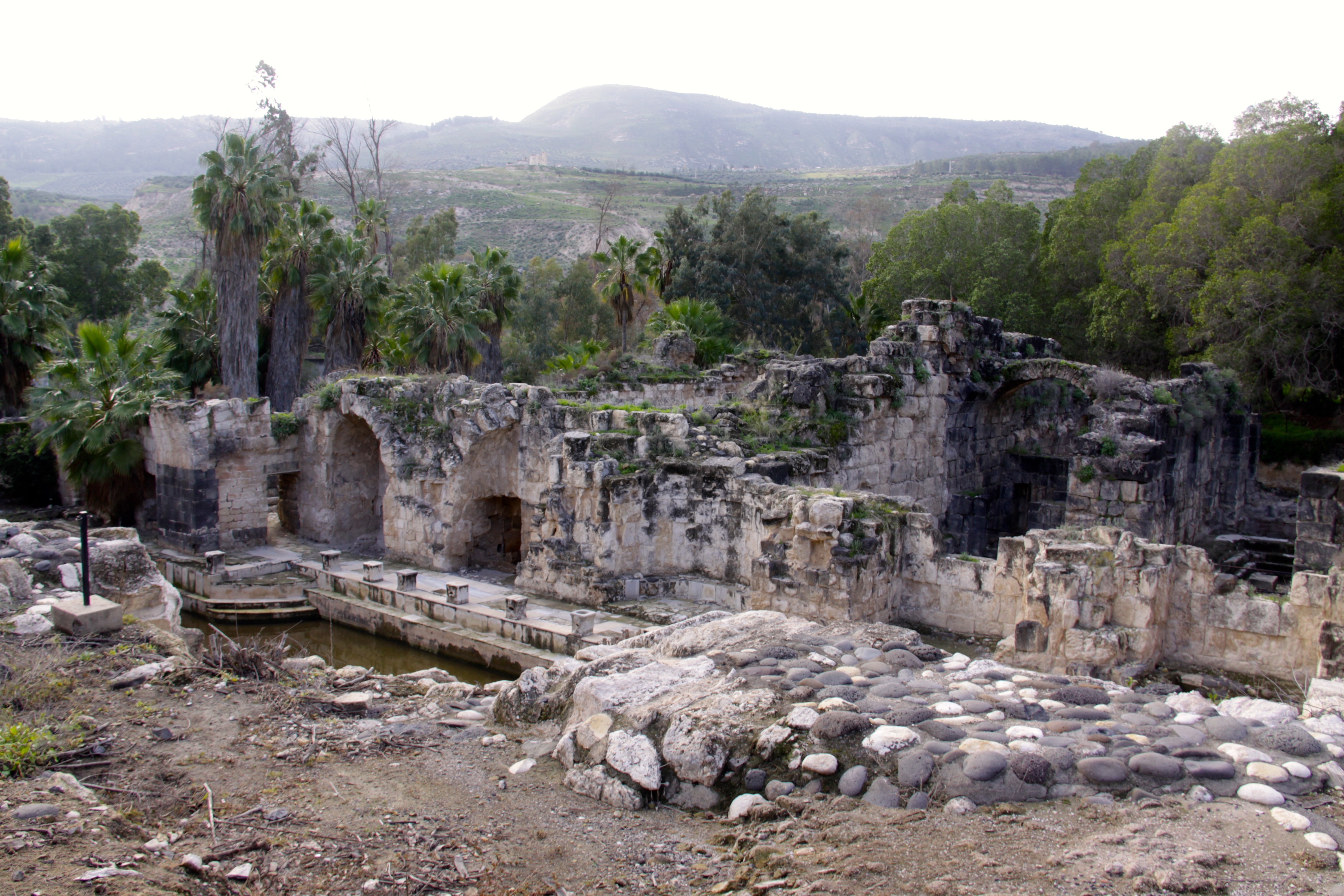
Back on the road, after driving along the border with Jordan, we arrived at Hamat Gader. Sergey and I set off to explore the flora and fauna of the park. We found the predecessor of today’s pool, the ruin of a Roman bath.

Roman bath

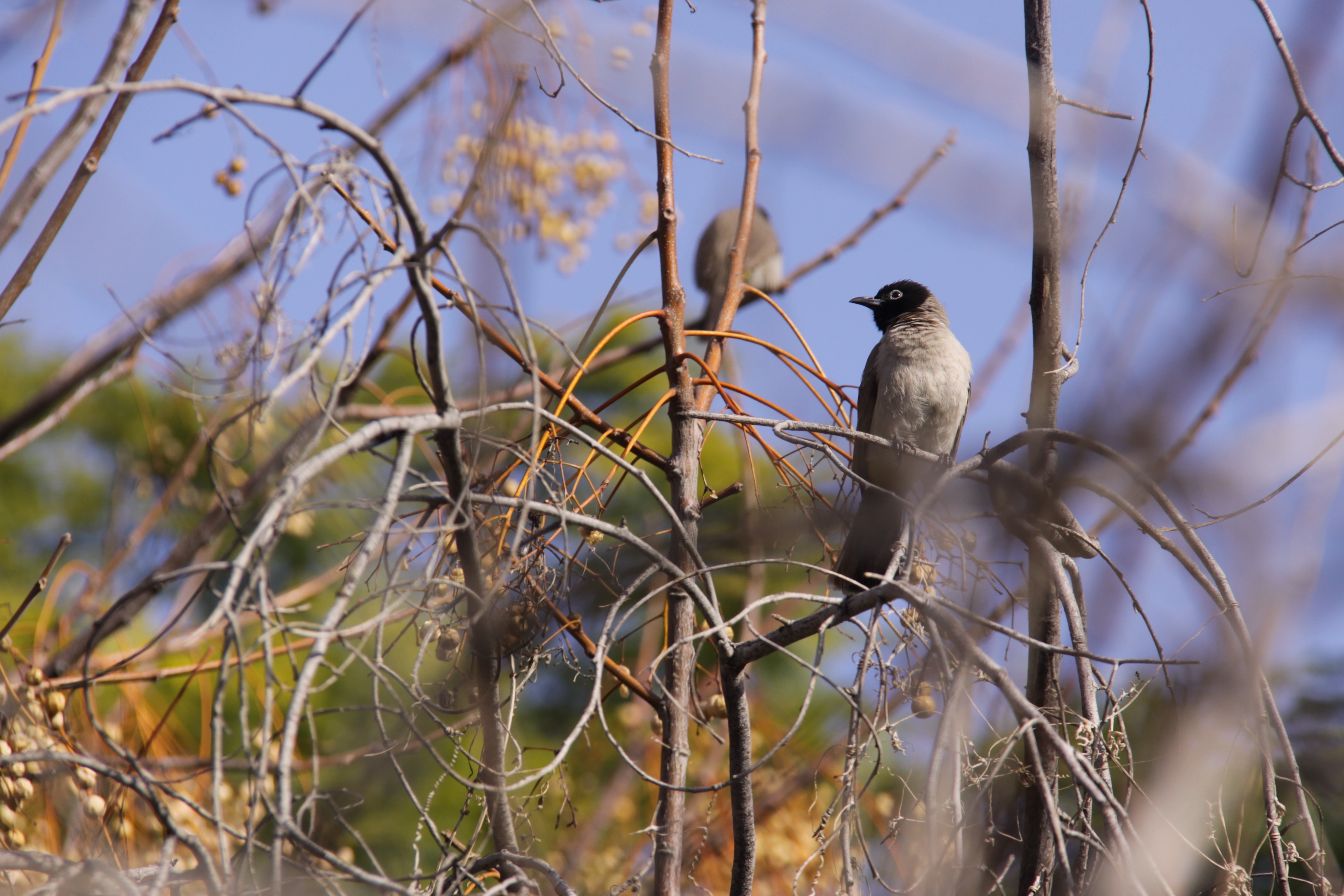
After documenting the ancient bath, I was distracted by a flock of birds: white-spectacled bulbuls twittering upon some trees near the ruin. Beyond them, I could just make out the shape of a mysterious green parrot, gazing impassively into the surrounding hills.

Bulbul

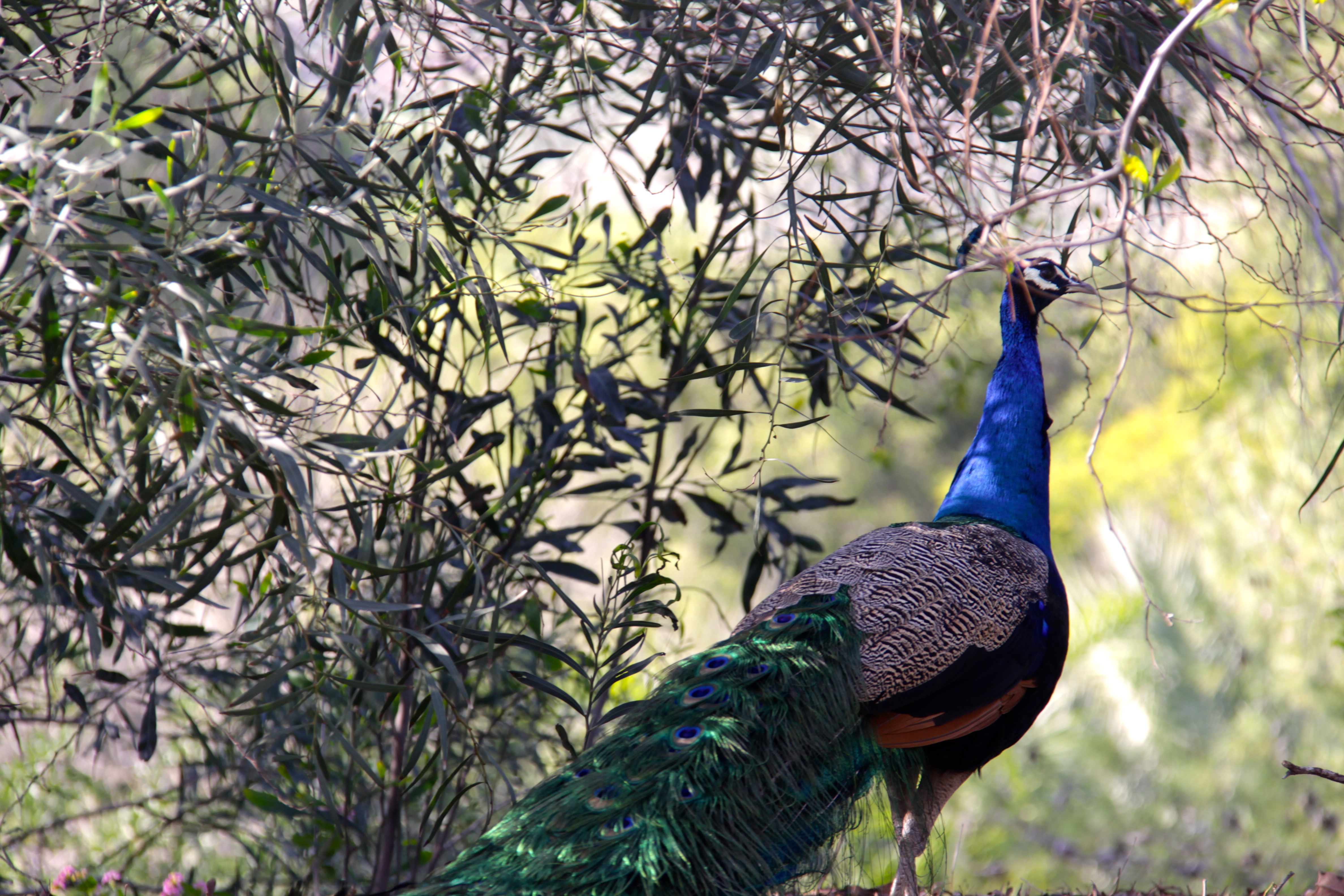
Then came the unmelodic squawk of an itinerant peacock. We gave chase. Above the ruins of a Roman amphitheater, we stalked him in pursuit of the perfect photo. He was not particularly interested, and gave us a final look of disdain before disappearing over the crest of the hill.

Peacock

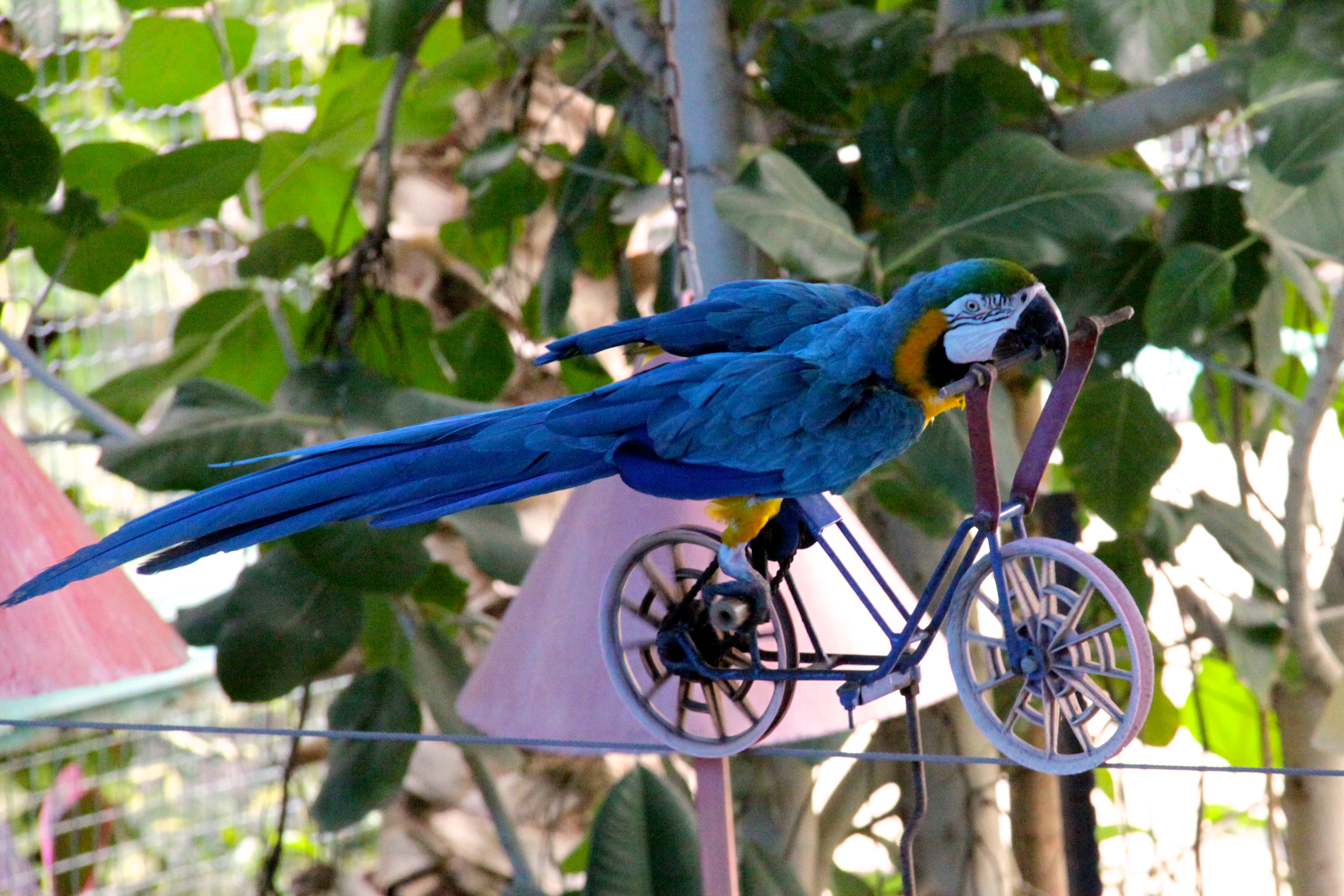
After our nature experience, we had a decidedly unnatural visit to the park’s “zoo,” which seemed more like a hapless mess of cramped terrariums and odd combinations of chickens and gazelles. Actually, perhaps that mysterious green parrot I saw was an escapee of the zoo’s tacky attraction, a parrot show. Sergey and I sat among hordes of tired parrots—I mean parents—and their shrieking children to watch parrots, macaws, and cockatiels perform tricks like pedaling a bicycle across a tightrope.

And a parrot biking across a tightrope.

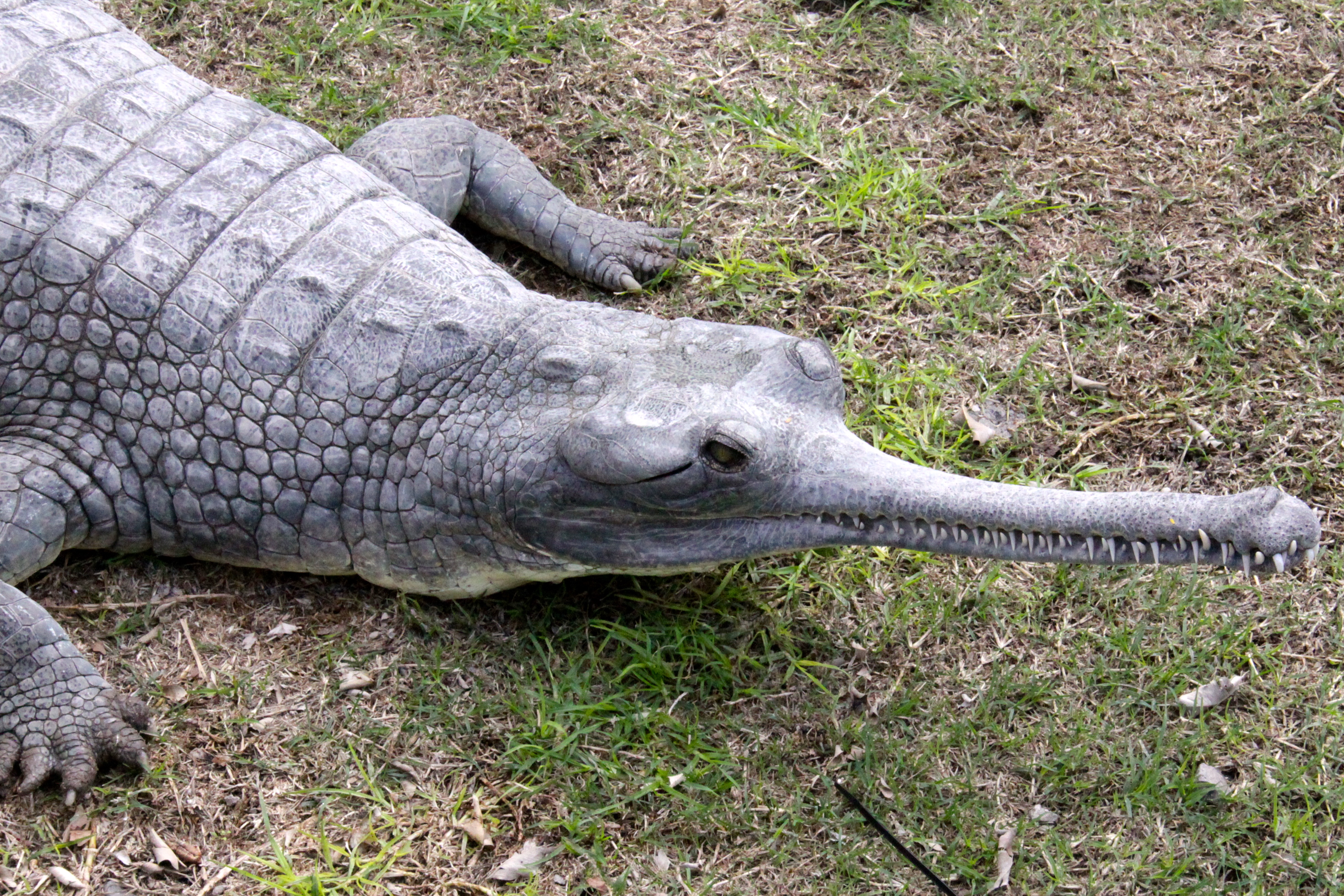
But the weirdest part was yet to come: the Alligator Farm. The farm consists of a series of enclosures tightly packed with alligators, crocodiles, caimans, and, strangest of all, gharials.

Pretty guy

These thin-snouted creatures look like something out of Dr. Seuss (especially the males, which sport a “sexy” bulb on the tip of their noses), but actually, they come from India, where they are extremely endangered. While at first their slender jaws seem like an evolutionary mistake, apparently the shape enables them to effectively hunt fish, and even to stun them with underwater jaw claps.

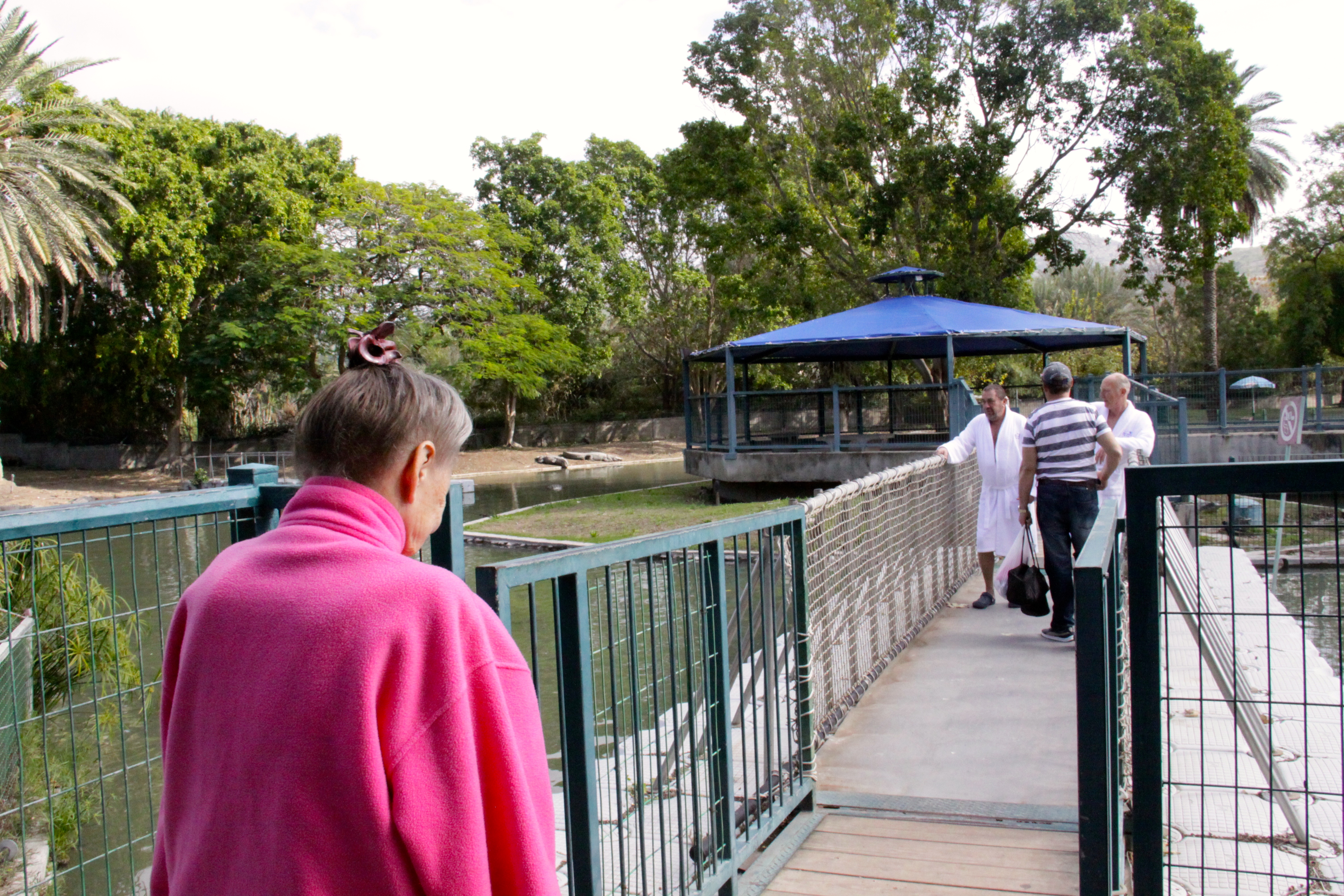
Rivaling the crocodilians in strangeness were our fellow visitors, who, clothed in bathrobes and flip-flops, apparently had emerged from the hot pool to cool down by strolling through the farm. I wonder what the crocs think of these oddly clad bipeds. Would he look good as a handbag?

Bathrobes

Soaking in the pool was…sulfuric. I was disappointed that afterwards my skin failed to sprout yellow crystals. What I will remember from this day are these comical snapshots of human-animal coexistence: spandexed bikers shepherding cows aside, and pink-skinned bathers walking between some of Earth’s oldest predators.

Dailyat al-Karmel

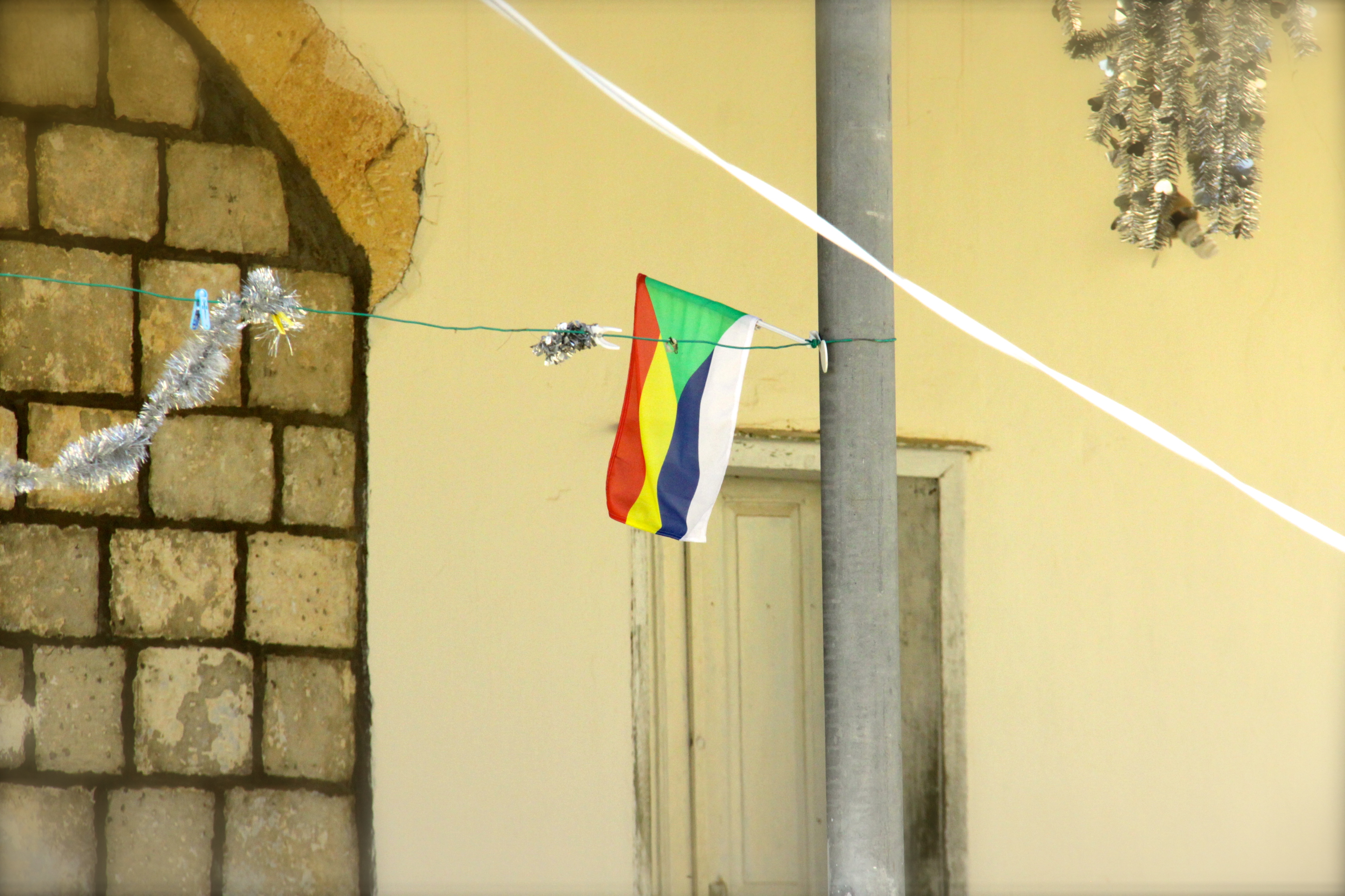
Druze five-color flag representing their five prophets.

Druze five-color flag representing their five prophets.

Frequently I hear reference to the “Druze village” on Mount Carmel, which summons a bunch of quaint huts in which the Druze peacefully paint pottery and bake their distinctive flatbread, which they serve topped with lebaneh (like sour cream cheese), tart zatar spice mix, olive oil, and fresh parsley. Driving through the sprawling “village” with its endless modern concrete apartments and houses, I realized my concept of a village didn’t quite match reality. We got off on the commercial strip, surrounded by souvenir shops and restaurants.

Dailyat al-Karmel is a town situated at the top of Mount Carmel, populated by Druze people. The Druze are a group that broke off from Islam over a thousand years ago to form their own syncretic religion. One of their tenets is obedience to and respect of the government wherever they reside, explaining why the Druze have fully participated in Israeli society, including serving in the military in the various wars. They are also known for their hospitality, which we experienced firsthand.

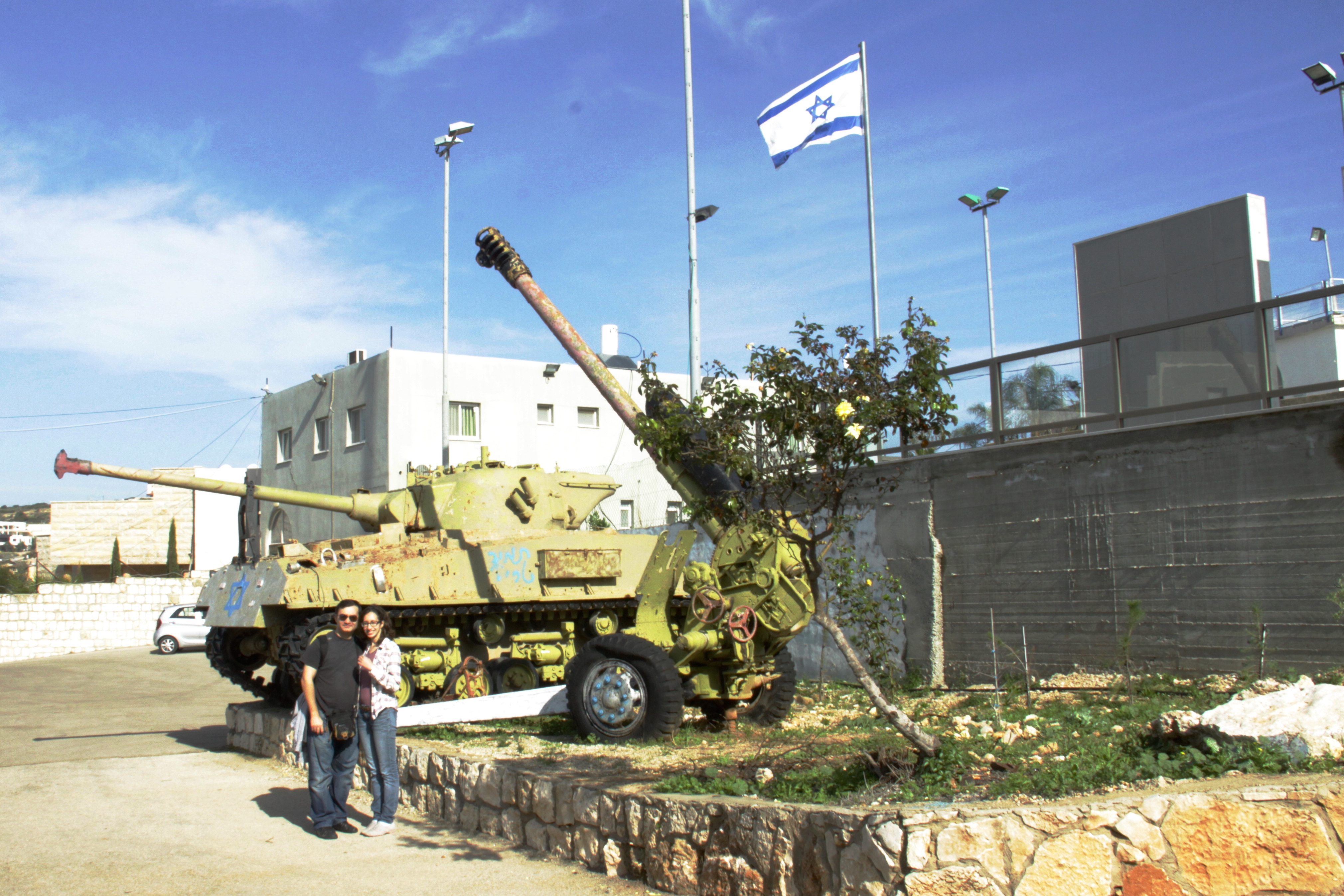
After walking up the commercial street, where you can find colorful textiles sold beside tacky statues (most notably a figurine of a seductively posed alien), we wandered onto a side street and found ourselves in front of a massive concrete domed structure. What was this place–a bomb shelter? A religious structure? No, it was a basketball court, as explained by the maintenance man who appeared to either guide us or shoo us off the property. Beside this odd dome were several tanks, apparently part of a war memorial. Sergey found this to be a romantic photo op.

Tanks near the giant dome

Tanks near the giant dome

Continuing our wanderings, I spotted a sign advertising Arabic coffee and we approached the building. To our surprise, rather than a café, we seemed to have stepped into someone’s living room. Sundry chairs stood around a large room, including stiff-backed chairs, armchairs, and couches. “Do you serve coffee?” we asked the man at the door, whose name was Zeedan. “Yes, yes,” he said, ushering us in. We sat down in some wicker armchairs and he poured us coffee in the usual miniature paper cups. Next came strawberries (in Israel, winter is strawberry season), and then baklava. Then he sat down beside us. This was unusual restaurant behavior, but he seemed to want to greet and talk to us. Unfortunately, the language barrier made conversation difficult beyond communicating where we were from, but at least we were able to write our names and notes in the gigantic guestbook he handed us, which had the notes of people from all over the world. It was strange to think that this sleepy town would be a crossroads for so many travelers, but nevertheless, the photographs cluttering the walls evidenced the acclaim of this town and this restaurant. One showed the president of Israel shaking Zeedan’s hand.

After some time chatting among ourselves, we decided to depart. When we asked for the bill, we were told it was all on the house. How very strange we felt not paying for our snack, and how charmed to be hosted so graciously, strangers as we were to Zeedan and his family! I guess that is wherein lies the secret to why this town can still be dubbed a “village”–despite the SUVs wending through its narrow lanes and the modernity all around, it retains a neighborly, hospitable culture.


Gettin’ hitched, part 4

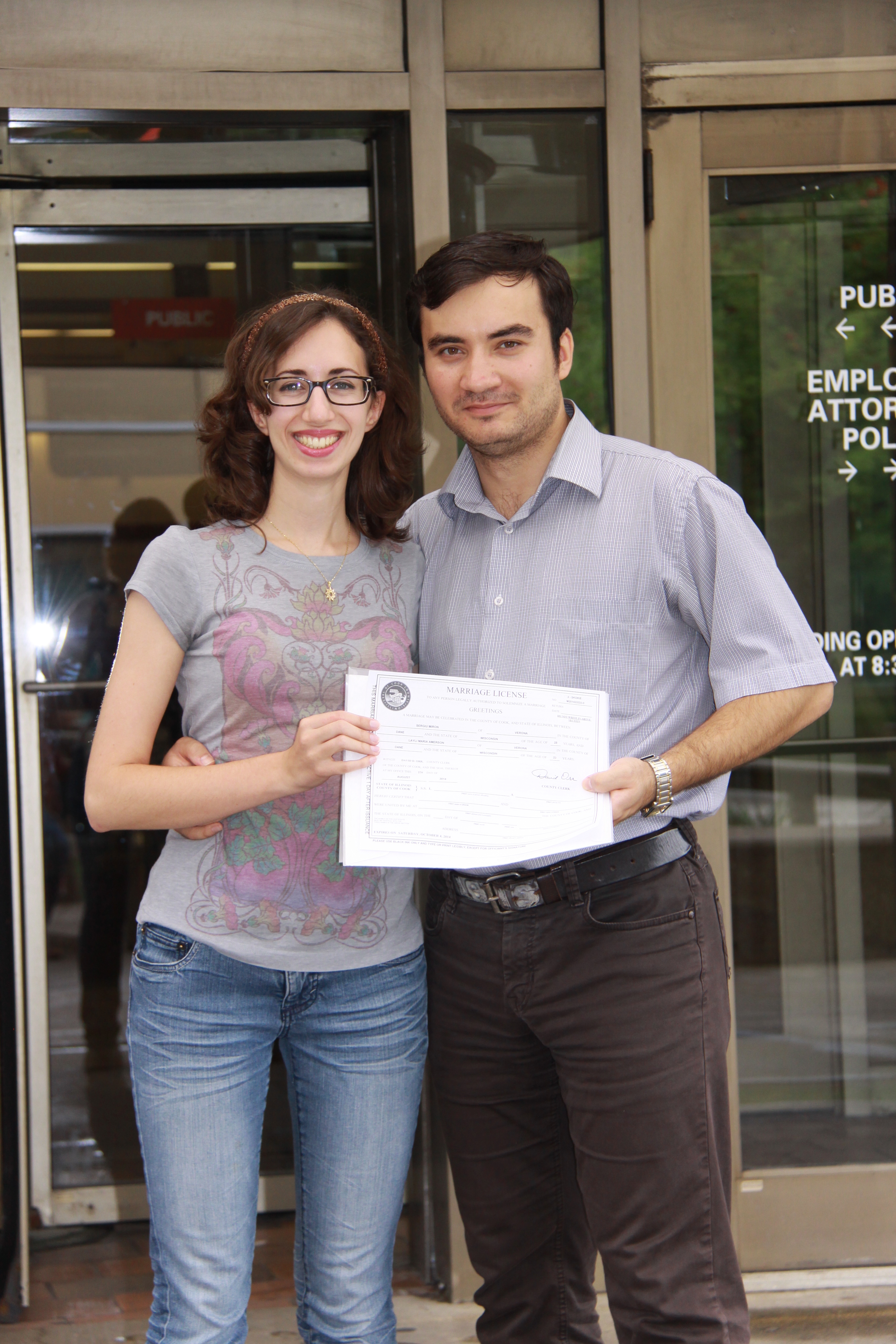
So, after the flurry of preparations, we headed to the Chicago area–first Sergey, to meet his friend Vadim, and then my parents and me.  Our goal upon arriving in Skokie was to get the marriage license ASAP.  We found the county clerk’s office, an expansive building housing courtrooms and various offices, and after returning our electronics (apparently prohibited) to the van and de-belting for the metal detector, we went inside.  We found our room and joined the line of couples waiting for licenses.  Finally, it was our turn.  The lady behind the counter did not seem to find her job romantic at all as she embarked on a long list of questions apparently designed to determine our capacity for trivia questions, like “Where was your mother born?” and “What is your social security number?”  I guess we passed the test, because we got the license, woohoo!  License to wed!

License to wed!

License to wed!

Soon after that, my parents left, and Sergey and Vadim went to a baseball game to marvel at its slow complexity (they managed to withstand one hour of three), and I waited in the hotel for Dianne to arrive.  Actually, I fell asleep long before she came and accidentally locked her out of the room, but don’t worry, we eventually had our reunion, and then the next day were joined first by Faye and Milly, and then by Addie and Safiyyah (Sadia came a bit later).  And thus began our Mount Holyoke reunion.  Seven sisters, three days, one Windy City.

So what makes it onto the travel itinerary for these womyn?  Let me tell you: a museum honoring social welfare activism (Jane Addams Hull House), a giant ferris wheel–and then fireworks, the Art Institute, an outdoor opera concert, a glass balcony hanging over the city, and more.  As for the tastebud tour of Chicagoan cuisine, our first day together, we indulged in deep dish pizza.  I think I know why this style is mostly constrained to Chicago; Faye gave it the review, “I feel like there is a giant cheese ball sitting in my stomach.”  Vadim, on the other hand, started with cheesecake and moved on to the pizza.  Well, some friends enjoyed the cheese ball effect, but perhaps it is no coincidence that we lunched at a vegan café the next day.

I must say, it’s pretty nifty to have friends who delight in both the swing ride at Navy Pier and in analyzing historical museum displays, who make a surprising beeline for the paperweight collection at the Art Institute and appreciate the tale of Salome as told through the music of Strauss.  I guess that’s why these ladies are my friends and have been for five years.

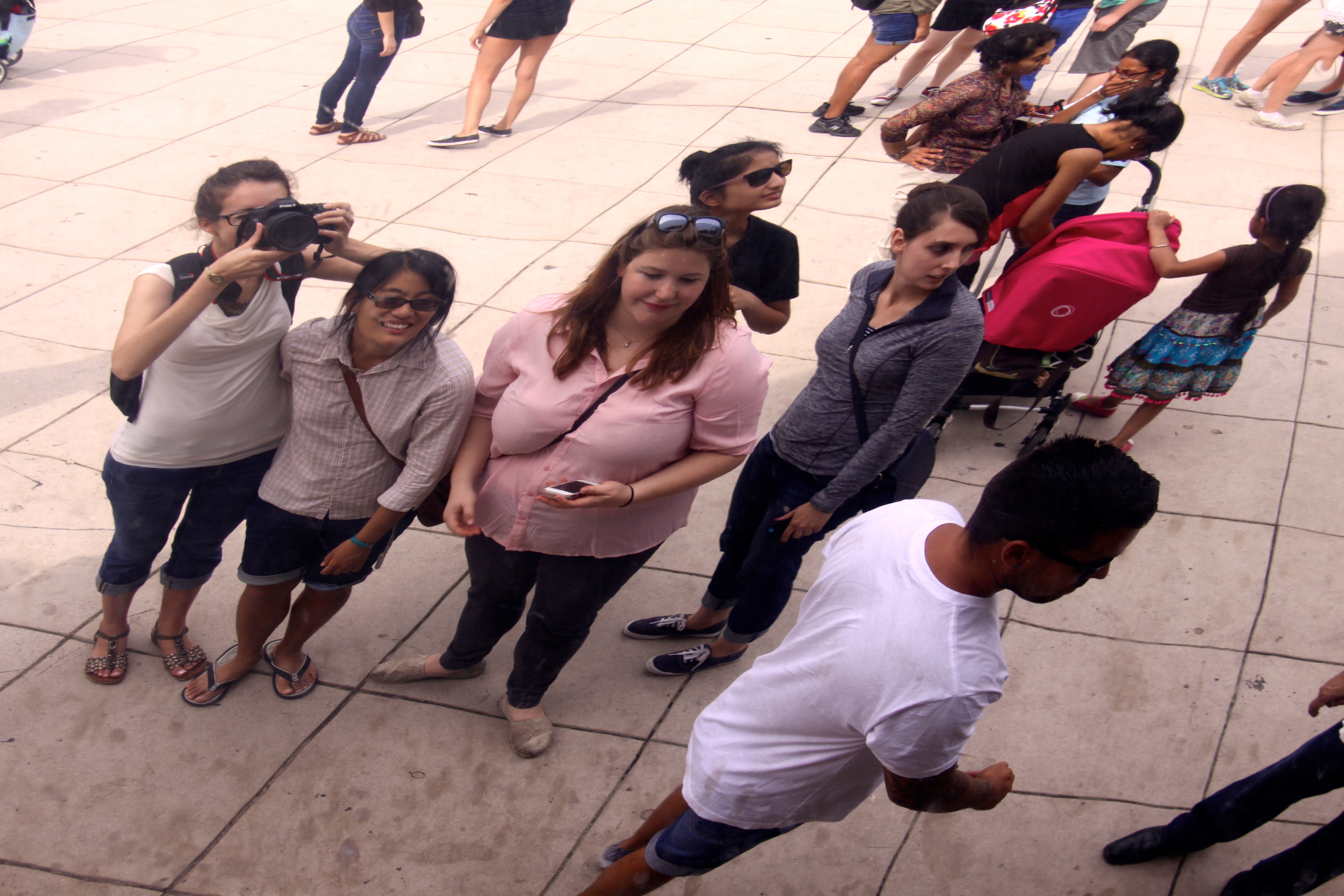
Reflections: our group visits Cloud Gate, better known as the Bean, in Millennium Park.

Reflections: our group visits Cloud Gate, better known as the Bean, in Millennium Park.

Speaking of the Art Institute, I was disappointed to leave its glowing galleries after only several hours.  Before departing, Sergey and I visited the special exhibit on Magritte together.  Surrealist paintings watched us from the black walls with disconnected body parts juxtaposed with strange objects and nonsensical labels.  Sergey found it all quite disturbing and concluded of Magritte, “This guy was sick.”  Then, I gave Sergey a desperate whirlwind tour, whisking him through all the Impressionist (“It’s nice but blurry”) and Renaissance galleries at a near jog.  Then it was time for us to leave our friends to revel at the artistic treasures as we boarded the train back to Skokie.  There was, apparently, a wedding to prepare for…

A day at the beach

The last few weeks have been hectic as Sergey and I nailed down such wedding requirements as invitations, reception location, accommodations, and dress choices (for me, not him).  So we decided to go on a relaxing trip to the beach to recuperate.

Little did Sergey suspect that day at the beach with me is, well, no day at the beach.
 
Actually I was not the only companion–we went with a bunch of IT guys and a few IT ladies to a beach outside of Haifa where the aquamarine of the Mediterranean laps white sands scattered with seashells…and cigarette butts and charcoal, but still, a relatively clean beach.
 
A few months ago, I had dipped my toes into the Mediterranean for the first time in Tel Aviv. It is perhaps a little out of order that I entered the Dead Sea, a three hour drive away, so much sooner than the Mediterranean, which of course borders Haifa, but beaches kind of scare me.  Actually, I have been to a Mediterranean beach before, in Barcelona.  My overall impression of that beach was indeed fear.  I was with my mom and Jasmine, and in our street clothes we felt a bit overdressed in the midst of what we realized was a topless beach.  It was nothing I hadn’t seen before in art class, but…
 
 
Back to our present beach. Now, my ideal beach activity would involve lounging in the shade of a parasol with a good book, the soothing sounds of the waves in the background.  Some people, however, prefer actually entering the water.
 
Not me.
 
I have a deep distrust of any open water between the size of large puddles and the Pacific.  I think this arose from several mildly traumatic incidents.  The first happened when I was a toddler and my swim instructor forgot to put floaties on me.  Following his instructions–which I remember as him goading, “Don’t be a scaredy cat!”–I obediently proceeded to step underwater and came up having swallowed enough chlorine to bleach my insides clean.  He was very apologetic.  Besides that, there were the books and movies involving watery graves–Moby-Dick, Life of Pi, Titanic.  Then there was the incident when, in my senior year at Mount Holyoke, I capsized a canoe, resulting in the loss of my spectacles and my dignity.  And the latest and greatest, the escapade in which Jasmine and I almost floated over to Jordan on the Dead Sea.  I still have the scars.
 
So, I argue that I am neither a coward nor a scaredy cat.  I am simply more aware of the dangers of water than are others.
 
To compound these concerns, I was feeling genuinely sick, and unfortunately the seaside vendors seemed to only be hawking tiny kidneys–or at least that’s what the local snack appears to be–instead of ibuprofen or acetaminophen.
 
I started out with “I will walk in the surf.”  I enjoy the nonthreatening whoosh of foam around my toes.  Then Sergey convinced me to actually go inside the water.
 
There were two sides to this beach.  One had some sort of breakwater that kept all the waves out; this is where most of the kids were.  And that was the only side I would even consider entering.  I waded in slowly, whining about the cold water, which was actually pretty warm.  I swam a little in the midst of the happy children and their floaty toys.
 
Then Sergey decided to push his luck and induced me to come into the side with waves.  Small waves, but still, waves.  I demanded he hang on to me–“Don’t you dare let go!”–and we rode the waves up and down a little.  Then I demanded he release me when I started to fear we were in too deep–“Let go of me NOW!”  (Don’t worry, I could still touch bottom.)
 
Once I had gone through my odyssey, I could finally exit the water and do what I had come for: lie down, put on a sunhat and apply multiple coats of sunscreen, and read my book while daydreaming about painkillers.

The Hyrax

Q: What would you call Dr. Seuss’s Lorax if he grew taller?
A: The Hyrax, of course!

I had never heard of these wondrous creatures before I visited Hermon National Park in northern Israel.  And I might not have noticed them, had it not been for my curiosity about some stairs leading up a hill at this park.  Explorer that I am, I decided that I had to see what was at the top.  We climbed up accompanied by another gentleman from our group.  When we were a few paces ahead of him, we heard him cry out–“Look!  Some sort of large creature!”

I froze.  Did mountain lions live up here?  Was one crouched on the nearby boulder, preparing to pounce?  We descended the stairs to see the fearsome beast.

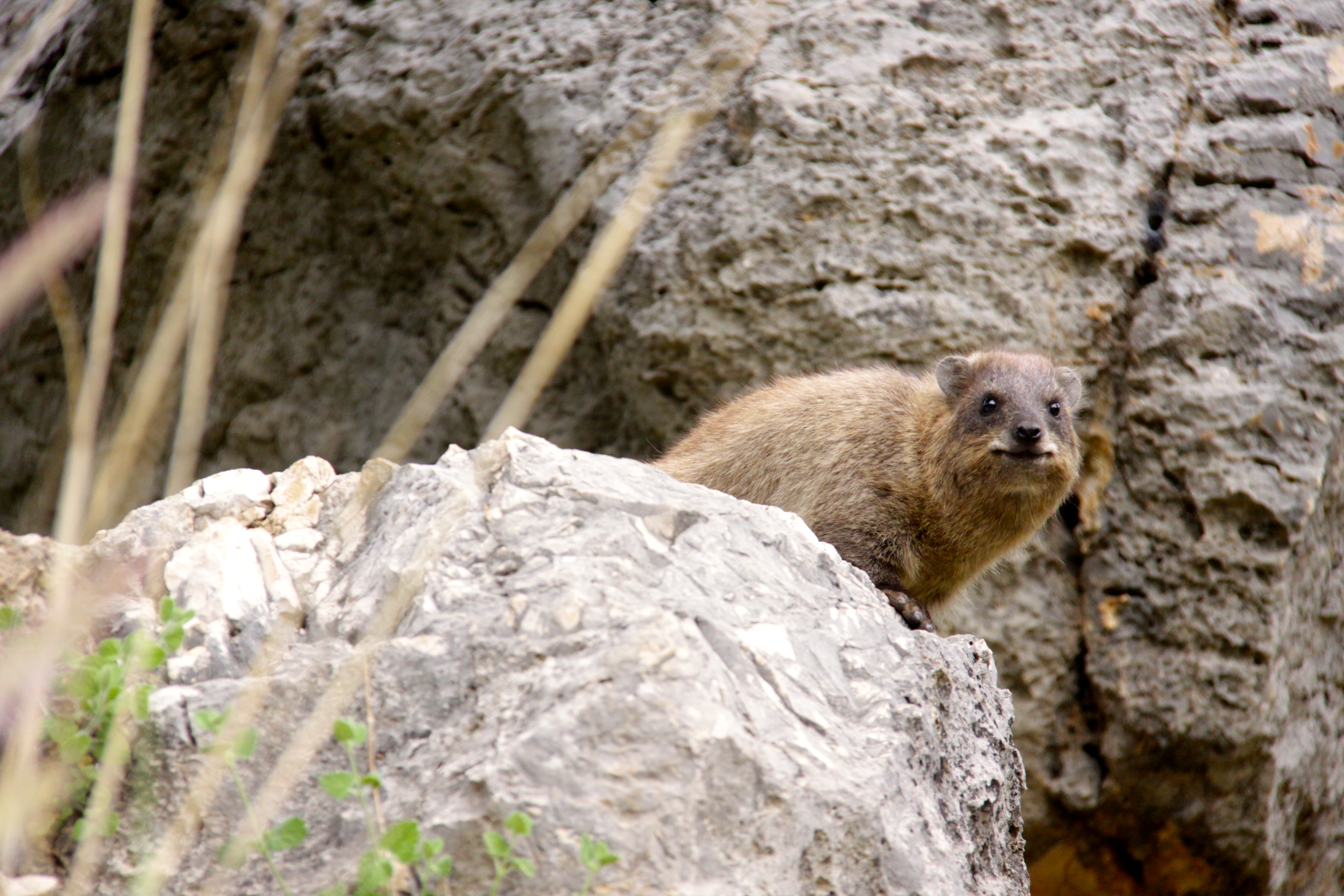
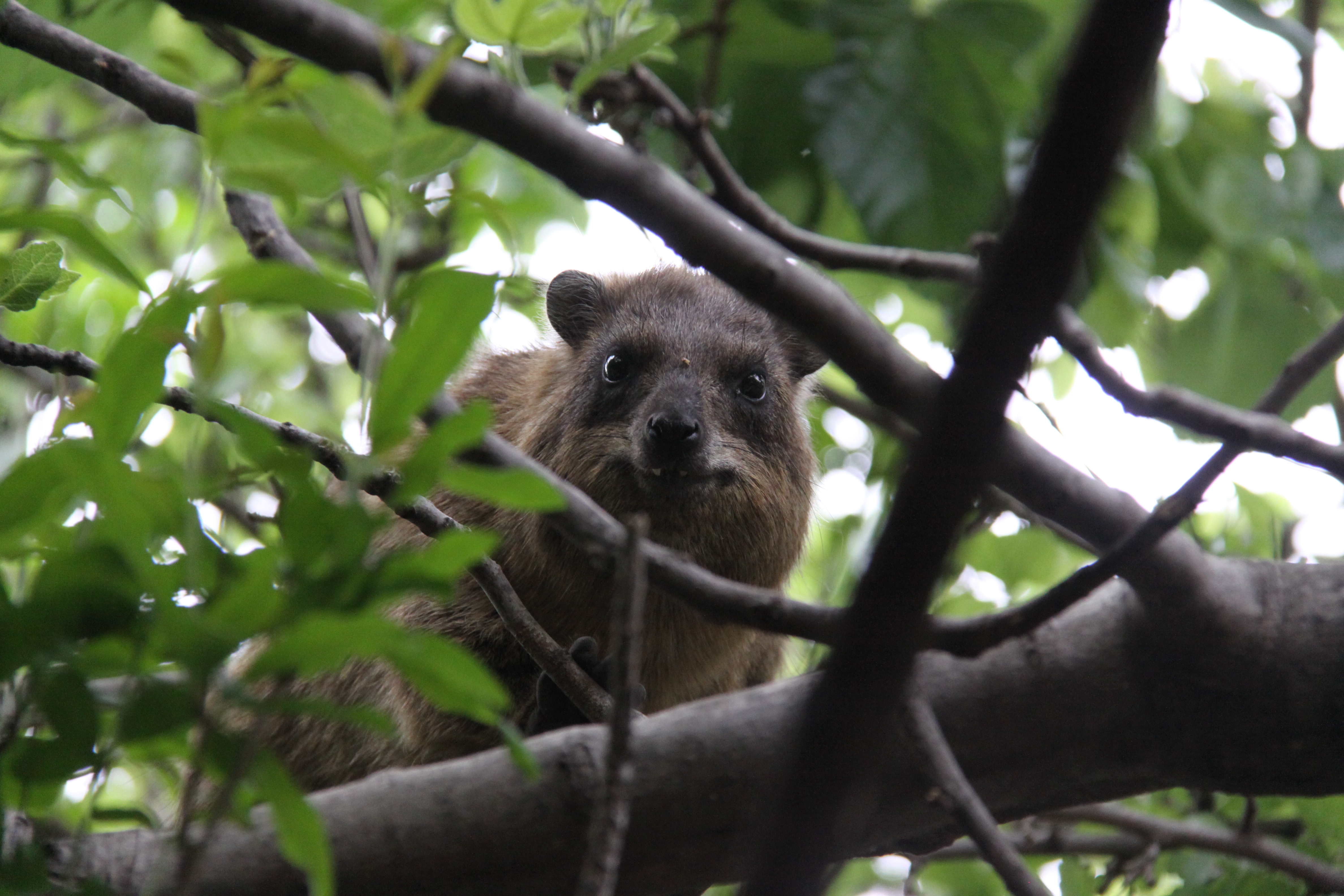
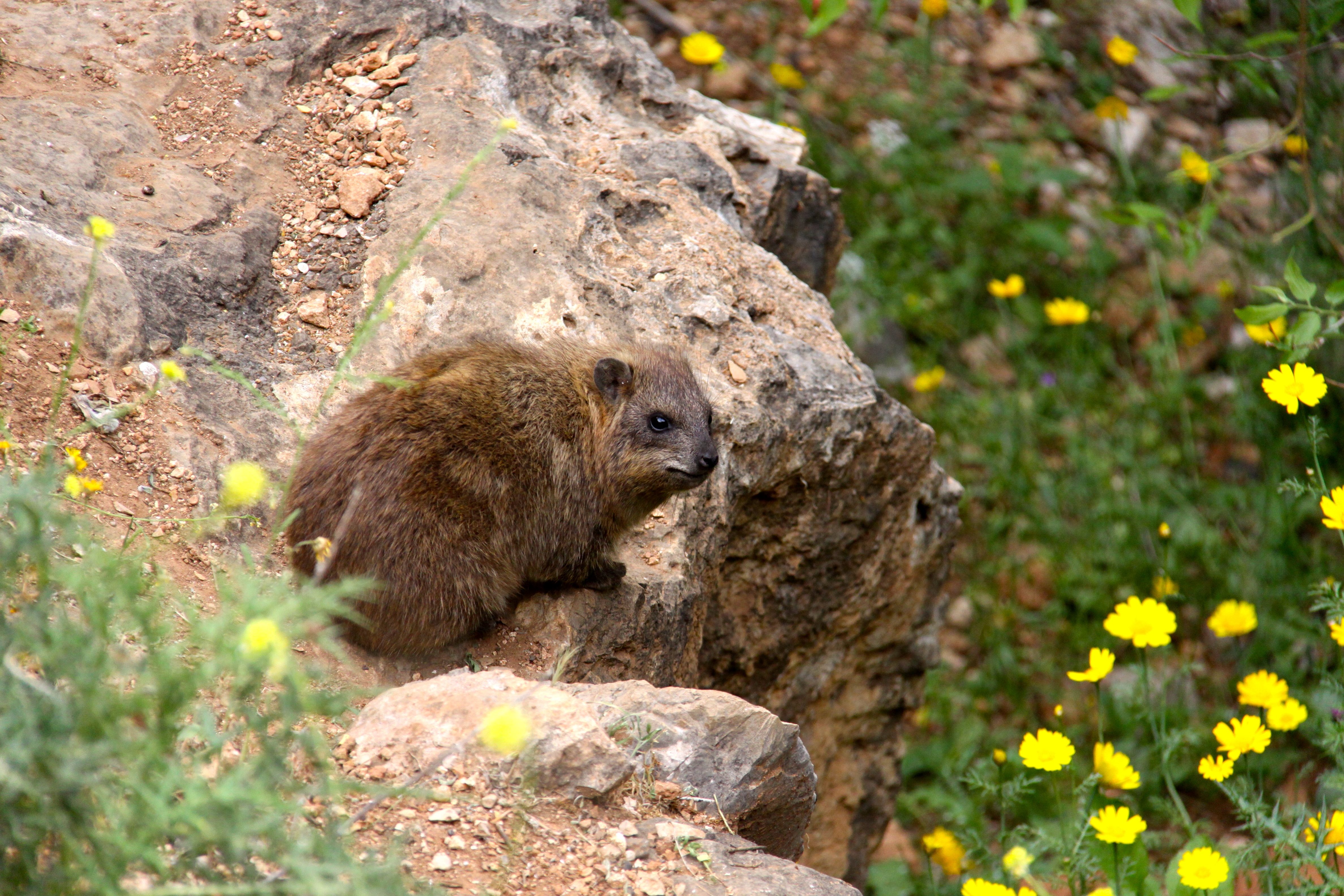
It was a brown, furry, ball of cuteness with a surly face, poised atop the enormous boulder with a clear “king of the hill” attitude.  It regarded us with disinterest, these lowly hairless creatures who had blundered into his realm.

Soon we discovered that there was a whole clan of hyraxes living on these boulders.  In a reptilian way, they like to sun themselves because they lack good thermoregulation (like me).   They are actually rather remarkable.  Although they look like big rodents, they are actually related to elephants (they even have mini-tusks), and their ancestors have been sunning themselves on planet Earth for nearly 40 million years–20 times longer than modern humans have been around.  Sergey and I went paparazzi on them, and a few indulged us by holding their poses.

Later, I was once again wandering in the park, this time behind some sort of utility building, when I spotted a small animal ahead.

“IT’S A BABY HYRAX!” I exclaimed and gave chase.  He skittered behind a tractor away from my camera, but this time we had truly hit the jackpot: a whole extended family of hyraxes peered at us from the brush beside this building.

This one is showing off his tusks in what appears to be the biggest smile a hyrax can give.

This one is showing off his bitty tusks in what appears to be the biggest smile a hyrax can give.

The nursery for the babies seemed to be indoors, through an open window; they played on a thick vine hanging from a tree, running up and down.  One young fellow got too excited and tumbled off the vine to the ground, then picked himself up and ran back.  It was seriously so cute it made me want to cry.

The time came that I had to leave my new quarry and resist the urge to take one back to Haifa with me.  I will have to content myself with my hyrax photo album.

Nimrod and Pan

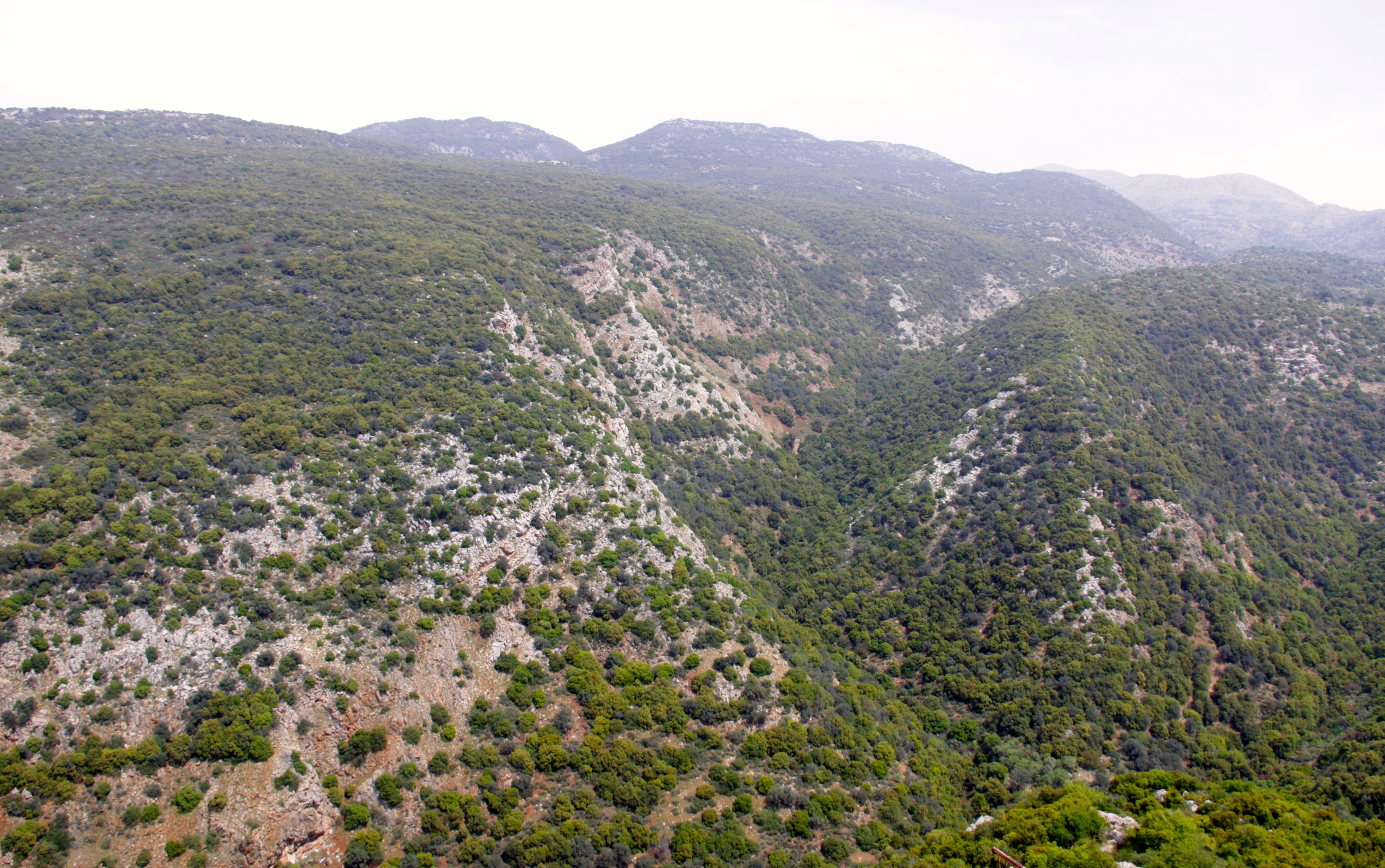
Last weekend, I exchanged Mount Carmel for its wilder cousins in the Golan Heights, thickly clad in green.  There were two destinations on this trip, which was organized by some coworkers: Nimrod’s Fortress and Banias Springs.

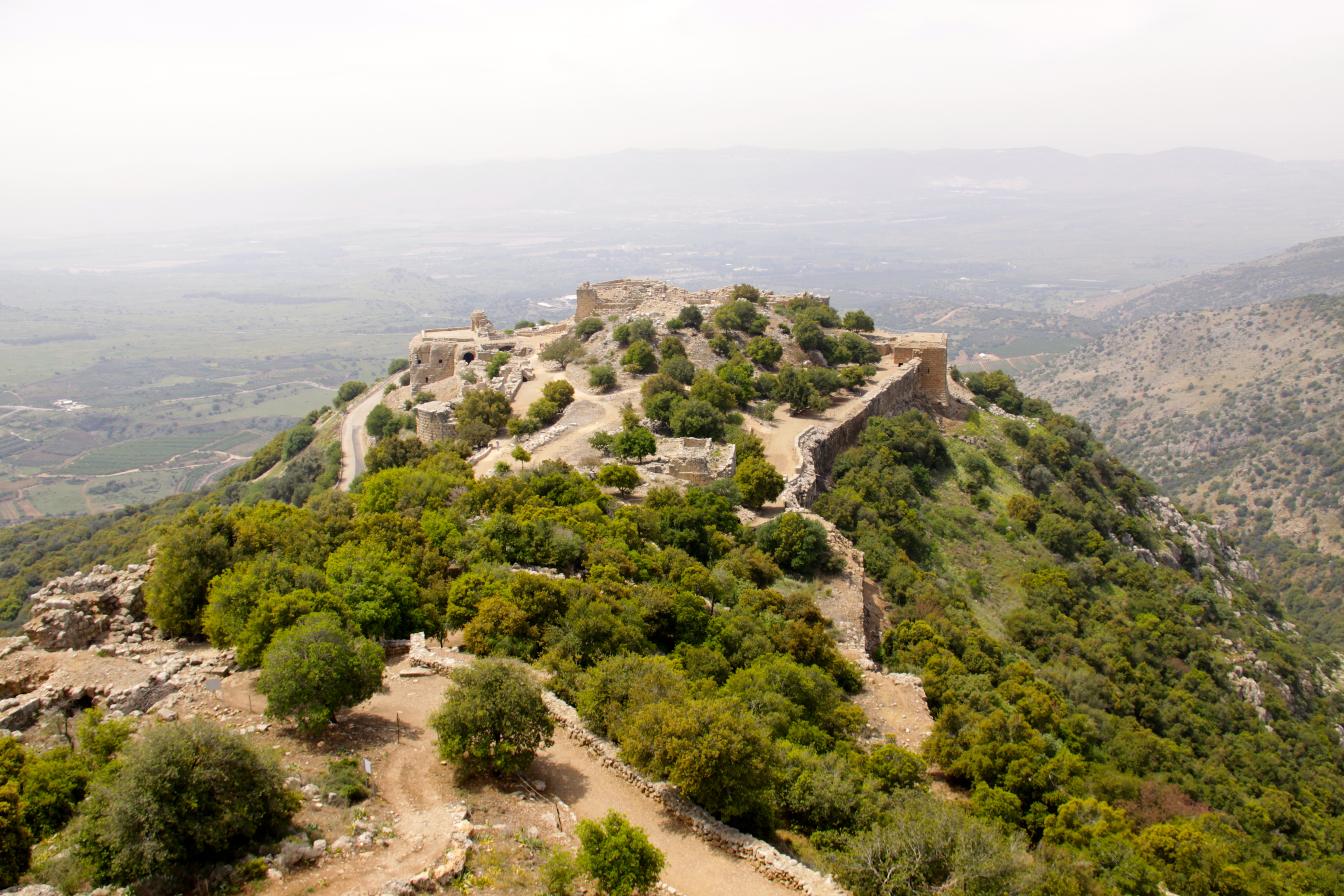
After some initial picnic-packing panic due to my forgetting cutlery (“We’ll have to scoop up the rice with Pringles!”), spoons were procured, and the day was off to a good start.  After a picturesque drive through verdant northern Israel, we arrived at Nimrod’s Fortress, looking very medieval indeed with its stone battlements crowning the mountaintop.


Fortress ahoy!

Fortress ahoy!

The fortress was built in the 13th century by the Mameluke Muslims.  According to legend, this is the place where Nimrod, great-grandson of Noah, was punished by God with a mosquito inside his head, which drove him mad.  Alternatively, and less interestingly, this might have been where Nimrod built a castle.  Anyway, suffice it to say that the fortress is really big and old, with various chambers and passages to explore–“a playground for adults,” as a friend put it.

The first thing I noticed was the tranquility.  Quietness is fairly impossible to find in the Haifa/Akka area–there is always the hum of traffic, barking dogs, distant voices, the occasional soccer match or lusty caterwaul.  But on this mountain, the predominant sound was birdsong.  I could almost feel my eardrums relax in the peace.

After a stroll along the length of the fortress, Sergey and I reached the keep.  The keep–the most defensible tower of the fortress–is also called the donjon, which is a much more entertaining name.  So, in a corner of the donjon, we found a steep staircase on the edge of the mountain.  (Don’t worry, there was a railing.)

“Do you want to go down there?”  I asked.  “It looks pretty steep.”

“Sure, but will you be ok?”

I took this as a challenge.

“Let’s be adventurous!”

After mincing my way down the crumbled steps, using Sergey as my banister, we reached a chamber.  After stooping inside, we saw the only way forward was to crawl through two low archways, which we did.  I was pretty proud of myself.  Let’s pretend “crawl through medieval fortress” was on my bucket list–accomplished!

Rare moment of physical activity.

Rare moment of physical activity.

My bucket list also includes not dying by tumbling off the side of a mountain in northern Israel, so when we saw that the stairs on the other side were even steeper and more deteriorated, we retreated.

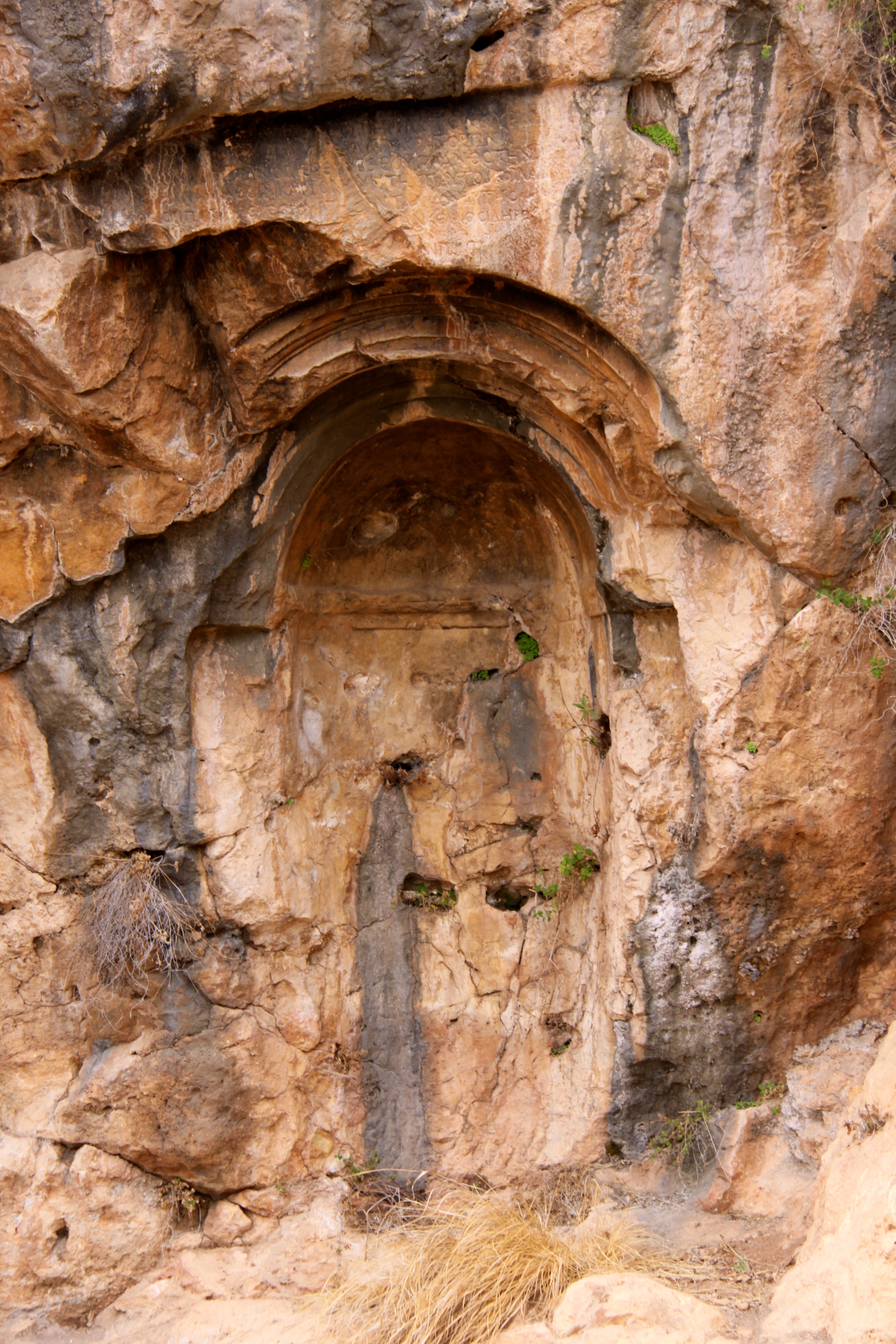
But our adventures were not over.  The next stop was Banias.  Sergey and I, hardy outdoorsmen that we are, were already exhausted by this leg of our journey.  While some in the group proposed a 1.5-hour hike, we sleepily wandered off toward the ruins of Paneas, an ancient Greek site of worship for the God Pan.  A wide grotto yawned in the reddish rock face; this was where sacrifices were tossed, apparently.  Niches in the rock indicated where statues had been.


Niche

Niche with Greek writing above

Now, to our credit, Sergey and I did attempt to do some hiking around the park.  We walked along a pretty stream adorned with foliage.  According to the pamphlet, we must have encountered the bur-reed, loosestrife, and common hemp agrimony.  To me, it sounds like some botanist was feeling buried in strife and acrimony.

About 15 minutes in, I threw in the towel.  To our delight, upon our surrender, we walked into a clearing where a Druze couple in traditional garb sold Arabic coffee and thin, crepe-like pita with zatar and lebaneh cheese.  It was a snack worthy of Pan.

Ok.  So I have endeavored to control myself for the duration of this post, making it somewhat edifying with historical tidbits gleaned from the brochures and Wikipedia, but what I really want to write about is hyraxes, which have since that fateful day entered my pantheon of adorable small creatures.  In fact, I think I need to devote a separate post to them–I’m just that enamored.