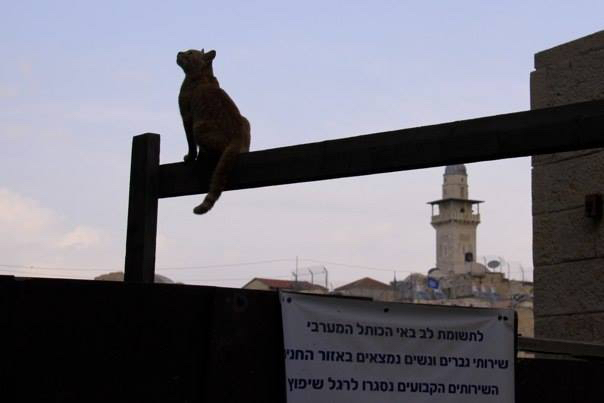
Cat near the Western Wall
Jerusalem. A city precious to the three major Abrahamic religions, and still a magnet for flocks of pilgrims and the occasional sherut-load of Bahá’í tourists.
Once again, I am straining to understand the explanations of Abboud, the sherut company owner/tour guide extraordinaire who is shuttling us around like a flock of ducklings. We are approaching Jerusalem on a highway that apparently featured in the Six-Day War in 1967. Several hollowed-out army trucks stand in the median strip as a memorial to those lost in the fighting.
The newer parts of Jerusalem look much like any other larger Israeli city, with sandy-colored buildings and wending roads. We stop to visit All Nations Church by the garden of Gethsemane. From here, on the Mount of Olives, we have a clear view of the walls around the Old City, the golden bulb of the Dome of the Rock peeking above, and the Valley of the Dead below. Abboud tells us that according to some tradition, the people buried in this valley will be resurrected half an hour early come Judgment Day, so spots go for $150,000 a pop. “I ask, ‘What can you do in that 30 minutes that you couldn’t do all your life?'” he quips. In Islam it is believed that on Judgment Day a bridge as thin as a hair will stretch between the Mount of Olives and the Dome of the Rock, and everyone will walk across. The unrighteous will fall to their deaths in the valley below. I’m probably too much of a literalist, but does this valley really look like it could fit all the unrighteous?
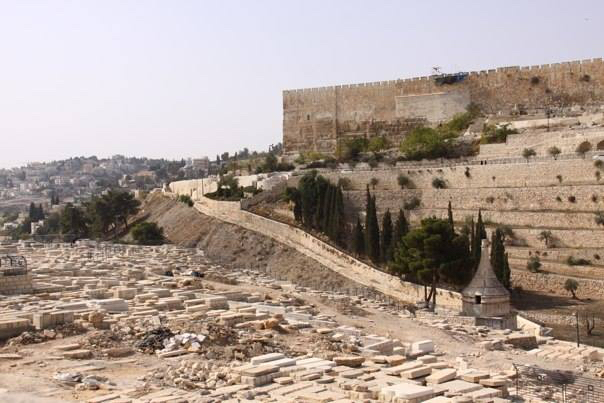
Valley of the Dead
We get into the Old City through a thriving marketplace in the Muslim quarter. Here is what I mean by thriving. At first, it is merely bustling, a mixture of tourists and residents going about their shopping, vendors hawking their wares in loud Arabic. But then we take a turn and the crowd grows thicker, until we are squeezed shoulder to shoulder, barely moving. I hang on to the person in front of me, wishing that we had one of those ropes preschoolers hold on to to when they walk outside to keep everyone together. This recalls riding the Metro at rush hour in Santiago, when there was always a distinct possibility that, unable to push through the packed bodies to the door quickly enough, I would miss my stop. Now barely moving turns to unmoving. Eventually the culprit behind the traffic jam appears, a young man pulling a cart loaded with what seems to be about ten giant boxes, three times his width, shouting hoarsely for people to get out of his way.
We saw the Dome of the Rock from a distance, because it is not open to non-Muslims. But we were able to see the holiest places for Jews and Christians, the Western Wall and the Church of the Holy Sepulcher, respectively.
To get to the heart of the Holy Sepulcher, we wove our way through a maze-like succession of chapels. Various sects have a (tense) agreement to share different bits of the church. After we had touched the spot believed to be where the Cross stood and gone down to the underground chamber where St. Helena discovered the buried Cross, we went upstairs to a different chamber with a short passageway, where Abboud invited us to look at some tombs. The first clump of our group clambered into the small space. I stayed outside and watched a priest we had encountered energetically waving his censer near the Armenian section reappear. Apparently this was also part of his scenting territory. He approached the little tomb grotto and nearly yelled at our group, “EXCUSE ME! What are you looking at?” Then he swung his censer around in front of the cavern, as if trying to smoke out some unwelcome moles. Soon he swept out of the room, leaving us baffled and smoky.
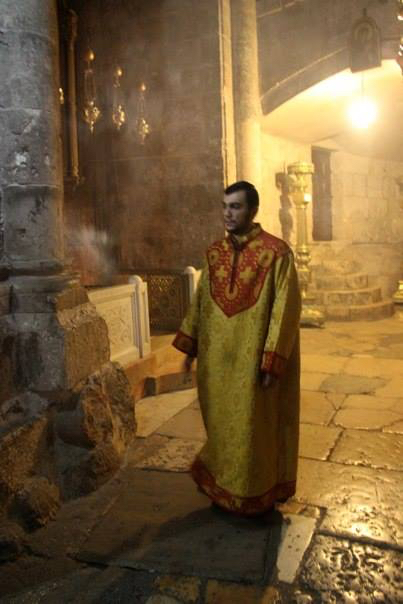
Guess he was incensed about something…
Now my turn came to go into the passage. This was the second time I whacked my head on a low overhang, so to be honest I couldn’t really gather what Abboud was saying, other than that there were four tombs around us, carved into the stone. Two were open and empty; two were closed. “Wait, so does that mean someone’s in there?” someone asked. “Yes,” he said, causing her to whimper. “Don’t worry, they don’t bite!” he said. I wonder what zombies from the years BC would be like…
In the end, it’s as much about the little things as the super famous sites. For instance, at lunch we were brought falafel fixings. Among the various dips was fool, a bland dip of mushy cold fava beans, which I would not recommend. “What is this?” someone asked. The server, a young teenage boy, responded monosyllabically, “Fool!” The inquirer heard “Food!” and burst into laughter. But even if he had heard right (fool!) it would still have been hilarious for us poor fools.
 Layli Maria Miron