Commuter

Warning: Not designed for twenty-somethings.

Warning: Not designed for twenty-somethings.

Once again, I have forgotten the cardinal rule of life without a car: gradual grocery shopping. I find myself expanded to twice my normal width, with my two reusable shopping bags (one of them features Big Bird’s grinning face) hanging off my shoulders, clutching a 32-pack of toilet paper.  I think it’s the toilet paper that convinces me I will never be a cool urbanite.  No one else on the bus which I’ve just waddled onto has so much toilet paper, or actually any at all.  Nor do the Israelis seem to bring a carryon bag stuffed with dirty laundry as I do every two weeks.

It is at times like this when I, the plodding commuter, feel like the most mundane creature in the world.

But then, as I shlep my laundry toward the machines, I look up and see the Seat of the Universal House of Justice, majestic white columns shooting upward, or I look ahead to see the dome of the Shrine, or I look across the bright blue bay toward Akko.  And it’s so dissonant: my mundane self, this holy place.

I think it’s time for some etymology.  You all know how I love my words.  Once an English major, always an English major.*

When it comes to describing the daily grind, mundane, pedestrian, and prosaic are close contenders.  “Mundane,” from the Latin mundus or world, in its astrological sense means of the earthly world rather than the heavenly one, more than applicable to my situation.  “Prosaic”–I usually dwell in a house of prose, infrequently one of poetry.  “Pedestrian” as an adjective evokes its noun counterpart, the unglamorous person in T-shirt, jeans, and sneakers waiting at the crosswalk.  And it’s fun to be a pedestrian pedestrian.  For the word-snobs among us, “quotidian” works as well, stemming from the same root as the Spanish cotidiana, meaning everyday.  Funny, all these terms are latinate.  A professor renowned as the strictest faculty member in the English Department taught me that English is a bifurcated language, pulling its vocabulary both from the sophisticated palate of Latin and from the earthy mouth of Germanic.   It would seem better to go Germanic to express the commonplace.

Even “commuter” finds its roots in Latin: com=together + mute=change.  Changing together.

Nice, isn’t it?  Six days a week, I change along with my fellow passengers.  Now that’s poetical.

*Thank your lucky stars that since graduating from Mount Holyoke I no longer have access to the Oxford English Dictionary online, or this post would be thrice as long.

Lost in translation

The world is governed by competing forces. There is the force of construction and there is the force of destruction. And then there is the force of confusion.

I. Constructive force

Annie is lying unconscious on the ground, and I’m supposed to revive her. First I call her name, then I squeeze her shoulders. No response. I unfasten her shirt and start chest compressions, counting to thirty. Then it is time for the breath. I pause from my frantic work to unwrap my mouth shield. Once secured over Annie’s inert features, I tilt her head back to extend her windpipe, hold her nostrils shut, and breathe. Nothing happens. Adjustments are made. I’m not squeezing the nose properly. I try again; still her lungs fail to fill with my air. I blow harder. Nope. I tilt her head back more, surprised at the flexibility of her vertebrae. Finally her chest rises, once, twice.

This is my first CPR training, and although both the dummies and the instructors are admirably patient with me, I can’t help but think that multiple redo’s would be less than desirable with a real victim. I picture myself pausing in the midst of a rescue to try to remember the mnemonic, DR CAB, or asking  Annie to just hang on, I’ll get the breaths right this time around.

Maybe someday I will be in a position to save someone’s life. I hope not.

2. Destructive force

Do you remember the gentle animal lover who has been making posts on this blog? She’s gone.

The transformation happened on the third day that, while standing shod in my flip-flops at the kitchen sink, I felt a tickle pass over my toe. Then another. Ants were once again exploring my feet, and they were also mapping the entire kitchen floor. Now, I have allowed all sorts of bugs to crawl on me. I remember one summer day, reclining on the swing in the backyard, I watched with fascination as a honeybee landed on my elevated foot and wove its body between my toes, perhaps assessing the crevices’ resemblance to a honeycomb. Then I went inside and wrote a poem about it. Spiders, roly-polys, gnats, ladybugs, lightning bugs, the rare butterfly–all have been my playmates. Darwin practiced entomology as a hobby, and I like to think that I do too.

Yet I find myself spraying some K1000 poison onto these ants, feeling little remorse. The ants are discomfited by the chemical shower, but generally scatter and survive. It’s the wrong kind of poison, of course, but the intention was there, and I will not be thwarted. I sweep, then I mop with a cleaning fluid that supposedly kills cockroaches. I am hoping it also works for ants.

That former animal lover is still here, don’t worry. I observe a pigeon outside the window and coo at it in the way Dianne showed me. It cocks its head. I coo again, then set some chunks of stale bread on the windowsill, an offering to the animal kingdom at large.

3. Confustive farce

Maybe I have that disorder Chuck Close has where he can’t recognize people’s faces. Except unlike him, I haven’t been making any brilliant art lately. I found out that I’ve been calling one coworker by the wrong name for a week now. I was calling him Jamal…perhaps he simply dismissed my mistake as a flattering nickname, as Jamal means beauty. In any case, he didn’t correct me. Yesterday I encountered an acquaintance on the staircase, smiled at him, and said, “Hey Jake.” Except it wasn’t Jake; it was a stranger who bemusedly smiled back. At least I’ve gotten assertive when it comes to my own name. No longer will I accept “Layla,” “Lali,” or other variations. My soft (mumbly) voice makes things difficult, though–upon first introduction, I become Haile or most recently Nelly, anglicized beyond repair.

Then, once introductions are past, there is the actual conversation. The wonderful diversity at the World Center means that English is spoken with every imaginable accent. In theory, I believe that responsibility for communication lies with both the (nonnative English) speaker and the (native English) listener. The latter needs to learn to recognize unfamiliar inflections and pronunciations and understand nonstandard constructions, just as the former learns the new language. In practice, I’m decent at understanding most accents, but add in a noisy background or multiple speakers, and I become an echo: What? Sorry, what? What?

It’s lunchtime, and this guy is telling me about some upcoming plans to go to the American consulate. I’m not entirely sure what happens at a consulate…maybe passports? Consuling? I ask him why he’s going, but don’t understand his answer. “So, where is the consulate?” “It’s in Tel Aviv,” he says. Eventually I discover that he’s going to “a metal concert,” where I’m sure he’ll get his passport issue worked out.

Even my friend the written word poses problems. As I’ve mentioned before, I’m surrounded by two alphabets I can’t read, Hebrew and Farsi. So I joined a Farsi class as a latecomer. I studied a few letters on my own beforehand. After the other students had settled in, I realized they spoke at least basic Farsi. It would seem the teacher took me as a charity case into a class intended to teach Farsi speakers how to write. As I struggled to sound out words, my head felt a little cold, like it wanted a dunce cap. I needed to remind myself that it had been many years since I had last learned a new alphabet (the English one), and that was back when my brain was young and agile. So please, if you say anything in Farsi, don’t be surprised when I respond invariably with “Esme man Layli ast” (My name is Layli).

Coming in for landing

The view from my room on the thirteenth floor. Good thing I don't have triskaidekaphobia.

The view from my room on the thirteenth floor. Good thing I don’t have triskaidekaphobia.

It’s been five days since my plane touched down in Israel and I arrived in the hilly peninsula that is Haifa. Since then, it’s been a flurry of visits to the shrines of Bahá’u’lláh and the Báb, special devotions and a Holy Day commemoration, and so many new names to learn. While I’m not immersed enough in Israeli culture to experience culture shock–indeed, the majority of people I’ve met are from North America–there are a few things that will take some getting used to.

1. The heat Haifa is sultry, and not in the attractive way. The highs don’t look terrible–mid-eighties so far–but combined with intense sun and humidity, the climate has me gulping water like a very sweaty fish. Thankfully there’s usually a breeze, and while my apartment doesn’t have central air, fans keep me less than feverish. Apparently August is worse. If I stop posting next month, you’ll know that I’ve found a nice corner with air conditioning where I’m estivating (summer hibernation!) until the city cools down. Lest I sound too whiny, I should say that the warmth stimulates vibrant flowers and fruit, like the oblong berry with milky, super sticky juice that an acquaintance picked off a bush and handed to me. “What is this?” I asked. “No idea,” she said, “but it tastes good.”

2. The language An English speaker can get by in Israel without learning Hebrew–street signs are translated, numbers are in Arabic numerals, and most people know some English. But when it comes to decoding a bread package, an advertisement, or a map that doesn’t cater to tourists, I’m confronted with an entirely unknown alphabet. I’m hoping to learn some conversational Hebrew beyond “Shalom” (hello) and “Toda rabah” (thank you).

3. So many Bahá’ís! They’re everywhere! Perhaps this should be obvious, but hey, I’m coming from a college community of five. (In reality, we comprise less than 0.003% of Haifa’s population.)

4. The wildlife Lizards and stray cats are the squirrels and chipmunks of Israel. I keep seeing lizards sunning themselves on the grounds of the Arc (the Bahá’í buildings on Mount Carmel) and at Bahji in Akka, and I’ve so far done a good job of restraining my instinct of giving chase to examine them, wannabe herpetologist that I am. We’ll see how long I can hold out before coming home with a new pet.

Affectionate guy

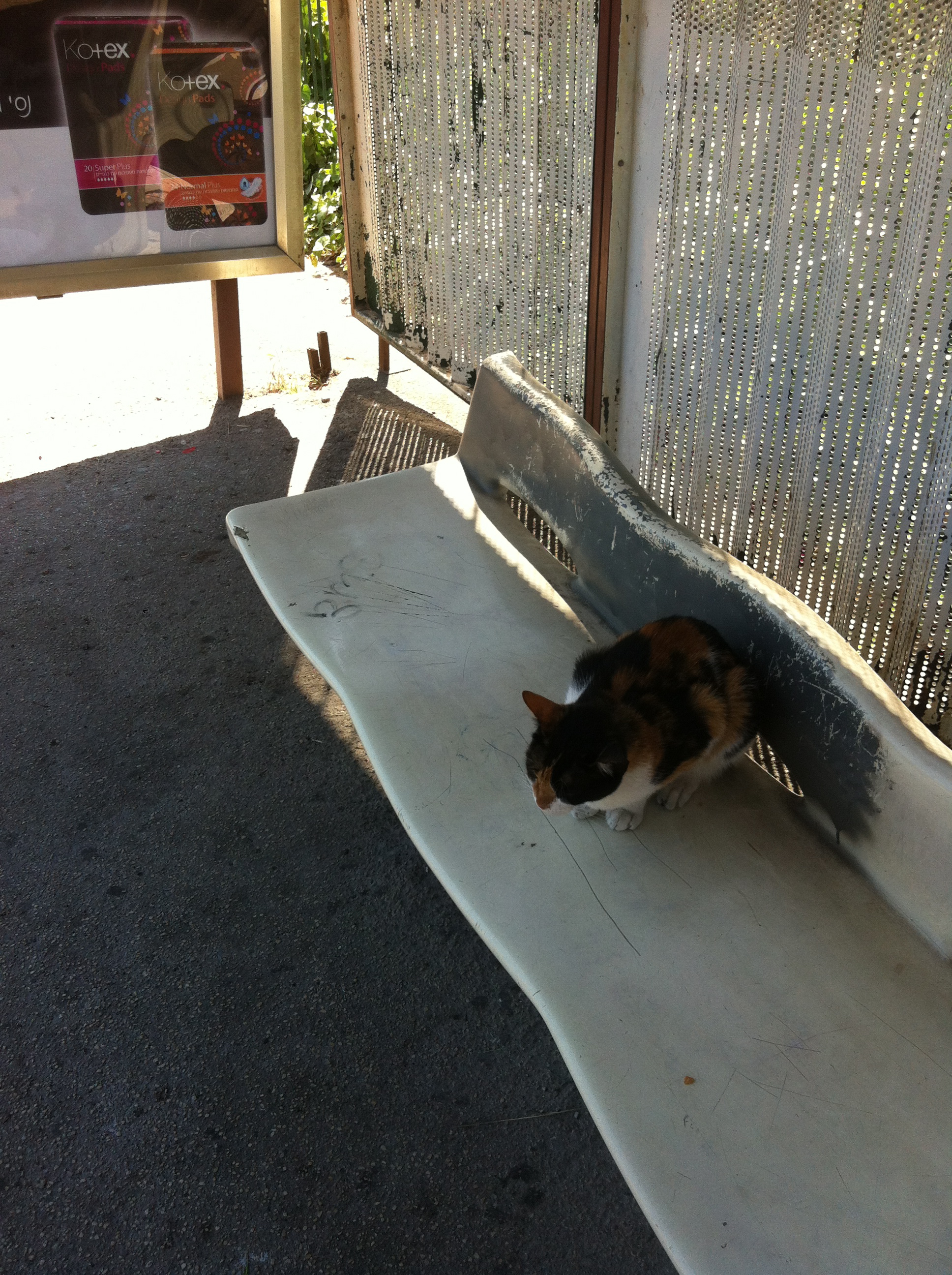
As for the cats, on my first day I went to the bus stop, where a cat with bright green eyes was waiting, I think for line 36. He was sitting on the bench and I joined him. He immediately avowed his affections for me by climbing into my lap. Envisioning tiny fleas hopping onto me, I stood up, and he jumped down only to wend between my ankles. But surely the most remarkable stray story thus far happened at Haifa Zoo. I was familiar with this zoo from a lecture by Israeli zoologist Avinoam Lourie, but while I knew the story of its fallow deer population, I did not know about its otter-kitten relations. Picture this: four sleek otters, chirping at the zookeeper as he dumps in their lunch of fish; two scrawny kittens in the exhibit, peeking out from behind some rocks. Tentatively, the kittens approached the fish. The otters and kittens seemed equally afraid of each other, and when the otters backed off a bit, the kittens began to snatch fish, scurry back to their hideout, then return for more. Who knows, maybe the otters will embrace the kittens as their own and become a feature on an “unlikely animal friends” documentary.

IMG_1143

5. Late-onset adulthood For the first time, I have to think seriously about budgeting, and cook not just for fun but so that I can eat. Life in Haifa is pricey. For example, a falafel sandwich–the “cheap” food of choice–costs around US$10. As far as cooking goes, using a gas stove is proving tricky. Given my absent-mindedness, I have serious concerns about accidentally leaving the gas on and suffocating my flatmates. While the electric stoves I’m used to have clear numbers marking the heat of each burner, here there are only cryptic drop symbols. Before I try to bake anything, I’ll have to convert temperatures from fahrenheit to celsius to the numbers on the setting dial. Needless to say, it might be a while before I make an unscorched batch of cookies. At least I’m used to cleaning my own space…although my attempt to use the vacuum cleaner, a “Vampyr” model that lacks both fangs and decent suction, required a lengthy struggle just to find the power cord. (It retracts  into the body of the beast.)