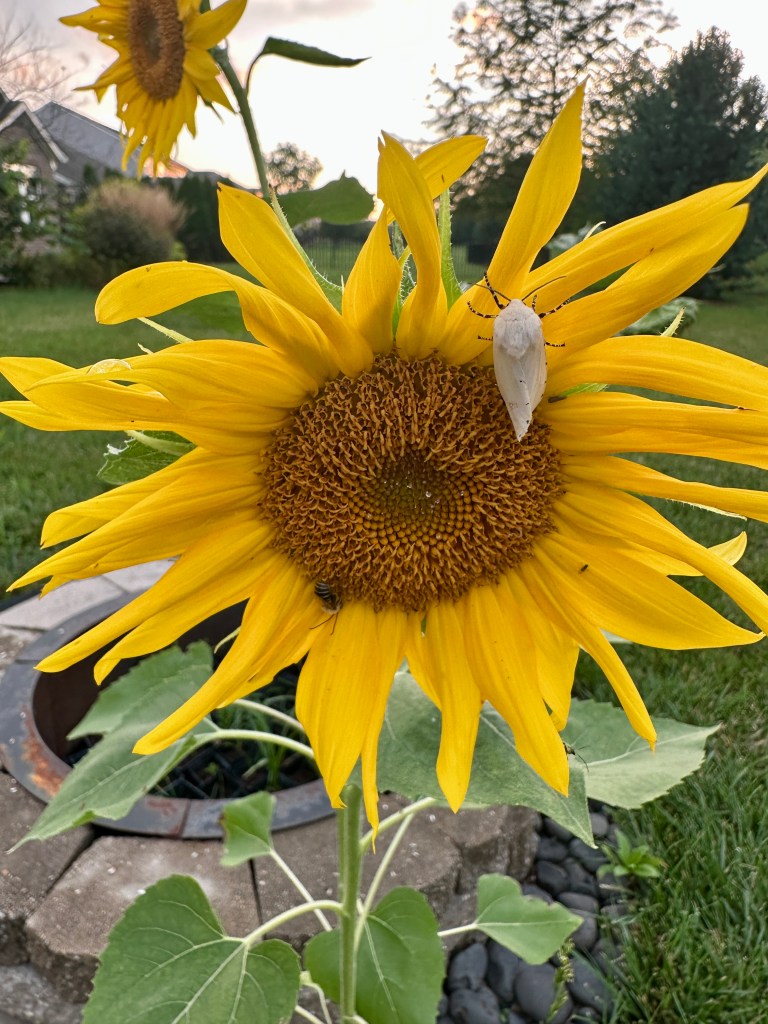
Salt marsh moth caterpillar feeding on mistflowerSalt marsh moth resting on sunflower
October. It’s been a couple weeks since I’ve seen my summertime favorites, hummingbirds and monarchs, which have no doubt departed on their southward migrations.
Looking back on the warmer months, watching caterpillars enjoy my plantings was a highlight—with one exception.
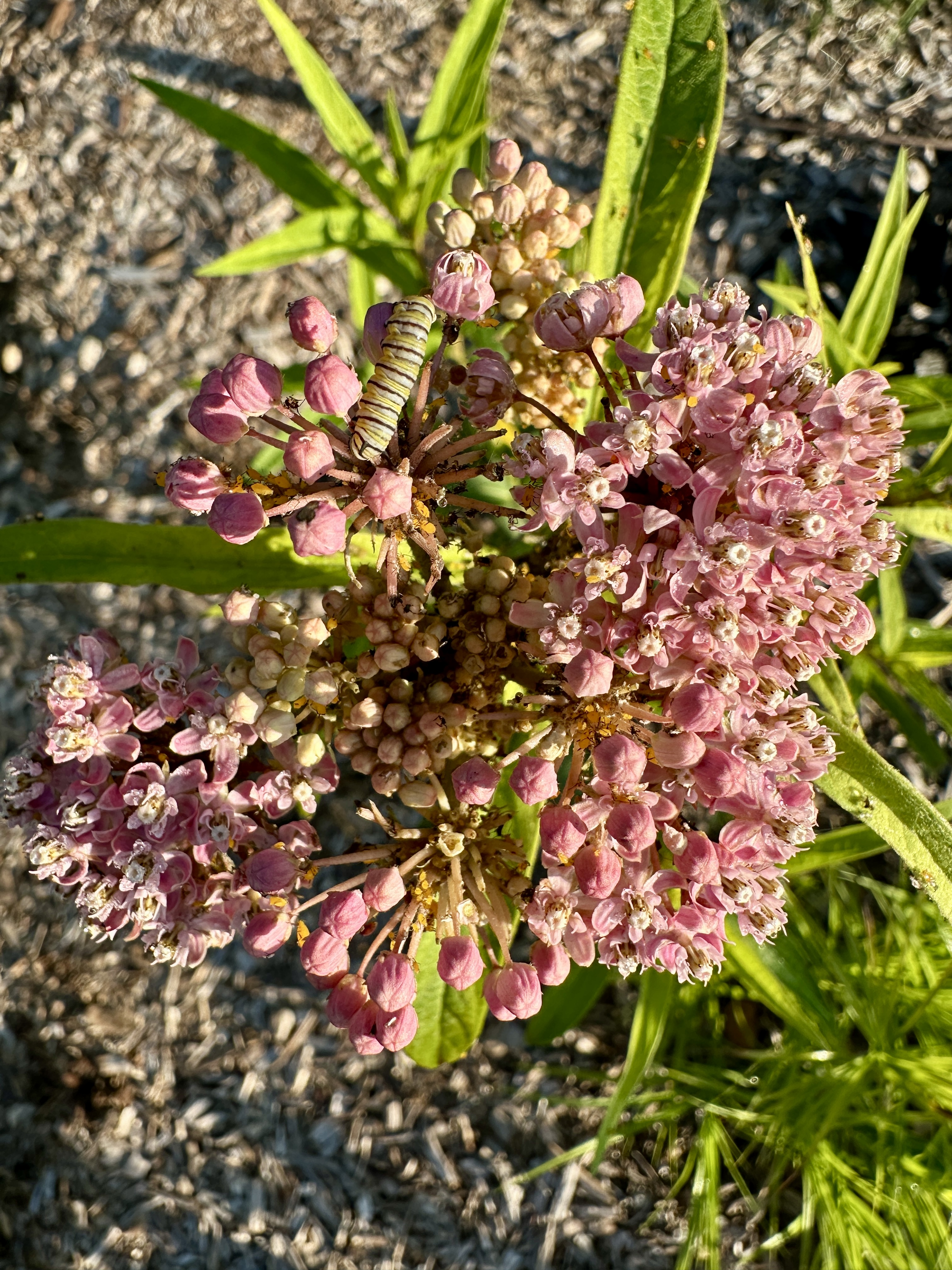
A tiny monarch caterpillar rests on milkweed flowers, seen in our yard earlier this month.
In Alabama, where at least a hundred trees inhabited our lot, one of my favorite activities was lying on the porch swing, gazing up at the leaves as they danced in the breeze. Once, a Caroline wren landed on me as I lounged, perhaps mistaking the motionless tree-gazer for a log.
It’s taken some getting used to our yard in suburban Indianapolis, where lawn predominates.
To be fair, it’s not entirely treeless: three cherry trees were presumably planted about a decade ago when the house was built. Besides the cherries, the landscaping included clematis, daisies, daylilies, daffodils, hydrangeas, hostas, and weigela. Each of these ornamentals is an exotic, generally with origins in Eurasia, so, while beautiful, they don’t do much for the ecosystem.
Of course, the majority of the quarter-acre lot is covered by lawn, which was a pristine, sterile monoculture when we arrived, thanks to the prior owner’s fastidious attentions. We heard they killed voles to keep the grass safe.
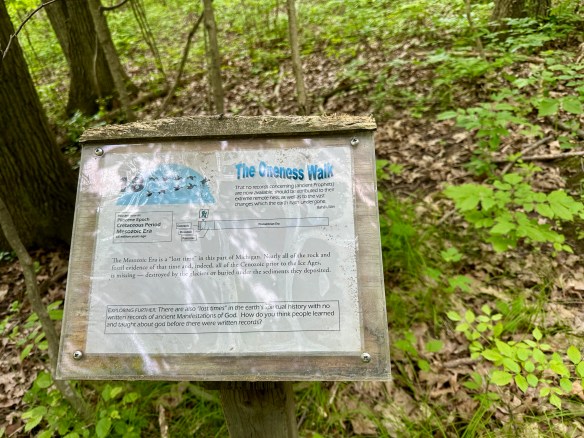
Walking in the woods, I see a field of pink phlox. A giant swallowtail butterfly pumps her wings beside a stream. As I swat mosquitos, signs along the path encourage me to consider this landscape in geological time, its current form molded by the glacier sheet that retreated some 12,000 years ago.
Time to contemplate time: 12,000 years, a moment to our 4.5-billion-year-old planet, yet an unfathomable ocean compared to my few droplets of decades.
April brings not only the loon on the retention pond, but the ephemeral woodland wildflowers in the Indiana parks. These flowers emerge before the trees have leafed out, and mostly disappear by summer, dormant until the following spring.
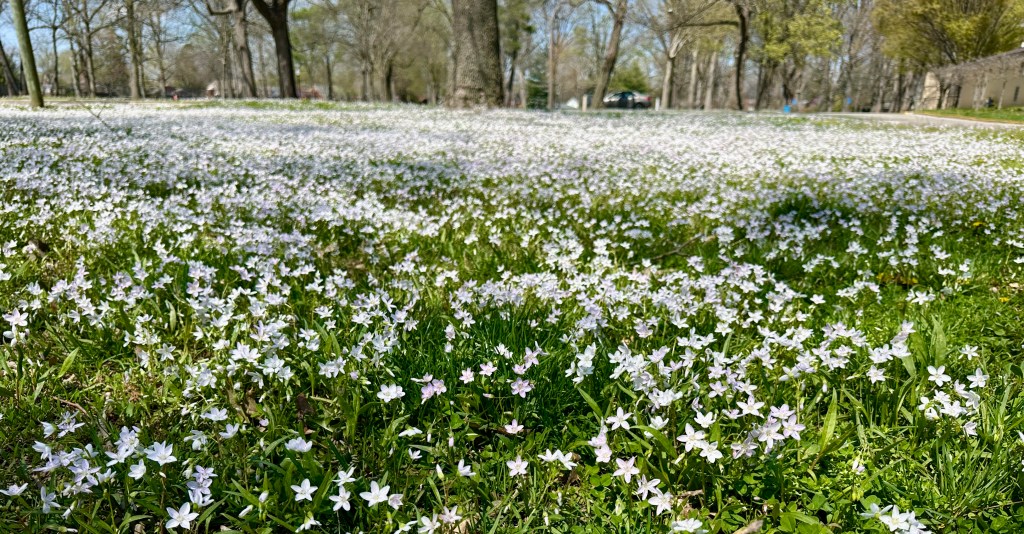
In my Alabama garden, I had planted one tiny ephemeral, Virginia spring beauty, admiring the pink pollen and stripes adorning the minute blooms. And then this spring I happened upon a field of thousands of spring beauties. Wandering through Columbus, Indiana, Sergey and I came upon a handsome park with mature trees towering over a lawn. Within the lawn grew endless spring beauties and violets.
Dogwood blossoms kiss wafting clouds. The sun now is strong enough to burn me after winter has left me pallid. April is a month of special wonder.
A dogwood blooms in Bloomington, Indiana.
En route to the zoo, I saw on a retention pond surrounded by duplexes a bird at once familiar and unfamiliar. I asked Sergey and Jasmine, did they think it was a loon? They thought it was more likely a duck because why would a loon, denizen of wild lakes and singer of an eerie song, have chosen this spot surrounded by Indianapolis’s web of highways to rest?
But Jasmine offered to turn the car around so we could investigate the bird. We parked, she grabbed her binoculars wisely stowed in the car for just such moments, and we carried my nephew.
The sky is weeping convulsively over the central states as I write, and the weeping cherry in the backyard is blooming. Actually, only the tree’s skirt of drooping branches blooms. Perhaps because of a grafting issue, it also grows a crown of upward branches, which bear only leaf buds, making the tree appear half dressed.
In Sea-Tac Airport, hectic and congested, one gate opens a serene vision. Rising 33 feet across vast windows, “I Was Dreaming of Spirit Animals” introduced me to the folkloric glass painting of Cappy Thompson. I happened upon another of her installations, “Stars Falling on Alabama,” at the Montgomery Museum of Fine Arts. And our most recent visit to the Seattle area brought me to the Museum of Glass, where I encountered her “Gathering the Light.” These bejeweled stories make me wish I could step inside.
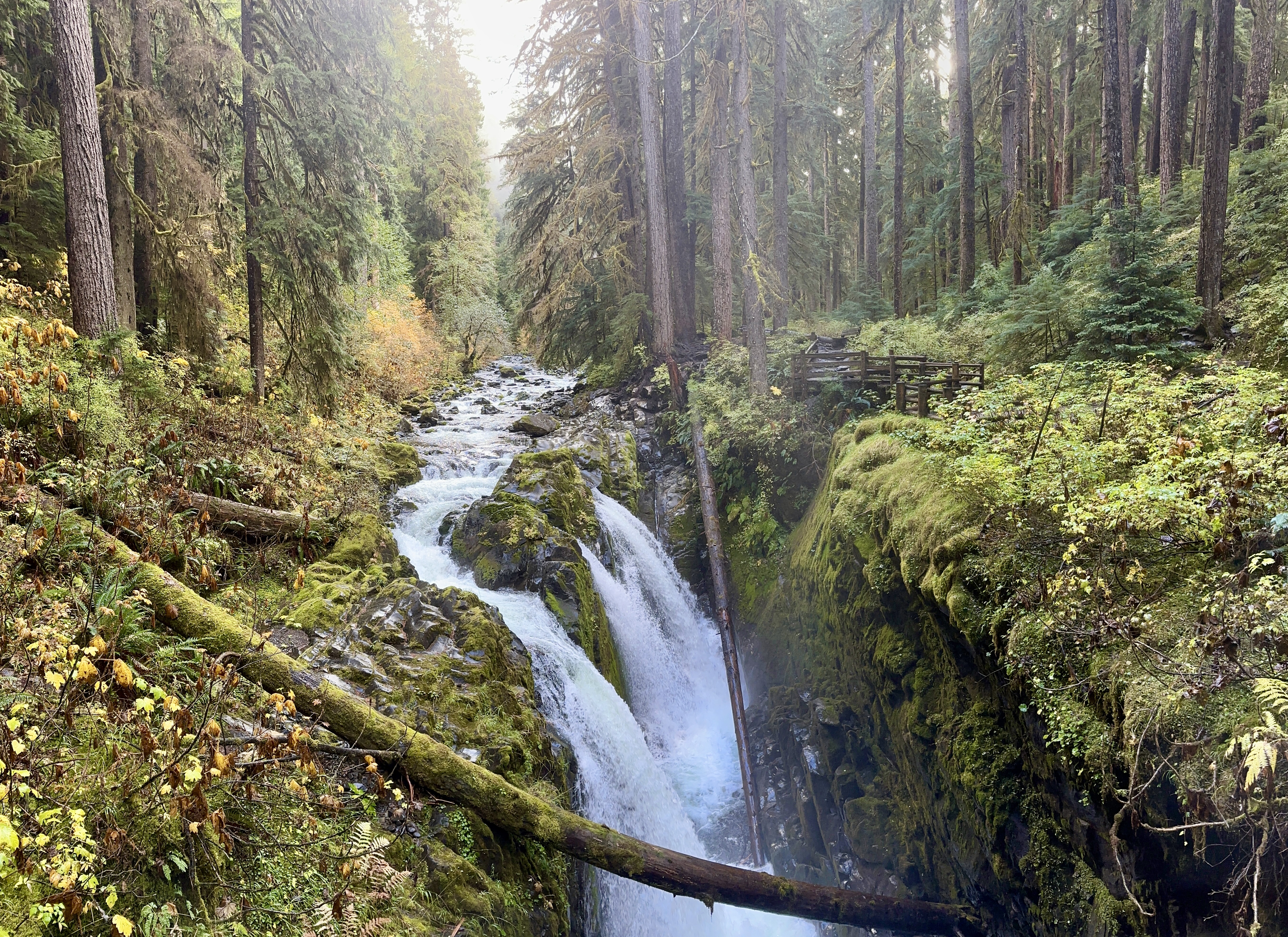
In the Pacific Northwest, sojourners can step inside kingdoms of mossy forests and majestic mountains. A delicate balance kept these systems thriving for millennia. Salmon, for instance, feed other animals, people, and even trees with the nitrogen they bring inland from the ocean. The fish’s remains nourish not only predators and scavengers, but the roots of ancient plants.
In the last dream I had before the alarm woke me, I had been walking under the tall trees in our yard, observing the plants and wildlife. Suddenly, I realized I was trespassing. This land had new owners.
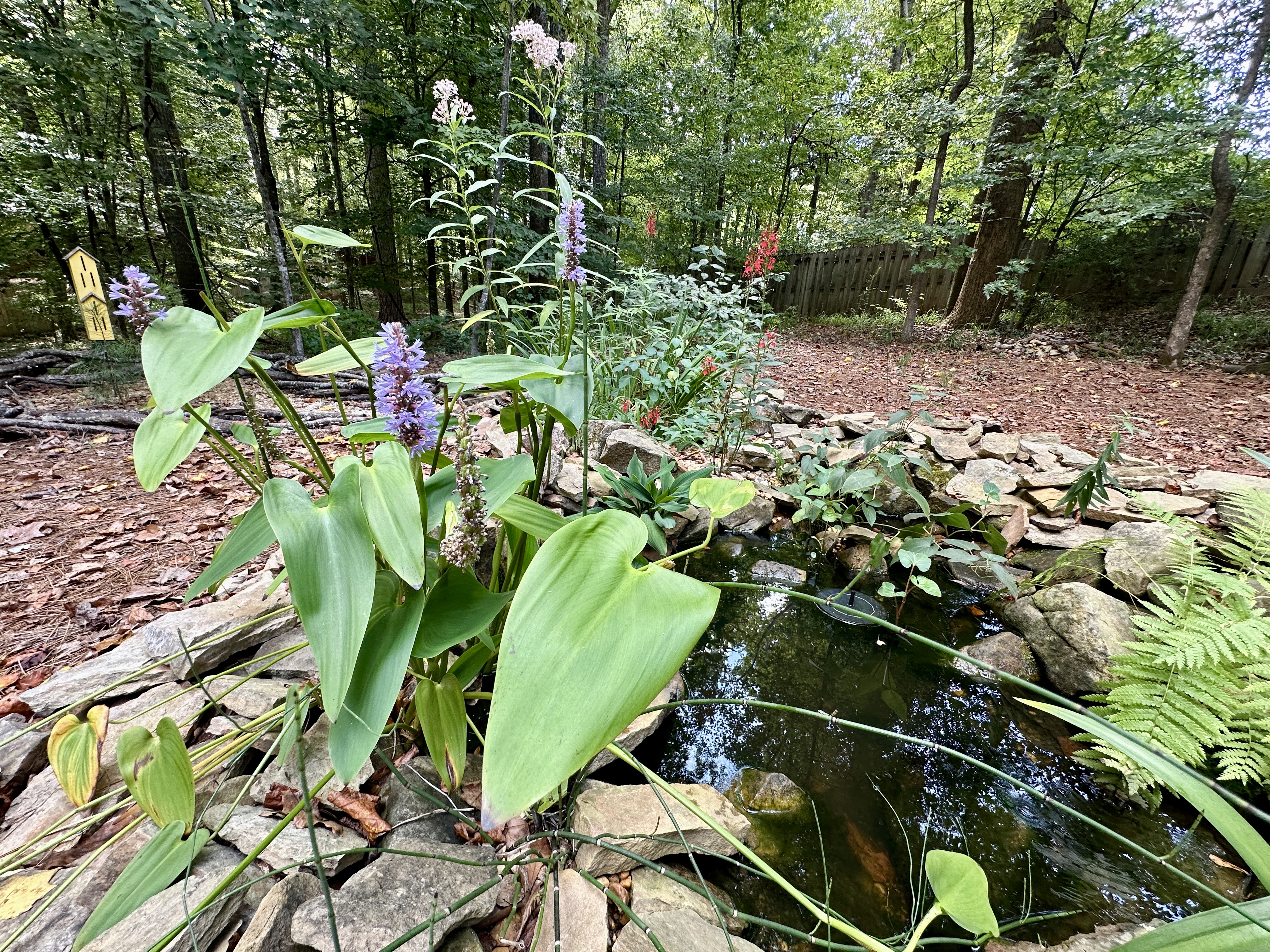
The water garden on our last day with it. Pickerelweed, milkweed, and cardinal flower were all in bloom.Continue reading →
A year ago, I enjoyed witnessing two of the tadpoles I’d been given develop into froglets and then big, beautiful frogs. Come winter, evidently, they managed to hibernate at the bottom of the pond, surviving even when a January cold snap coated the surface with an inch of ice.
By this spring, we’d had a year and a half together—me watching intently and hoping for their wellbeing, them tolerating my presence. I was intrigued when, one day, I noticed the two frogs wrestling. Shortly thereafter, while I sat on the porch in a rainstorm, I saw one of them hop away from the pond and across the yard—and that was that. Not so much as a parting ribbit.
Last year, I heard a birdsong that astounded me with its melody. The Merlin app’s Sound ID told me it was a wood thrush, describing the call as haunting and flute-like. This spring, I was thrilled to hear the trill again: the wood thrush had made it back from his wintering grounds in Central America. I’ve never laid eyes on this bird since he stays in the most forested parts of the neighborhood, heightening the mystery of his wordless ballad.
Southern blue flag iris rises above a Dixie wood fern in our tiny rain garden.Continue reading →