Middle-Marching: Lessons on Compassion

Driving to and from Bloomington, where I go to my office at Indiana University three days a week, the interstate unfurls and my mind can travel along with my body. 

I see the land grow hilly and wooded as I go south. From my start date in September to December, I watch autumn advance. Days shorten: I set out before dawn and return around sundown. Leaves inflame, then drop. I like the morning drives best when mist pools in the dells of cornfields.

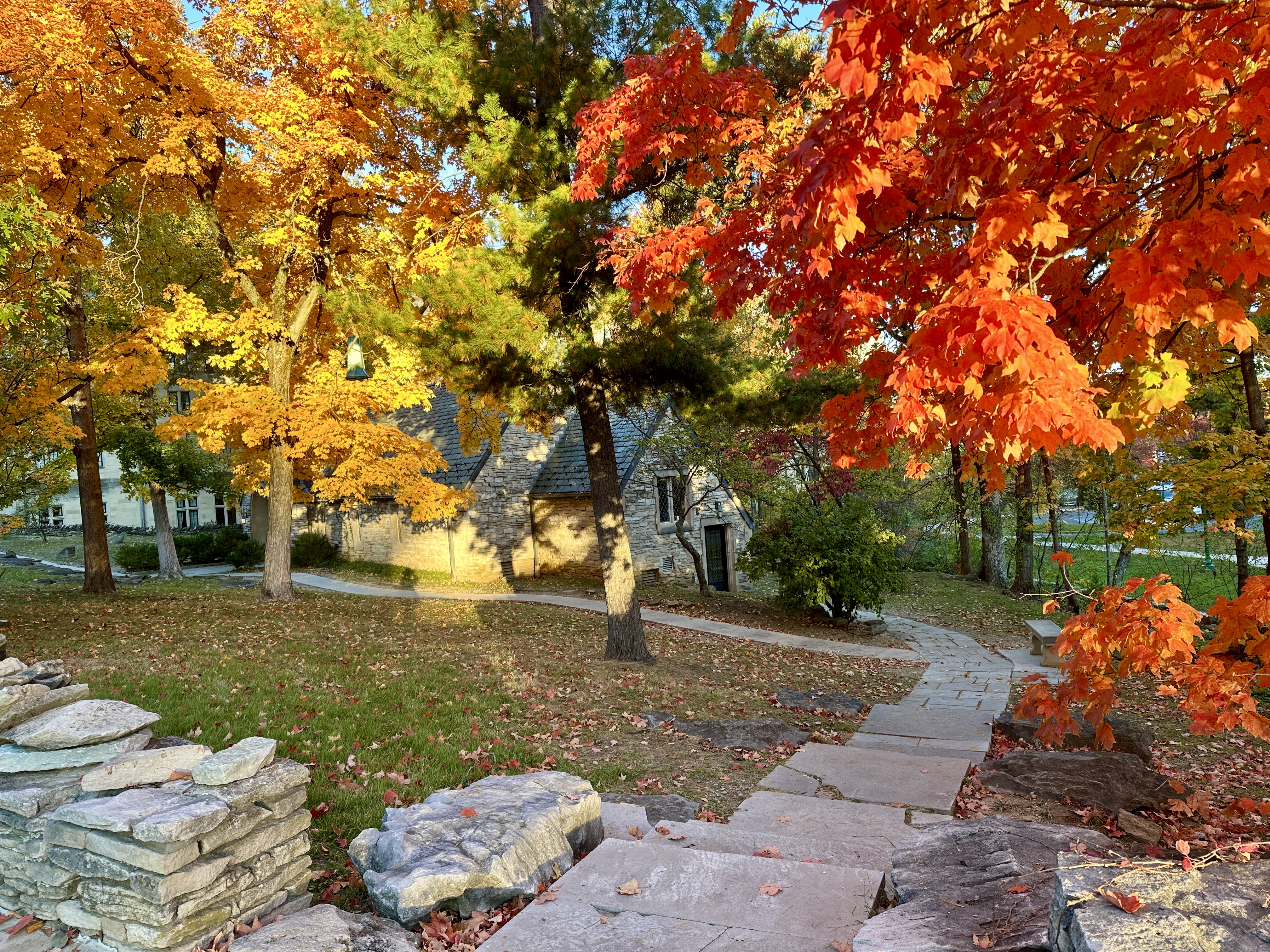
A limestone chapel peeks out from behind autumn foliage.
Beck Chapel at Indiana University Bloomington
Continue reading

Sluggish ekphrasis

Recently, Sergey and I visited the Tikotin Museum, which is quite possibly the only Japanese art museum in Israel. We were practically the only visitors and enjoyed having the place to ourselves, from Zen ink paintings to netsuke to imaginative woodblock prints.

Speaking of Zen ink painting, the concept is to not plan out the painting–to let it come naturally, to accomplish it with just a few quick strokes of the brush. In high school painting class, we were supposed to make this kind of painting. Just a brush, ink, and a single paper board–no sketching. I recall I was dissatisfied with my first painting of birds lined up on a branch and did a second one as well, defeating the Zen point. Oh well.

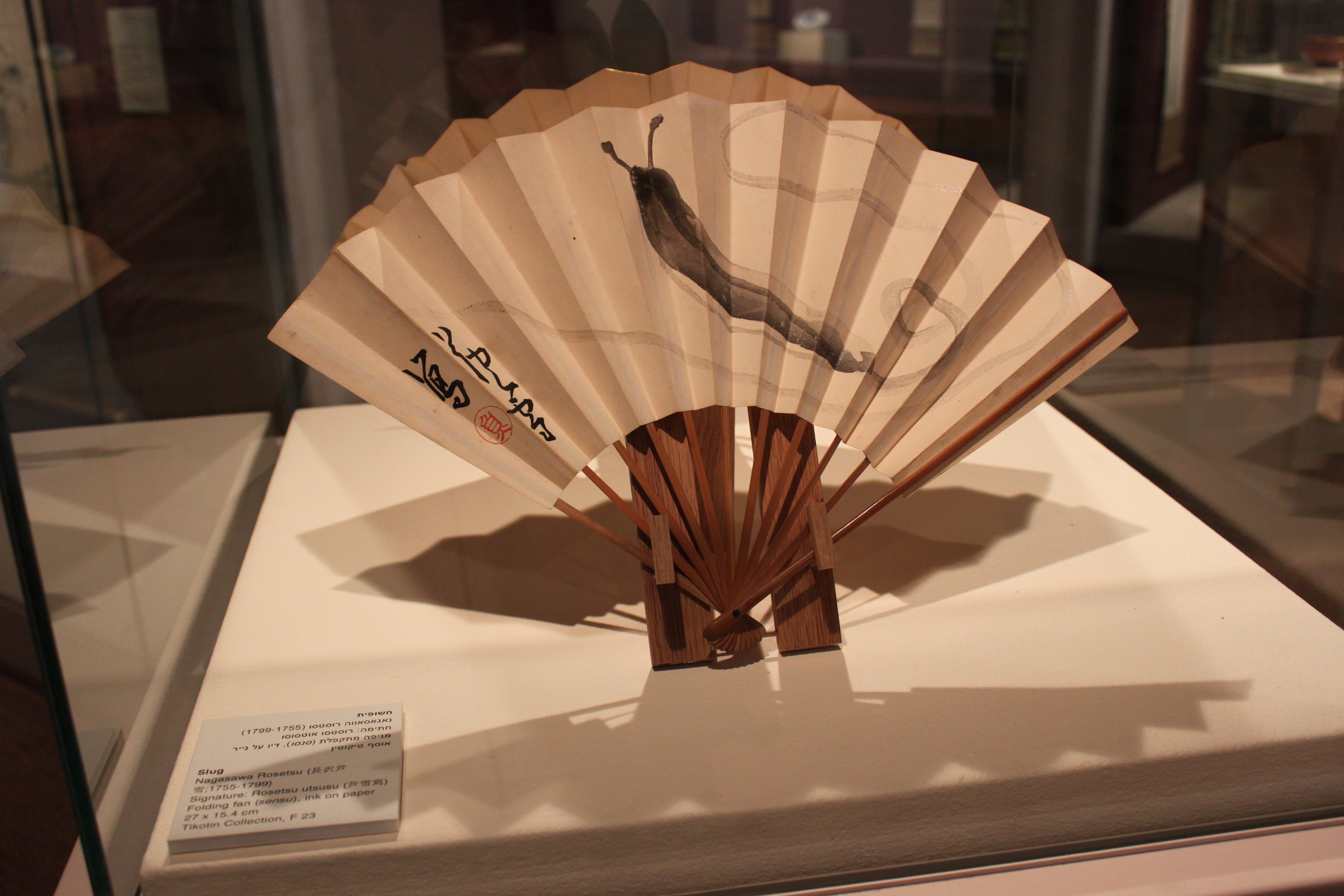
In any event, the Zen paintings at the museum ranged from scribbles and blobs to fully formed scenes involved cheerful little gods and skinny monks. But one struck my fancy (hehe, fancy) in particular, and it inspired the following ekphrastic poem.

Slug fan


A gray slug pulls its sticky trail

across the undulating folds:

an ink painting on paper fan.


What fingers waved this fan?


Did a courtesan twirl it

to cool her swan neck,

painted white to the nape?


Or a Zen monk under the red sun

oxygenating his contemplation

of the non-essence (the nonsense)

that flows through the universe?


Or a ruddy, readied warrior

bristling with weapons like a sea urchin

prepared to impale whatever soggy ghosts

emerge from the lace-winged waves?


Or a virtuous woman

idling upon her coastal balcony

and swatting the mosquitoes from the air

as she waits patiently for her warrior to return?


What floating world

was stirred by the delicate indelicacy

of a slug-painted fan?

Day 6: A palace and a dervish

A few days after leaving Turkey, I had a dream that I was wandering in a vast palace covered with Iznik tiles. I think this was the result of our tour of the Harem of the Topkapi Palace and Tiled Pavilion of the Archaeological Museum, both of which demonstrated an artistic obsession with these intricately painted tiles.
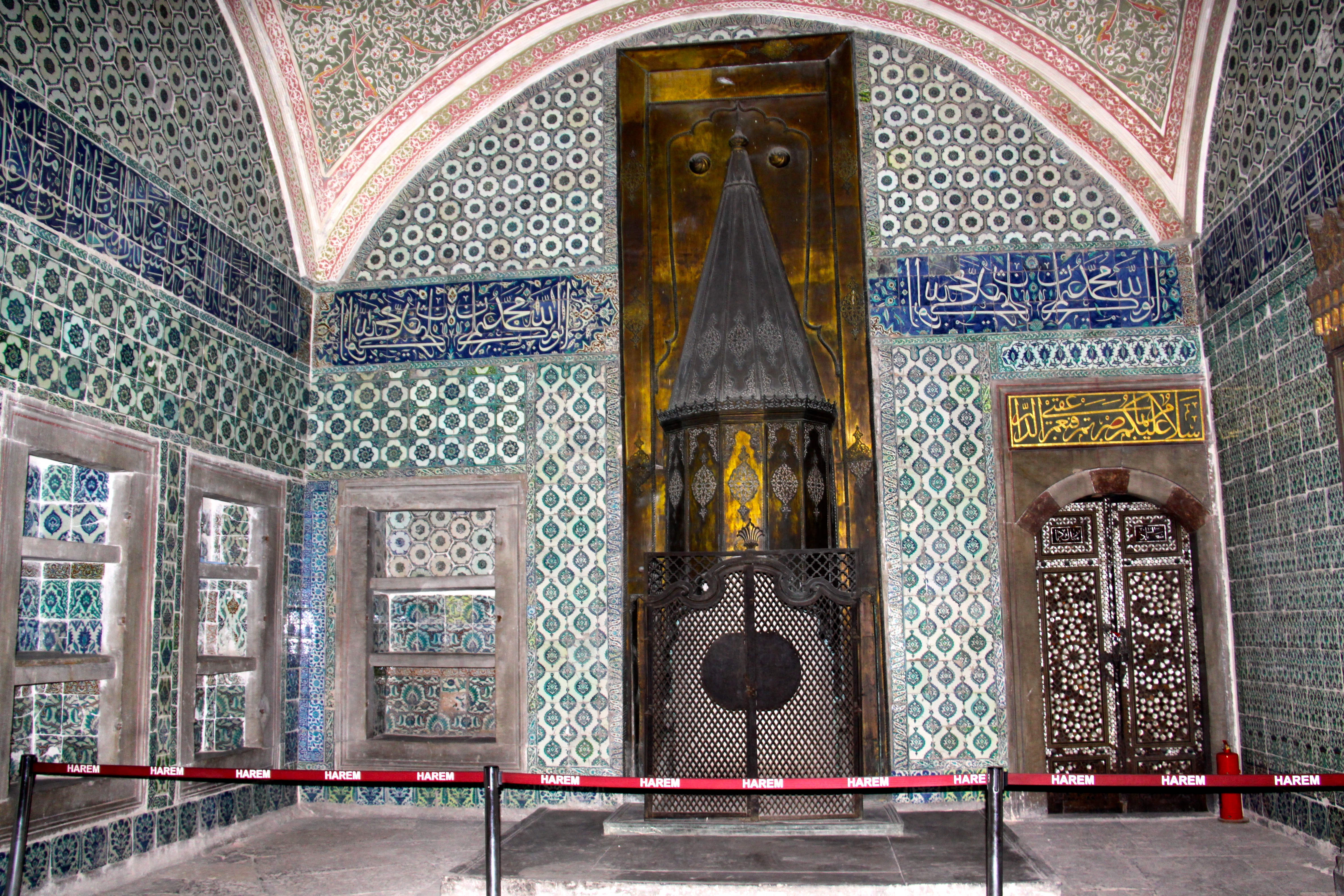
Tiled walls in the Sultan's room

Tiled walls featuring calligraphy surround an ornate fireplace in the Harem.

The day had already turned gray and rainy by the time we got to the palace grounds. The palace is not a single building, but rather a giant complex of buildings around four courtyards. Every sultan made his addition to the complex as new needs arose. At one point 10,000 people lived and worked in the compound, so I suppose the crush of tourists actually helped us imagine how busy this place was when it functioned.

We started with the Harem, the section of the complex where the sultan’s wives and mother lived along with the eunuchs and concubines who tended to the women. Contrary to Western notions, the harem was primarily an administrative establishment, carefully designed to ensure there would be no squabbles over succession because of heirless sultans.

The Harem is the most decorated part of the palace, with many of those Iznik tiles coating chamber after chamber. After touring that part, we began our grueling expedition through sopping courtyards to see the treasury (lots of shiny jewels), the kitchen (unfortunately foodless today), and the armory. In the armory, I found myself suddenly intrigued by a thin sword on display and desperately needing to examine it up close for several minutes, which I assure you was not at all because there was a heat vent below the vitrine. We were amused to find the weapons arranged under signs such as Stabbing, Slicing, Smashing, etc. There were a fair share of funny elements to the palace besides the weapons: the sultan’s throne in his reception chamber appeared big enough to fit ten men side-by-side, the council chamber where the ministers consulted had a window grille above it through which the sultan could listen like a literal eavesdropper, and his mom’s room was located strategically between his room and the rest of the harem. Ah, the tough life of a sultan!
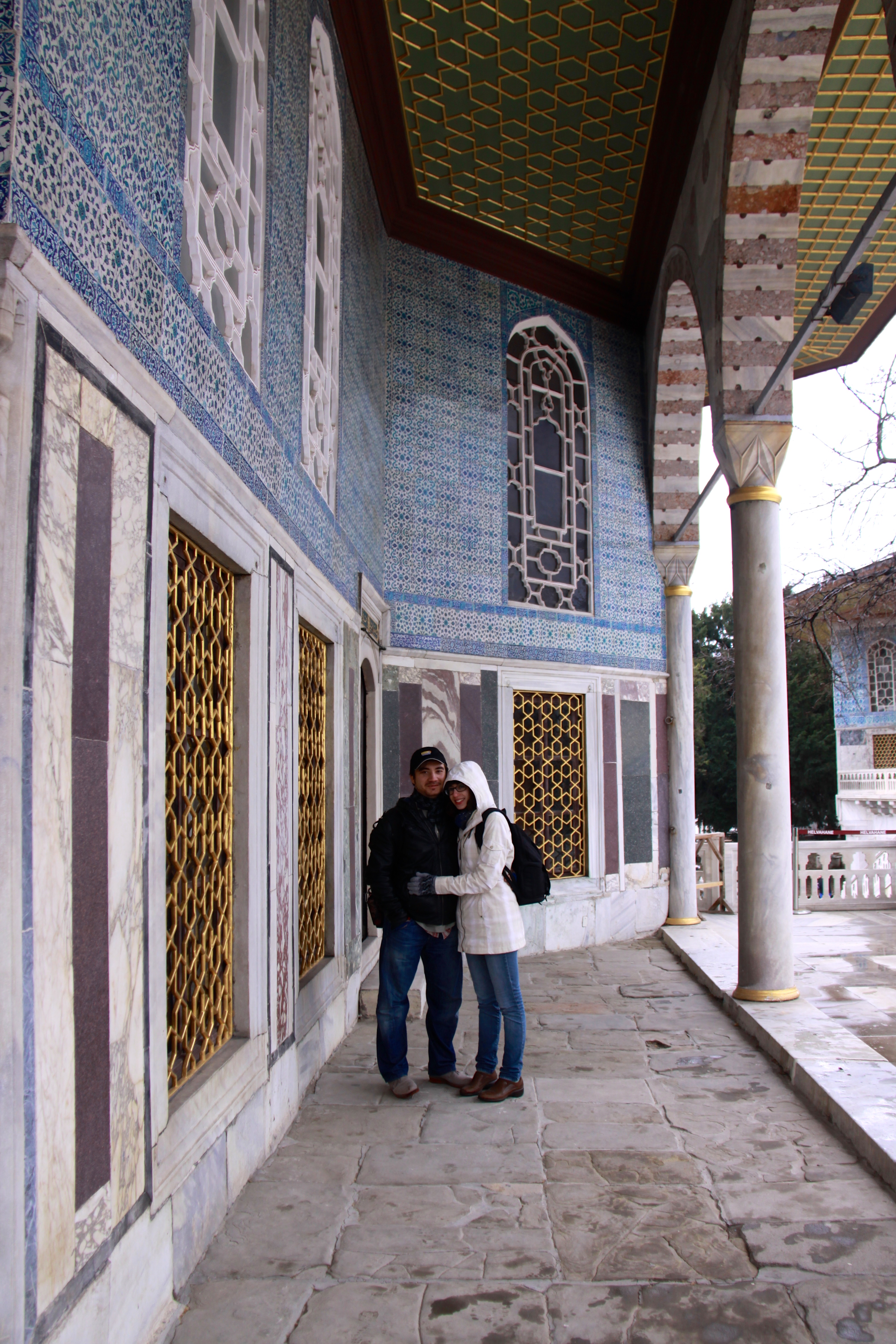
"So...cold..."

“So…cold…”

Hungry and wet from the drizzle, we proceeded to our next stop, the archaeological museum, which is actually a set of three museums. The visit started on a happy note when we found coffee that didn’t cost $10 a cup, approximately the palace price. Now, the café where we lunched had a decent selection with entrees, salads, and sandwiches—but once we had decided on our picks, stomachs growling, we were informed that out of the 20 choices on the menu, they actually only had dolma and pistachio cake in stock.

I guess this was a preview of the rest of the museum, which was under—you guessed it—restoration, and the starring items, such as the famed Alexander Sarcophagus, were off display. A bit perturbed, we made the most of the remaining sarcophagi and their occasionally belligerent inscriptions (e.g. “If any man disturbs this tomb, let him be smashed and his whole family crushed”).
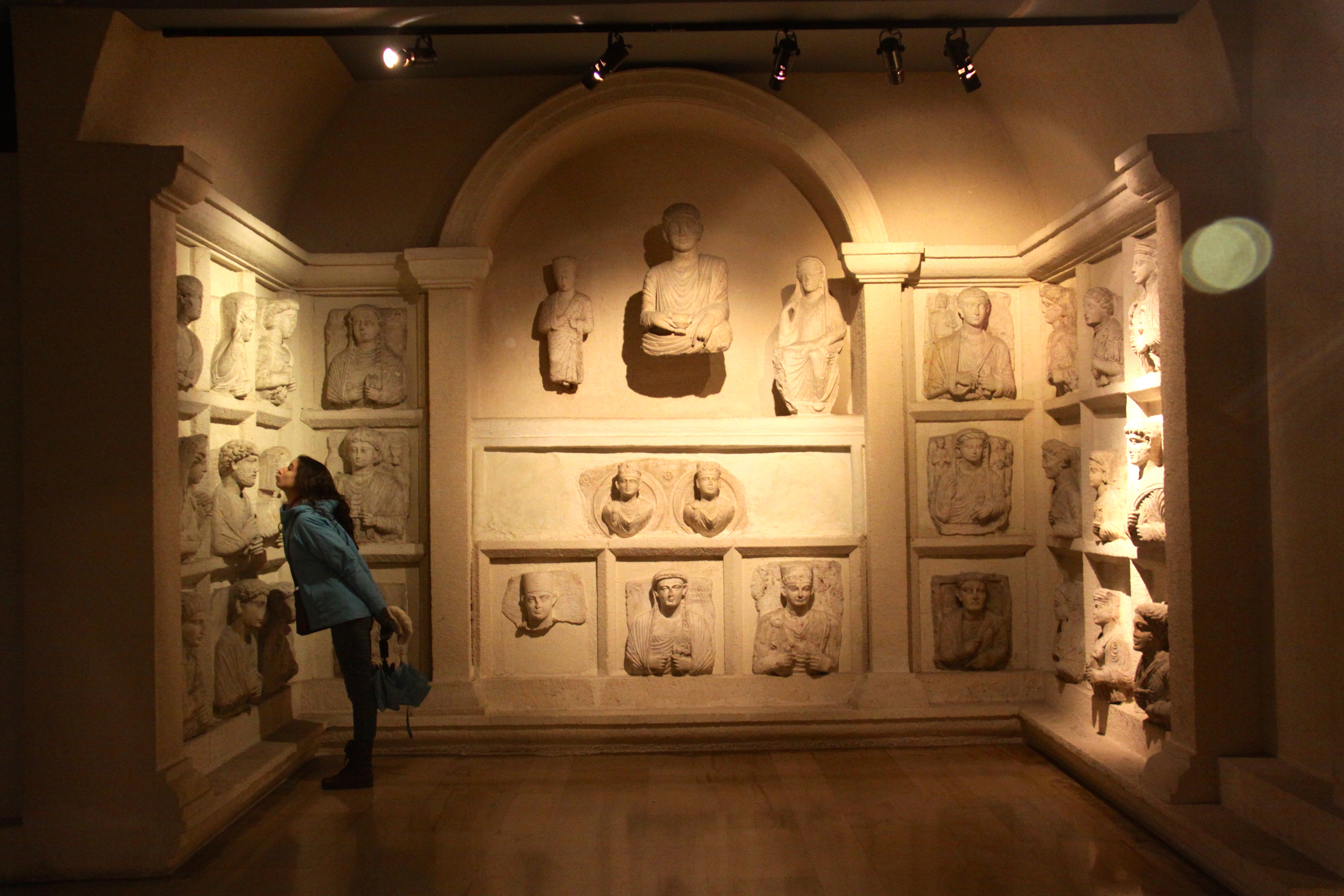
We love history!

Up close and personal with ancient history.

We walked over to the museum next door where we saw…more tiles! In fact, this small museum is called the “Tiled Pavilion.”
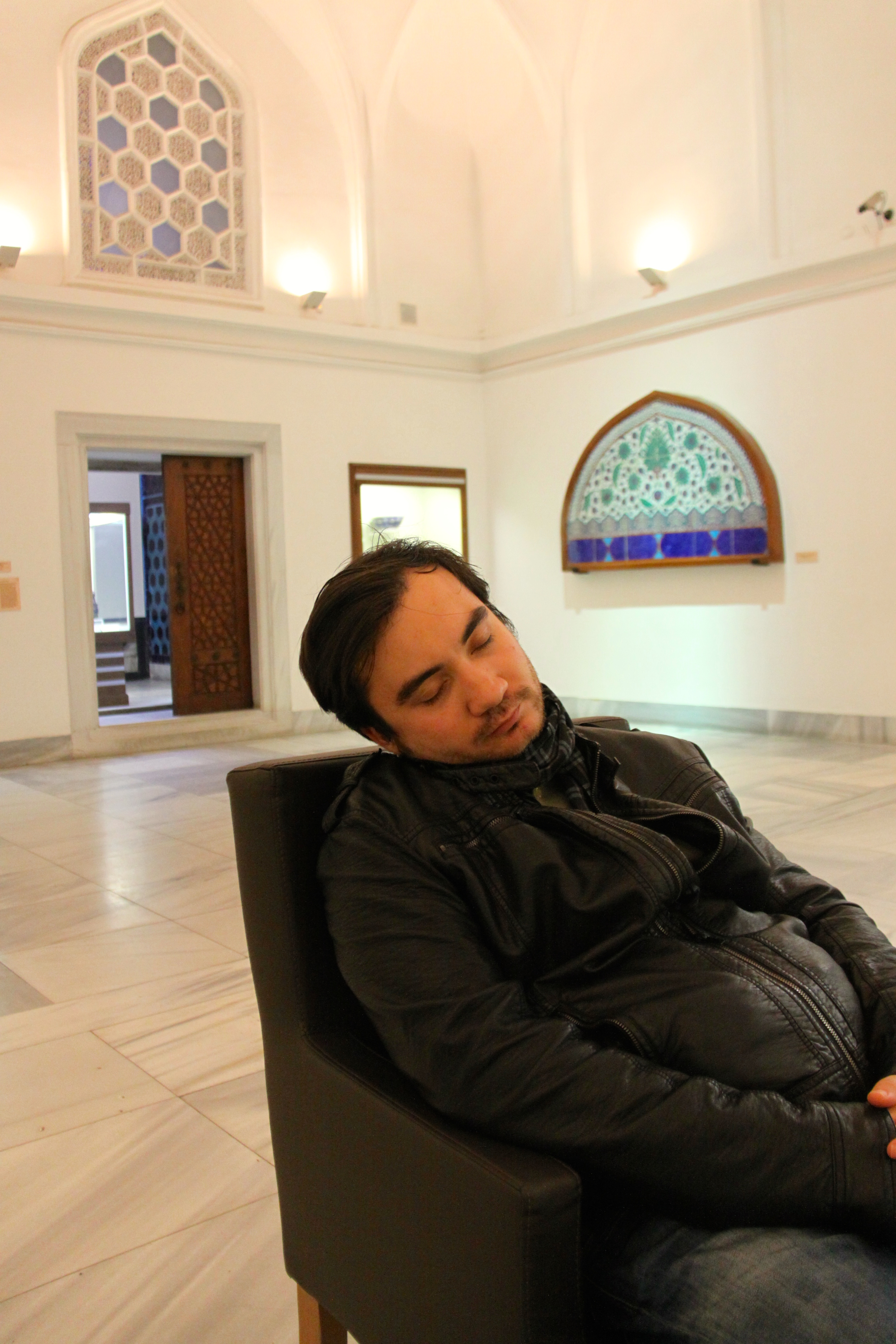
Excited to see tiles!

Or “the Tired Pavilion”

Finally, after a detour in the sculpture garden, which is where the disenfranchised statues are left to suffer the elements, we went to the last museum: the “Ancient Orient.” Upon my approaching the entrance, I was greeted by a guard clearly communicating that my entry was unwelcome. Apparently, they chase everyone out 20 minutes before the museum actually closes. I convinced her to let us in for “one minute,” and after we cruised through Babylon, the lights went off. But I could not leave without seeing at least one famous item, the Treaty of Kadesh, the world’s oldest known peace treaty. The guards relented and flicked on the lights for us to get a brief look at the tiny cuneiform tablet.

And that concluded our day of odd museums.

With only a few hours left in Istanbul, we headed to the Arasta Bazaar, where Jasmine purchased a beautiful inlaid box and Sergey and I drank the shopkeeper’s apple tea. Then we happened upon an outdoor restaurant where a trio was performing—and, most excitingly, a whirling dervish was whirling!
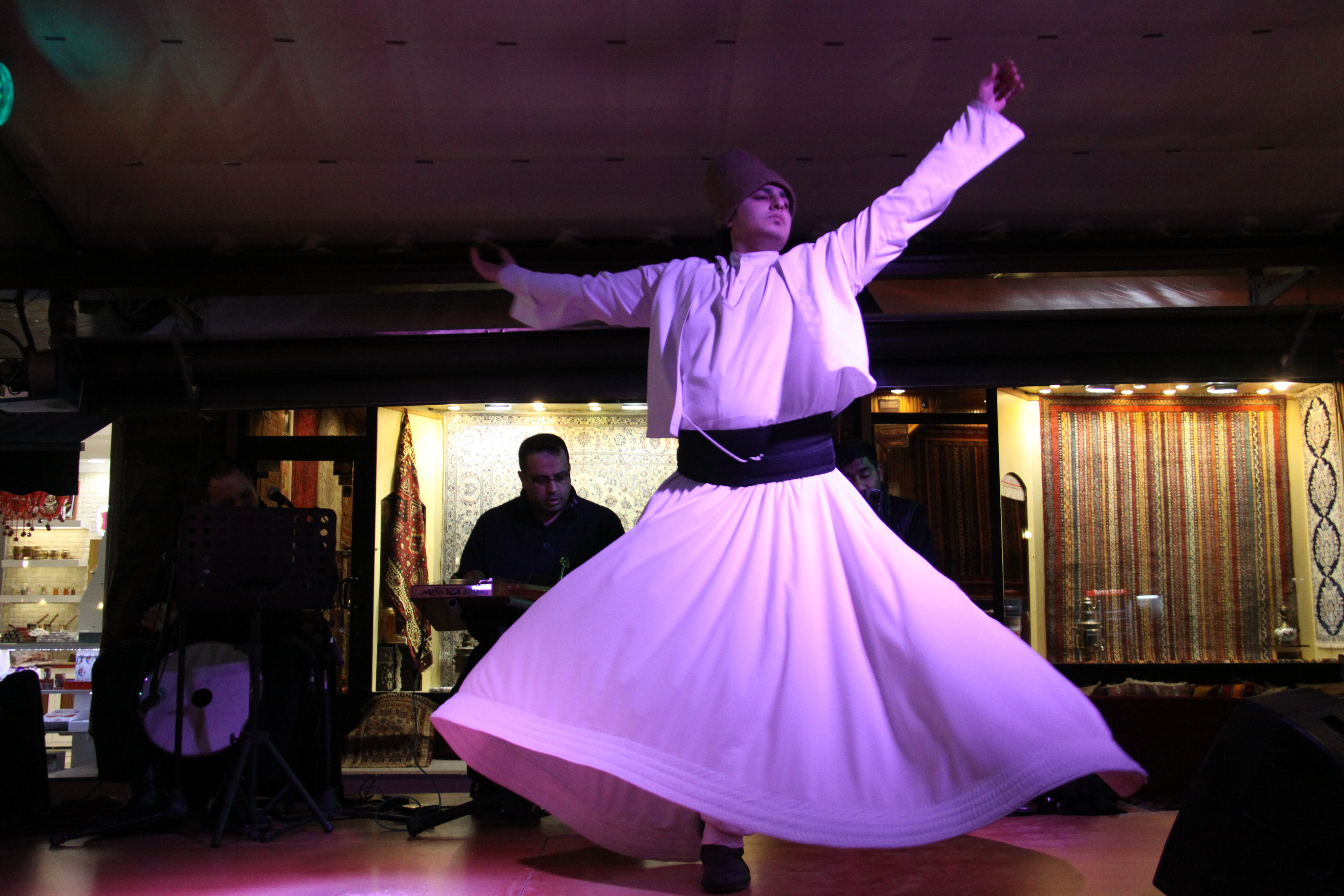
Dervish

Whirling dervish, Sufi dancer, your skirts are a sheltering canopy, your eyes, divine ecstasy.

Entranced, we watched from the sidewalk, and then decided it was worth eating a freezing al fresco dinner to see him whirl. While I’m always skeptical of the authenticity of “cultural” activities in a tourist district, he seemed to be legitimately meditating as he spun, eyes nearly closed, apparently unconscious of his audience, including the paparazzi in the front row seats (us).

Finally, it was time to say “good night” to Istanbul. Our journey had reached its end.
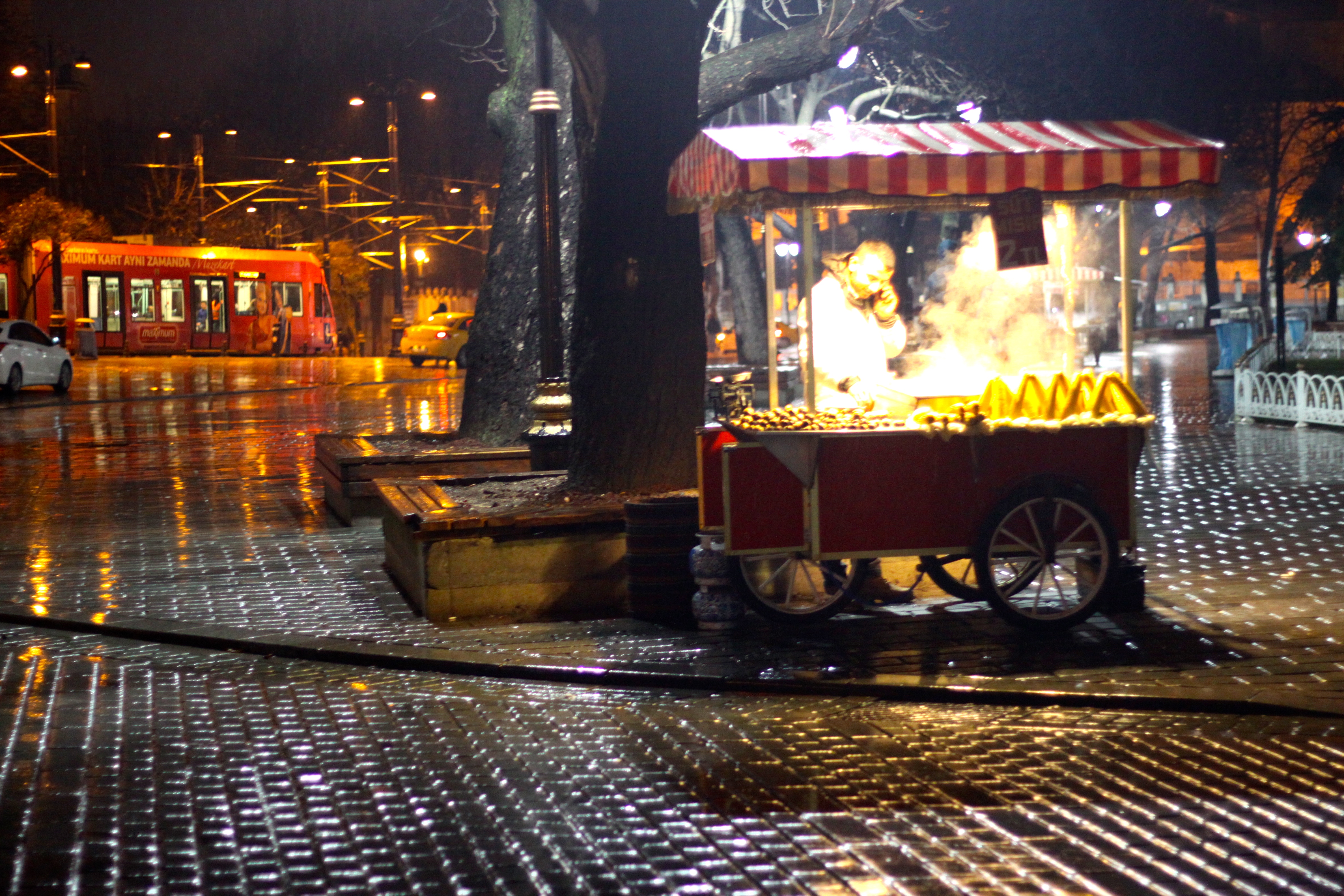
Near Divan Yolu

City of 10 million people

burqa-clad women, bohemian men,

fish sandwiches scenting thousands of fingers.

East meets West

almost

separated by the strait of the Bosphorus

marble tongue of Marmara licking the cold cup of the Black Sea

and Black Sea pouring its dark contents into Marmara’s mouth.
Grandpa

My grandfather, Grandpa Bob, passed away on September 23, 2014.  Born on the eve of the Great Depression and raised Bahá’í, he joined the US military toward the close of World War II, served for a year, then returned home.  He married my grandmother, Bernita, and studied accounting through correspondence courses, which led to him starting his own accounting business, Amerson Tax Service, which is still in the family.  With Grandma Bea, he raised five children, including my father, his namesake and youngest son.  Grandpa was a staunch Bahá’í who served on the Local Spiritual Assembly for 40 years, using his accounting skills as treasurer.  To his last days, although physically weak, he found the spiritual energy to teach the Faith.

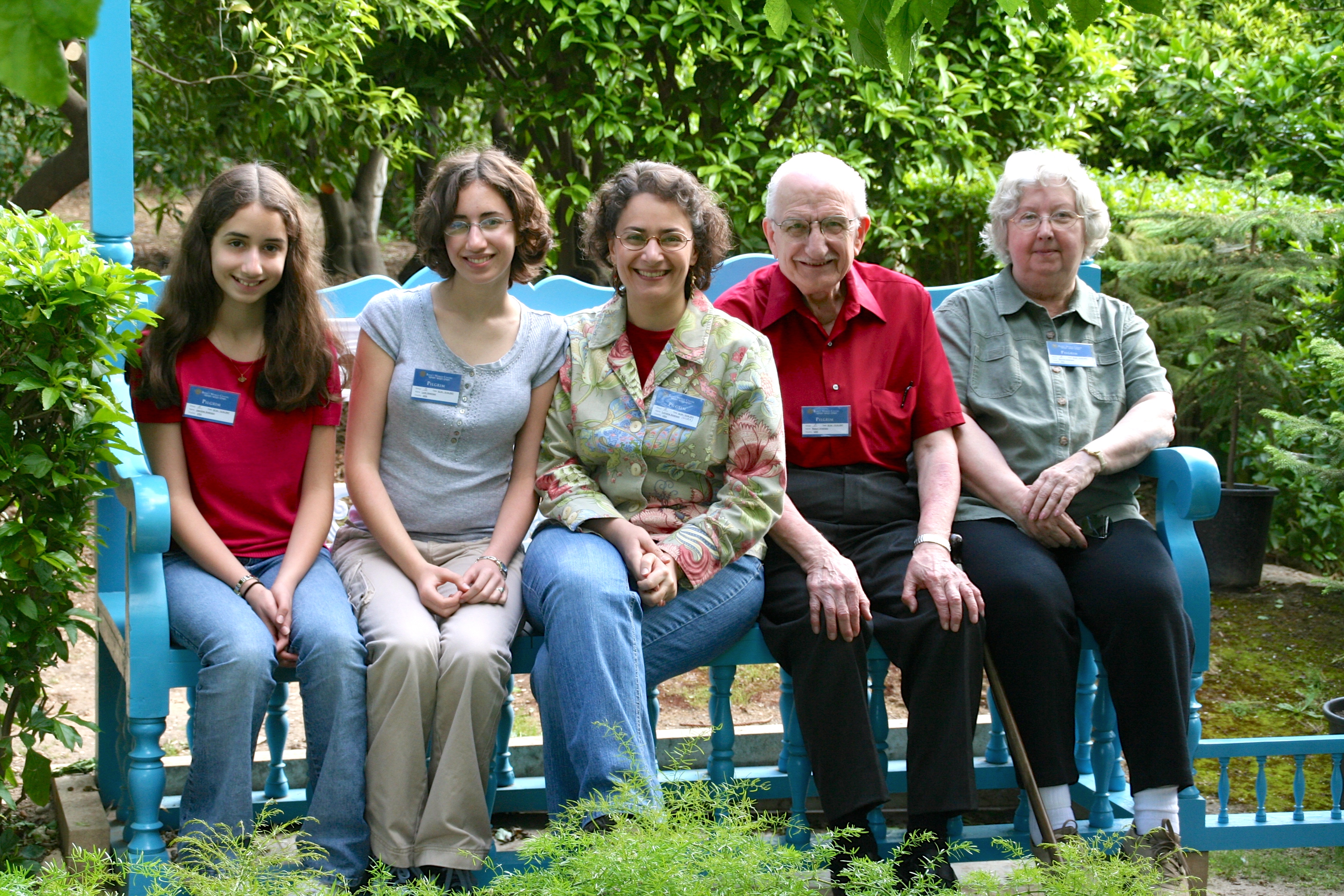
Amerson family on pilgrimage in 2005.

Three generations of Amersons on pilgrimage in 2005.

I picture Grandpa standing outside his apartment at the end of the long, red-carpeted hall, waiting for my family.  When we visited Grandpa and Grandma at their home in Waukesha, we would buzz up to them to unlock the front door, and then he would come out to wait, smiling at us as we approached.  We would be greeted with one of Grandpa’s dependable remarks, something like, “Look who it is!” or “Hey, kiddo!” and then take turns hugging before going inside the apartment.

Well, poetry gives me a way to express my love for a man who was a constant in my life for over 23 years–and who will continue to be, only in a different realm.  Reading this prayer of ‘Abdu’l-Bahá might help clarify some of the allusions.  I find the evocative mystical landscapes rendered in ‘Abdu’l-Bahá’s prayers for the departed comforting, as they help me to imagine the unimaginable next world, the Abhá Kingdom.

Elegy for Grandpa

For Robert B. Amerson (1929-2014)

It is strange to mourn when a loved one

takes joyous sail on the boat of eternity

bound for that sea of light.


But still I do.


What better to remind me

of my own humanity

than the throb of grief

I feel for you?


I know not what seas and rivers

lie before your prow,

through which valleys they flow,

waiting for your journeying,

so for the mystery of what’s to come

and for my constraints of time and space

I trace a map of the mystic rivers

with these rivulets down my face.


To release with grace,

to suffer a temporary separation

and trust in an immortal elation:

these lessons form your final legacy.


Remember my parting words:

“We will see each other again”—

not among the ashes and clay,

but immersed in brilliant rivers and seas

when I join you on my fated day.

Mother’s Day

Today is Mother’s Day.   So, in honor of one of my most dedicated readers:

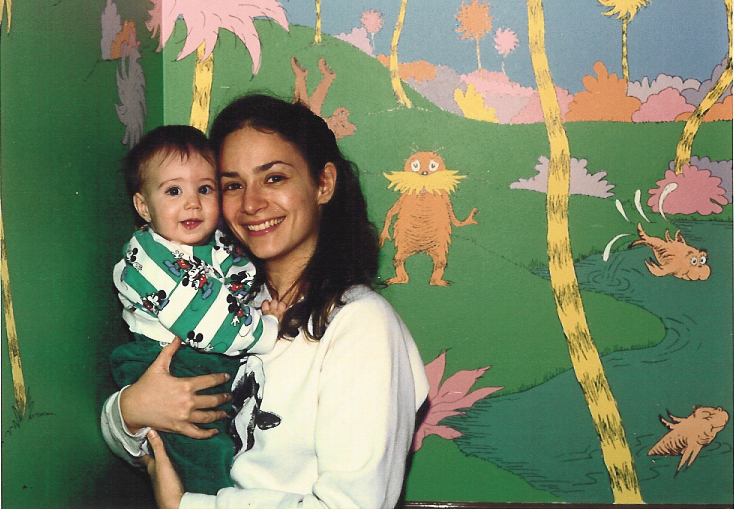
Mommy holding me in front of the Lorax mural she painted.

Mommy holding me in front of the Lorax mural she painted.

Here you are with me and this mural

both at least partially your creations.


You must have been so patient,

finding the inspiration,

sketching the composition,

then painting so neatly

until the magical landscape encircled us.


When I think of you, I think of you making:

collages, frames, food, family,

the bright birds from gourds and beads,

your mind winging baroque whimsies.

Mother: creator.

To Mommy, across the seas.


Rat a tat tat

It was Friday morning, and I was on my way to the office.  As usual, I knocked on Sergey’s door (a few floors downstairs) to pick him up for the daily commute.  He opened the door.  “Can you come in for a moment?” he asked.  “I have something to show you.”

Now, the last time Sergey said that, he had a bouquet of roses waiting for me inside.  This time, it is a rat.  I don’t want to read too much into what this means about the progress of our friendship, but…perhaps some backstory is in order.

First, Sergey and I had watched Ratatouille, which I find an unbeatably adorable movie.  I mean, a French foodie rat with family problems?  So cute.

A few days later, the movie really came to life.

Apparently, Sergey’s version of the gourmand critter flew/climbed in through the kitchen window.  Yeah, Israeli rats climb walls and break into apartments.  He and his flat-mate, upon discovering their guest, hid nearly all the food and dish ware and sterilized the kitchen.  They left out sticky traps, peanut butter scented, to catch the beast.  But this rat was smart, and, while avoiding the traps, went for the real peanut butter, nearly gnawing through the lid.  I had to admire its palate and persistence.

The final weapon in the weeklong battle of man versus rodent was old-fashioned rat traps.  That is how on that Friday morning there came to be one terrified rat cowering piteously in the corner of a trap on the kitchen counter as I looked on.  Seriously, it was so pathetically afraid–trembling, big beady eyes panicked, squeaking whenever Sergey spoke or moved.

In the abstract, I don’t think retaining vermin is wise.  Rats carry all sorts of pestilence and are a health danger to humans.  But, watching this creature, clearly so afraid to die, how could we do anything besides give it freedom?  So outside we went with this pet, and released it into some bushes.  It ran off without so much as a backward glance.


TO A RAT  (apologies to Robert Burns)

Small, worm-tailed wee creature,

with dirty paws your concerning feature,

why do you choose to live

‘neath this ancient fridge?


At quiet hours you grow spunky

and gnaw a banana like a monkey

leaving your marks of hunger

for us in the morning to discover.


I am sorry that we curse your life,

tempting you with cruel delights,

tidbits luring you into traps like sirens,

rewarding your desire with a prison.


But, wise rat, you chose well your abode

for herein dwells a gentle landlord

who cages and evicts you without pain or loss–

though perchance you will miss this kind host.


Check out “To a Mouse” for the classic rodent ode.

Kingfisher

Today for the third time

I saw the kingfisher.

Today for the third time

he saw me and flew away.

Jewel bird, he is his own diadem,

amethyst crown and sapphire cloak

with a lick of silver at his throat.

He saw me, and he retreated

as I stepped closer, hoping to gaze

at such treasures as my greedy eye

and his glittering wing can alchemize. 

Blushing

Nine roses

Nine roses

Do you blush?  Maybe you’re one of those cool and collected types.  Actually, I’m usually one of those types, except when my “personal life” comes up.  In those cases, I am the most bashful of them all.  I couldn’t actually tell you what colour I turn, but beet red sounds like an accurate description, as all the blood in my body rushes to my face.

I brought a love poem to share with my poetry group this week.  As lunch started, I found myself goring increasingly nervous and regretting that I’d cheekily subtitled the poem “Yes, this is a love poem.”  (One of my friends in that group is constantly accusing my poetry of being about love.  No.  It’s about birds.)  When that time came–“Did anyone bring anything?”  I reluctantly admitted I had…and started blushing.

“Uh, it’s a poem I wrote for Valentine’s Day, so it’s kind of embarrassing,” I said.  (I mean, who wouldn’t bare her heart in gratitude for a bouquet that perfectly colour coordinates with her red and green themed living room?)  I promised that if my face returned to the more pallid end of the pinkness spectrum, I would share.  At some point I steeled myself–blushingly–and distributed the poem.  If I could manage that, then I can handle sharing one with you, dear reader.

Oh, and yes, this is a love poem.

 Your name is a lamp

for the flame of my tongue

and to call out to you

through the dark

sends sparks

through the lacework

of night

I wonder, did the saint

of the alphabet

know the brightness you would be

when he invented the

wheeling majuscule

and smile-capped conclusion

of your name

Sing it or say it, you make me

live every day

radiantly

Pomegranate

Sweet as a low voice wafting up to my window, that
pomegranate my father brought in a Pyrex
custard cup, puckery tart as a perfunctory
 
peck on the cheek, bright as ten fingers wearing
red nail polish waving in the sunshine.  Mysterious,
too, pile of rubies walled inside the thick hide
 
of a red rhinoceros, and I never realized
the lengthy mining trips Daddy went on
to bring those bright seeds in the clear glass
 
until I fight the whole creature on my own.
Slice and pull, wiggle the seeds loose like baby teeth;
they collapse and bleed, and soon red spatters stain
 
the counter, the wall, the floor, and me.  This is
a good fruit to teach patience, I think, my impatience
increasing while the seeds drop into a bowl
 
like sand in an hourglass.  And I try to picture
Daddy doing this invisible exercise with his long
pink fingers, maybe slow, surely neat,
 
and me receiving the glowing seeds, the teaspoon
ready, savoring the flavor but never quite
tasting their message: This I give for love.