Metamorphosis: An Ode to Bugs

October. It’s been a couple weeks since I’ve seen my summertime favorites, hummingbirds and monarchs, which have no doubt departed on their southward migrations. 

Looking back on the warmer months, watching caterpillars enjoy my plantings was a highlight—with one exception.

Continue reading

Student-Consultant Interactions: From Single Visits to Partnerships

Logo saying the Peer Review, 10th anniversary, 2015 to 2025.

Smith, Zoe, Caroline LeFever, and Layli Miron. “Student-Consultant Interactions: From Single Visits to Partnerships.” The Peer Review, vol. 10, no. 1, 2025.

Abstract: What can consultants do to move students to return to the writing center? To identify strategies that accomplish this end, two undergraduate researchers and an advisor surveyed students who had repeatedly visited a single consultant. We then analyzed the data, coding consultant strategies and noting repeated occurrences. We also recorded appointments of consultants with high rates of returning clients, collecting transcripts detailing the strategies they use in first-time visits. Our research contributes to our field’s understanding of why some students return to the writing center and what students want from their consultant, intersecting with current conversations that acknowledge student writers as co-creators of writing centers and recognize peer tutors’ emotional labor. The consultation that we document and analyze may find use in consultants’ professional development.

Full Text: You can read the article or the full issue.

Turning Lawn into a Wildlife Garden: Year 1

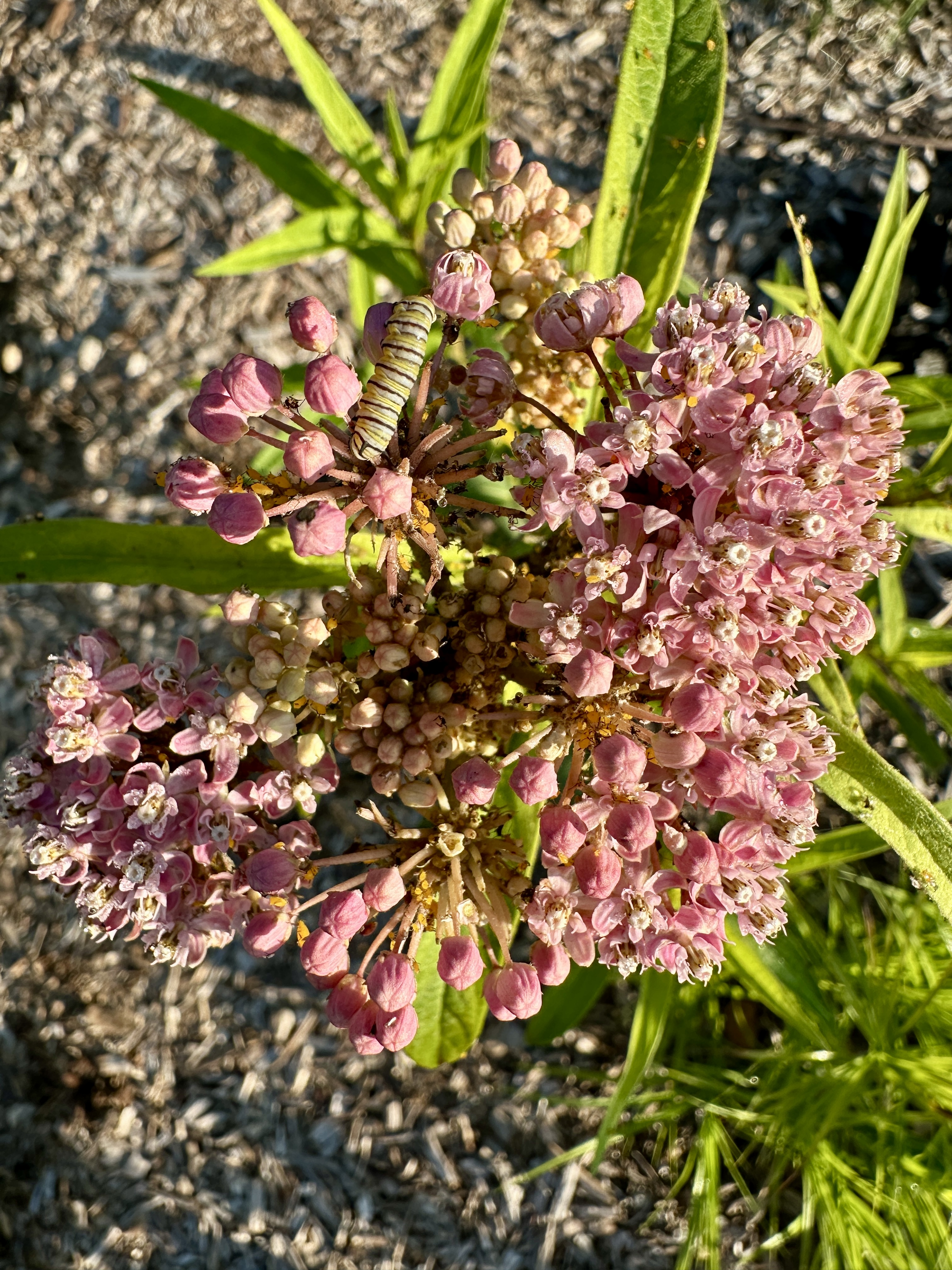
A small caterpillar rests on a cluster of pink flowers.
A tiny monarch caterpillar rests on milkweed flowers, seen in our yard earlier this month.

In Alabama, where at least a hundred trees inhabited our lot, one of my favorite activities was lying on the porch swing, gazing up at the leaves as they danced in the breeze. Once, a Caroline wren landed on me as I lounged, perhaps mistaking the motionless tree-gazer for a log.

It’s taken some getting used to our yard in suburban Indianapolis, where lawn predominates. 

To be fair, it’s not entirely treeless: three cherry trees were presumably planted about a decade ago when the house was built. Besides the cherries, the landscaping included clematis, daisies, daylilies, daffodils, hydrangeas, hostas, and weigela. Each of these ornamentals is an exotic, generally with origins in Eurasia, so, while beautiful, they don’t do much for the ecosystem.

Of course, the majority of the quarter-acre lot is covered by lawn, which was a pristine, sterile monoculture when we arrived, thanks to the prior owner’s fastidious attentions. We heard they killed voles to keep the grass safe.

Continue reading

Eras, Geological and Personal

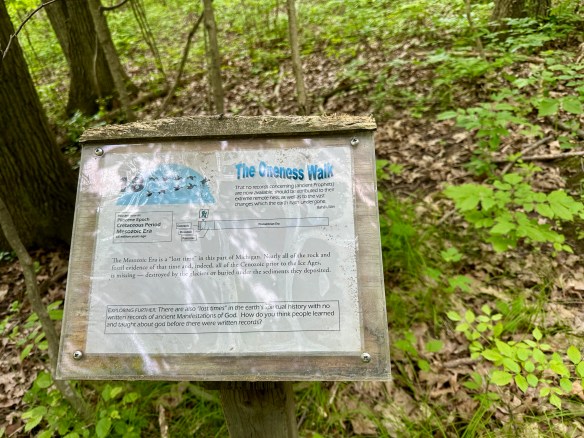
Walking in the woods, I see a field of pink phlox. A giant swallowtail butterfly pumps her wings beside a stream. As I swat mosquitos, signs along the path encourage me to consider this landscape in geological time, its current form molded by the glacier sheet that retreated some 12,000 years ago.

A sign in a forest titled "The Oneness Walk." The sign describes developments lost to history, both spiritual and geological, due to lack of records.

Time to contemplate time: 12,000 years, a moment to our 4.5-billion-year-old planet, yet an unfathomable ocean compared to my few droplets of decades.

Continue reading

Ephemera of Spring

April brings not only the loon on the retention pond, but the ephemeral woodland wildflowers in the Indiana parks. These flowers emerge before the trees have leafed out, and mostly disappear by summer, dormant until the following spring.

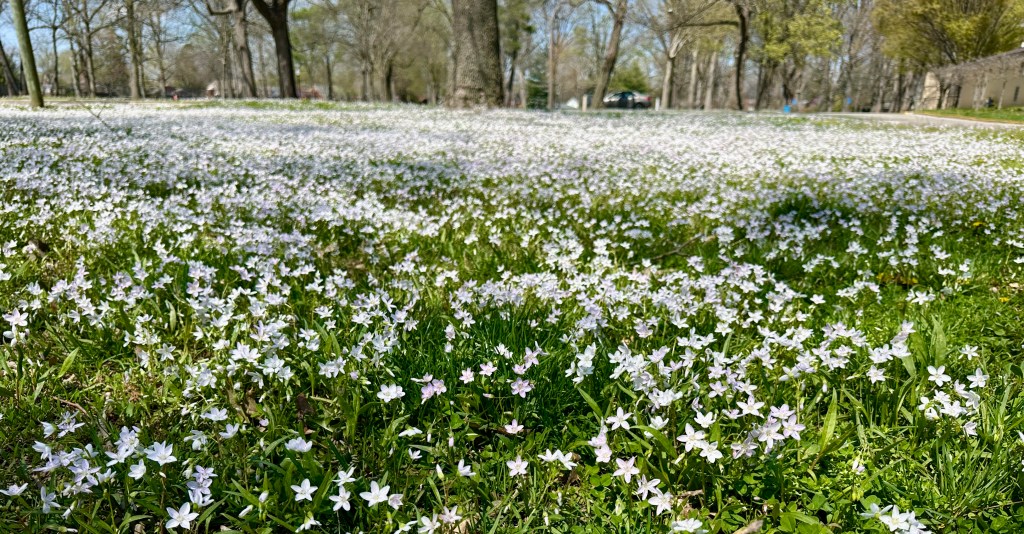
In my Alabama garden, I had planted one tiny ephemeral, Virginia spring beauty, admiring the pink pollen and stripes adorning the minute blooms. And then this spring I happened upon a field of thousands of spring beauties. Wandering through Columbus, Indiana, Sergey and I came upon a handsome park with mature trees towering over a lawn. Within the lawn grew endless spring beauties and violets.

Tiny white flowers fill a field.
Spring beauties blossom in Columbus, Indiana.
Continue reading

Columbia University’s Bahá’í Club Builds a Spiritual Community

Students at an Ivy League school face the same spiritual tests as many youth across our nation, but in an environment where personal ambition and competition are vaunted. Striving to find a higher purpose can feel like a lonely journey—unless students can connect with like-minded peers.

Ajay Mallya, a senior at Columbia University, identified as agnostic when he entered college. His family is Hindu, but Mallya did not grow up deeply immersed in Hinduism. As a teen, he attended Catholic school and found Catholicism to be intriguing. Nevertheless, Mallya felt ambivalent about religion overall. 

“I’m an applied math major who enjoys science and math. I always thought there was a huge clash between science and religion,” Mallya explains. Still, he wondered: how could his life contribute to society?

Continue reading

Houston Community Revitalizes Feast Gatherings

Every Central Figure of the Bahá’í Faith has championed Nineteen Day Feast gatherings as keystones of community life. The Báb and Bahá’u’lláh ordained that local communities should gather on the first of each Bahá’í month. Abdu’l-Bahá wrote: 

“As to the Nineteen Day Feast, it rejoiceth mind and heart. If this feast be held in the proper fashion, the friends will, once in nineteen days, find themselves spiritually restored, and endued with a power that is not of this world.” 

Shoghi Effendi, the Guardian of the Bahá’í Faith, specified that the Feasts should include devotions, consultation on community matters, and socialization to create fellowship. Beyond these outlines, communities have many options in how they design their Feast gatherings.

Sometimes, the consultative portion of Feast, which usually includes reports on recent activities, the status of the local Fund, and open discussion, can become the focus. In Houston, this administrative emphasis had characterized Feasts for some time. To quote a younger participant, it led to gatherings that felt “boring.” As the 2020 pandemic restrictions were lifted and people could once again gather in person, the need to revitalize Feast gatherings became apparent. Community members turned to Houston’s Local Spiritual Assembly for support. 

Continue reading

The Loon

Dogwood blossoms kiss wafting clouds. The sun now is strong enough to burn me after winter has left me pallid. April is a month of special wonder.

Branches of a dogwood tree in blossom are juxtaposed with an old building with a clock tower.
A dogwood blooms in Bloomington, Indiana.

En route to the zoo, I saw on a retention pond surrounded by duplexes a bird at once familiar and unfamiliar. I asked Sergey and Jasmine, did they think it was a loon? They thought it was more likely a duck because why would a loon, denizen of wild lakes and singer of an eerie song, have chosen this spot surrounded by Indianapolis’s web of highways to rest? 

But Jasmine offered to turn the car around so we could investigate the bird. We parked, she grabbed her binoculars wisely stowed in the car for just such moments, and we carried my nephew. 

The visitor was indeed a loon. 

Continue reading

Middle-Marching: Lessons on Compassion

Driving to and from Bloomington, where I go to my office at Indiana University three days a week, the interstate unfurls and my mind can travel along with my body. 

I see the land grow hilly and wooded as I go south. From my start date in September to December, I watch autumn advance. Days shorten: I set out before dawn and return around sundown. Leaves inflame, then drop. I like the morning drives best when mist pools in the dells of cornfields.

A limestone chapel peeks out from behind autumn foliage.
Beck Chapel at Indiana University Bloomington
Continue reading