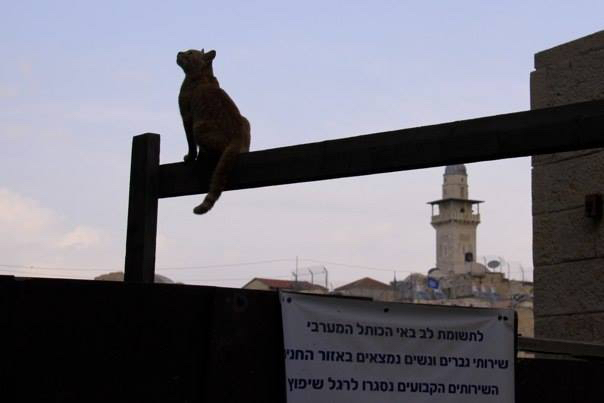
The home of the spider

There is a flâneur inside all of us.  If I recall my art history classes well enough, once Paris was Haussmanized–many of the charming little streets were converted into wide, orderly boulevards–a new species of pedestrian emerged: the flâneur.  The flâneur was a window shopper, an idler, an urban vagrant who did not necessarily set out with a destination in mind; he walked around to see the city and maybe stop for a croissant every once in a while.

My flâneurism (which sounds like a dangerous combination of flan and aneurysm) manifested in some exploration of the Hadar, a commercial and residential district which, according to the map, my street borders.  I can’t tell you how much time I’ve spent examining maps of Haifa in a fairly futile attempt to commit the general layout of the city to memory.  There’s the tourist map I keep in my purse at all times, and the one on my bulletin board at home, and there’s even one up in the office.   So I had my route planned out, and I successfully found the main shopping street with its endless noisy clothing stores and the department store wherein I found this happy couple.  Please take a moment to note his rakishly angled spectacles and her receding hairline.  Aren’t they cozy.

They do say love is blind...

They do say love is blind…

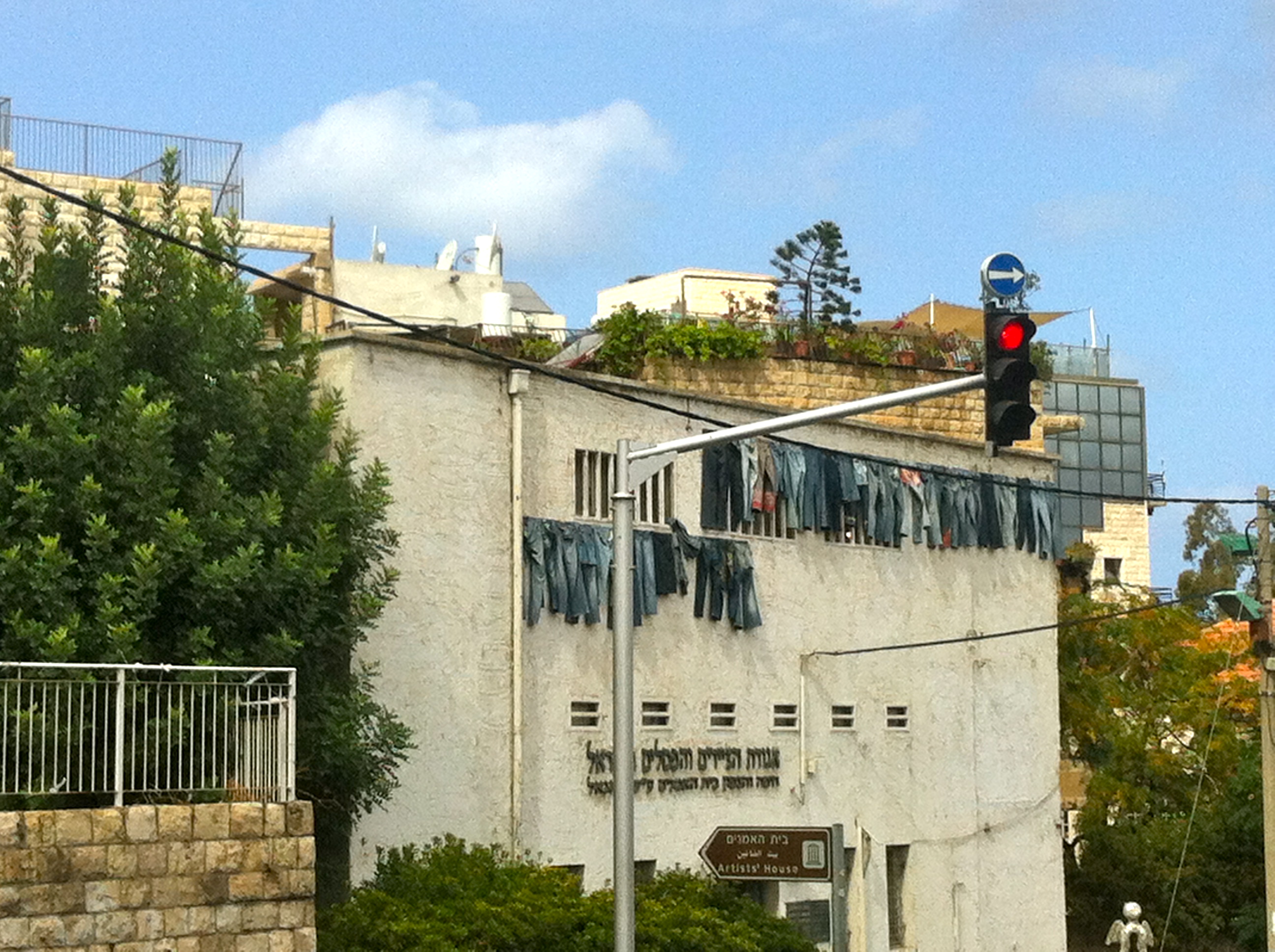
And this–jeans as art, or maybe the dryer broke:

Artist's house

Artists’ house

Once I had procured some houseplants and a muffin tin, I decided to retrace my route.  If I could accomplish that, I figured that would mean I actually knew the Hadar.

I did not accomplish that.

I suppose I was distracted by the unusually cool weather, the streets damp with rain, or maybe it was the dead cat in the street.  Anyway, I forget to take a turn and found myself in an unfamiliar area.  Unwisely, I decided to keep walking.  I suppose I hoped my “intuition” would lead me aright and my apartment building would suddenly appear in front of me.  Eventually, I swallowed my pride and found the friendliest looking person around (not a particularly easy task–Haifans are not the smiliest bunch) and asked for help.

“English?” I asked.  Over the course of the morning, I had gotten accustomed to the answer to this question being a shake of the head.  But it turned out she spoke very good English.  After she explained where I needed to go, she pointed at my map and asked, “Does it help?”  Good question.  As soon as I pull it out, I mark myself as an outsider, a foreigner.  But when I try to navigate without it, I end up seeing more of Haifa than intended.  Perhaps trying to make me feel better about my orienteering failure, she said, “The streets in Haifa are like the home of a spider.”  A very messy spider, I might add, the kind who eschews neat webs in favor of tangled nests where he stores his victims, including young women carrying Tourist Board maps.

Recipe: Birthday pudding with rainbow frosting

Sometimes I like to put my apron on and make a mess of the kitchen, or as some people call it, “bake.”  (Please note that I have not yet broken the oven in my second flat.)  Today I would like to share with you a favorite recipe.

Here’s how to start.  Plan to host a few friends for dinner.  Find out a few hours before the event that one of these friends has his birthday and “you should really bake a cake.”  Try not to panic.  Luckily, of course you have a stock of the staples dark chocolate and raspberries, so decide to make raspberry brownies.  Google “raspberry brownies” and go with the first hit, because time is running out.  The recipe description is:  “Squidgy and super moreish, these gorgeous foolproof fruity chocolate bakes will be snapped up in seconds.”

Try to get over the way the words “squidgy” and “moreish” make you think of squids and Othello, the Moor of Venice.  In fact, try to get over that whole sentence with its bubbly British English.

Nickelodeon vs. Shakespeare

Shakespeare and Nickelodeon. I get them confused sometimes.

(Also, foolproof?  Just saying, have you ever met this fool?)

Follow the recipe.  It’s pretty simple, really, except that simultaneously you should also be trying to use a rice maker for the first time ever and chopping veggies for the stir fry.

Check the brownies after the allotted 30 minutes.  Discover that they’re still molten.  Replace in oven.  10 minutes later, they are a bit more magma than lava.  Take them out and let cool.

Now, “let cool” to you means “let cool for five minutes.”  And you’re impatient to get those birthday candles affixed, so stick ’em in.  Then realize they are melting into the brownies.  Remove.

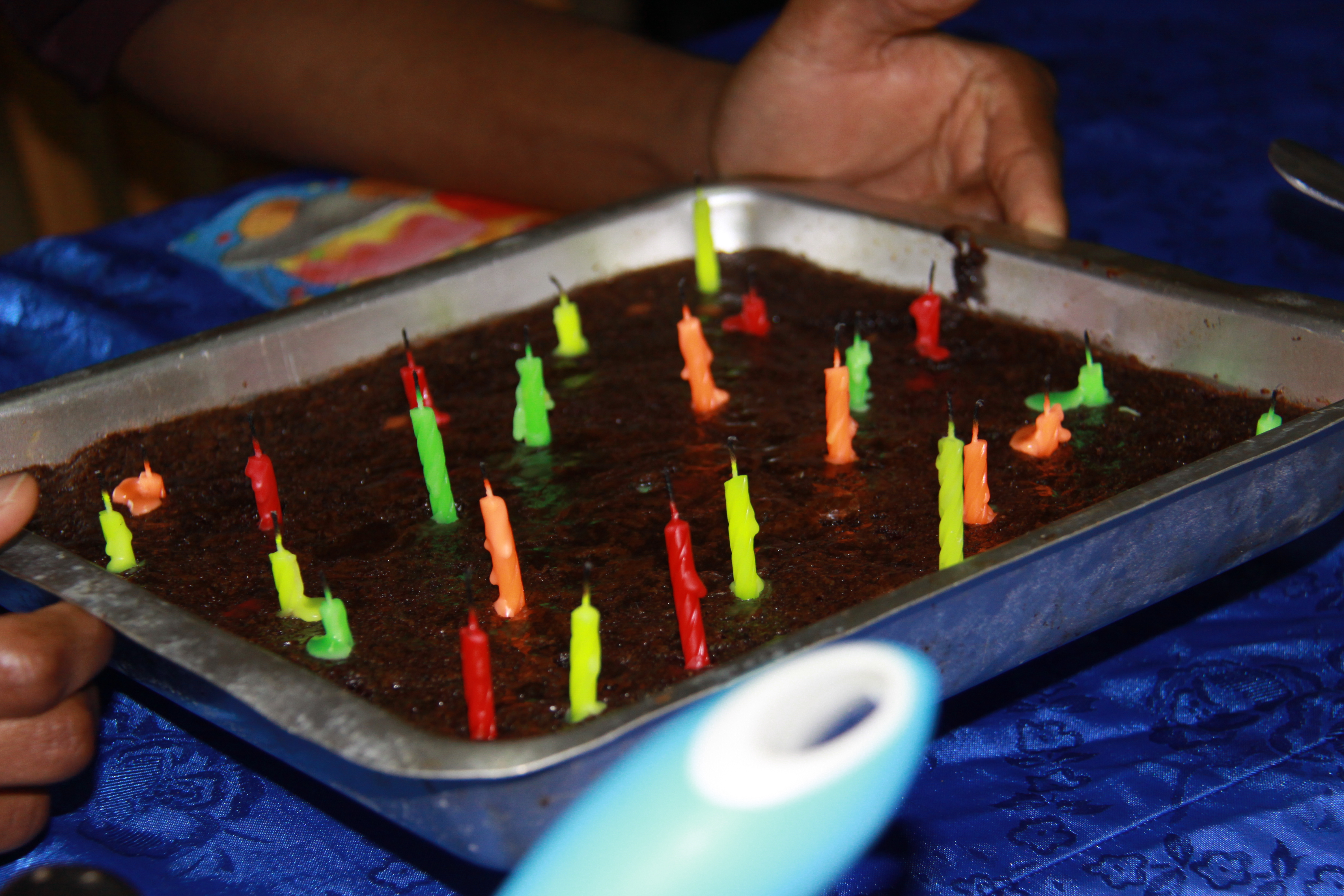
Once actually cooled, reinsert the candles and light.  There are 26 candles; the friend is turning 27.  26 is still a lot of candles even if it is a lie.  Use approximately 10 matches and nearly burn your hands trying to light them all.  The candles are mere fluorescent stubs by the time you sing the birthday song and the wish is made.  When extinguished, the candles make a lot of smoke.  Luckily, you don’t have to worry about setting off smoke detectors, because you don’t have any.  And the birthday candles will provide a colorful layer of frosting.

After the fire.

Now wait for all the wax to be picked out, leaving the surface of the brownies pockmarked.  When it comes time to serve the brownies, they are, well, squidgy, which you now know means “floppy and pudding-like, refusing to maintain any shape.”  One of the friends inquires politely, “Are these fully cooked?”  They are.  They’re simply mislabeled, because you billed them as “raspberry brownies” when in reality it’s chocolate pudding with paraffin enhancements.

Thank you for joining me for another baking lesson.  There will be more to come as I pursue a truly “foolproof” (Layli-proof) brownie recipe.

The sea below the sea

I’m back in the office, and my back muscles are sore.  It’s from all the floating over the weekend.

That’s right: for the first time since my train pulled into Haifa, I stepped foot outside the Haifa-Akka area.  When I signed up for the Dead Sea trip, allured by the promise of adventure, I knew one thing: it was salty.  And also dead, as anything that tries to live in the sea would probably become quickly pickled.  I had a feeling it had some biblical significance, like, wasn’t that where Jesus walked on water?  Or where Moses parted the sea?  (I assume your Bible knowledge is better than mine and you know that would be the Sea of Galilee and the Red Sea, respectively.)

It was a rather long ride in the sherut, as we must avoid the West Bank.  I plugged in my earbuds and listened to Devendra Banhart.  I wish I had chosen someone more pronounceable and less indie to listen to, because when questioned about my music choice, my response provoked raised eyebrows.  “Dev-end-ra-ban-heart, have you heard of him?”

If I didn’t pay too much attention, it would have felt much like the trip from Verona to Chicago–wide highways, green signs (except in Hebrew, Arabic, and English), gas stations en route.  But after a while we entered the desert.  I knew I had entered a strange land when I saw the camel crossing signs, and then the camels, a few clustered by the side of the road, probably waiting for a sherut with open seats to come pick them up.

“Alright, we’re about to go underwater,” Abboud, the sherut driver famed among the Bahá’ís, said.  “You all ready to hold your breath?”

We were going below sea level, deeper and deeper “underwater.”  The Dead Sea, Wikipedia tells me, is the lowest point on dry land in the world.  It’s a sea below sea level.  Interestingly, because of the great atmospheric pressure, you’re safer from the sun’s harmful UV rays there, despite the constant clear skies.

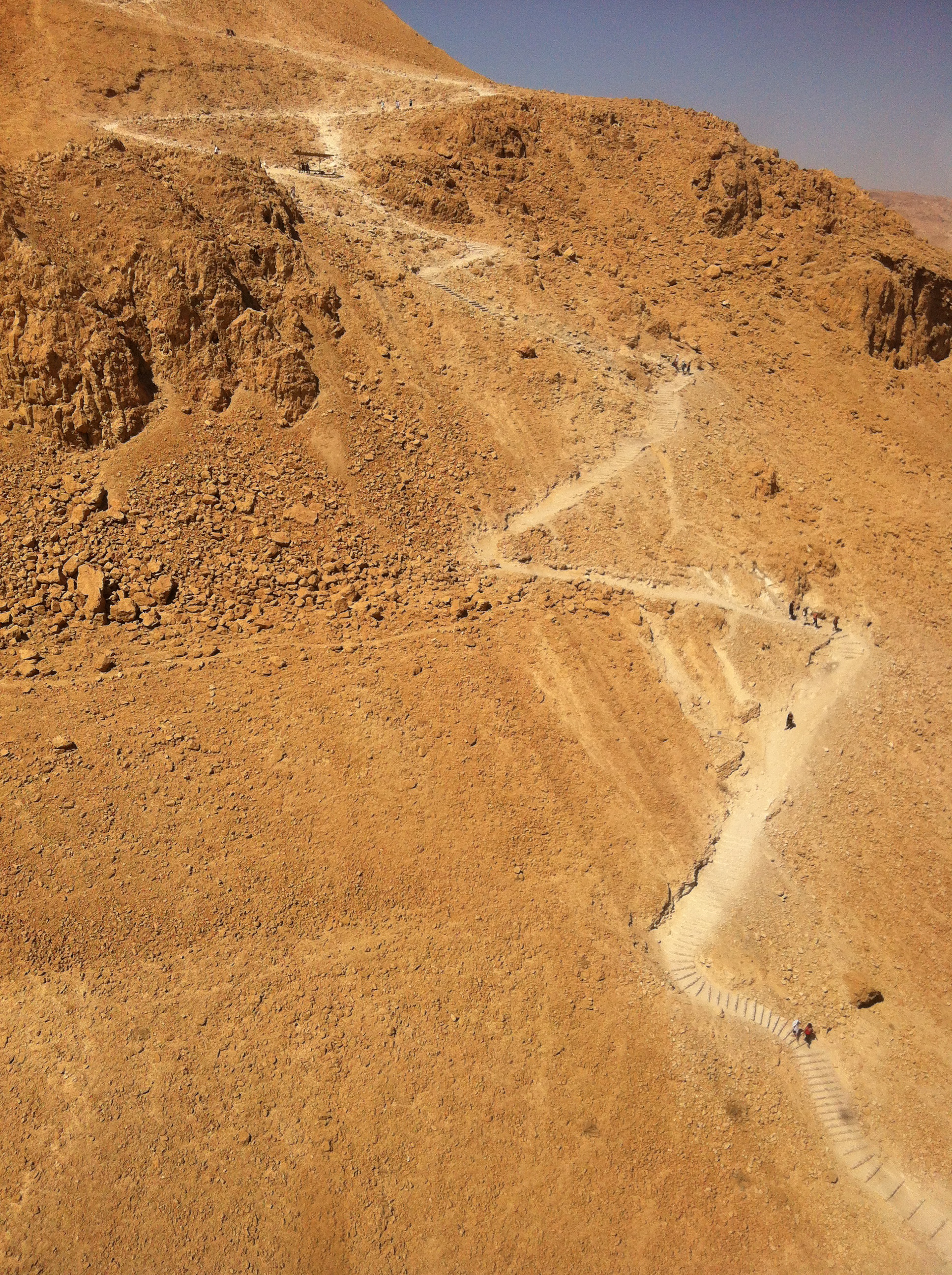
Hiking trail up to Masada.  No thanks, I'll take the cable car.

Hiking trail up to Masada. No thanks, I’ll take the cable car.

Our first stop was Masada, the ruins of a fortress and palace built on a plateau by Herod the Great.  When the Jews rebelled against their Roman overlords, they made their last stand there, kind of like the Alamo except less Texan.  In short, the Jewish men decided to commit mass suicide and die free rather than allowing themselves and their families to be captured and enslaved by their foes.  When the Romans entered the fortress, they were greeted by hundreds of lifeless bodies.

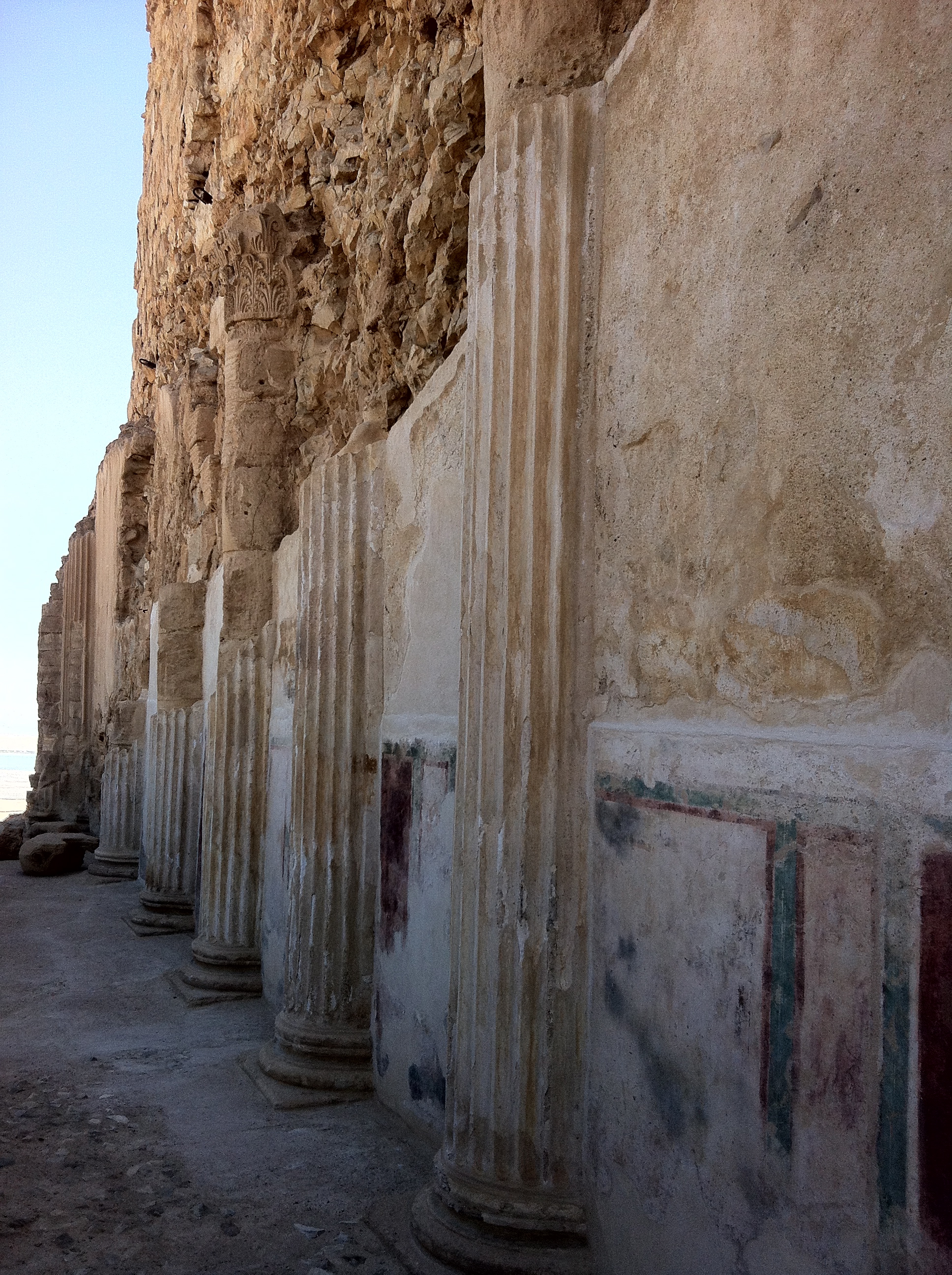
Ancient columns.

Ancient columns.  A key part of ruiny décor.

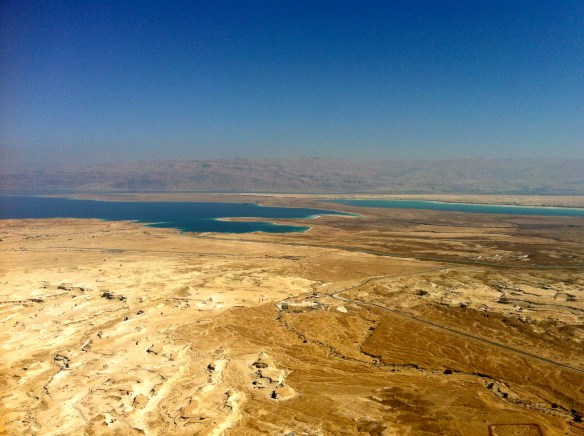
Mainly what I learn from visiting places like Masada is that I don’t have the mind of an archaeologist.  I have a hard time looking at stone walls and envisioning Herod or the Jewish rebels.  But the panoramas of the alien landscape were something to behold.

IMG_1282

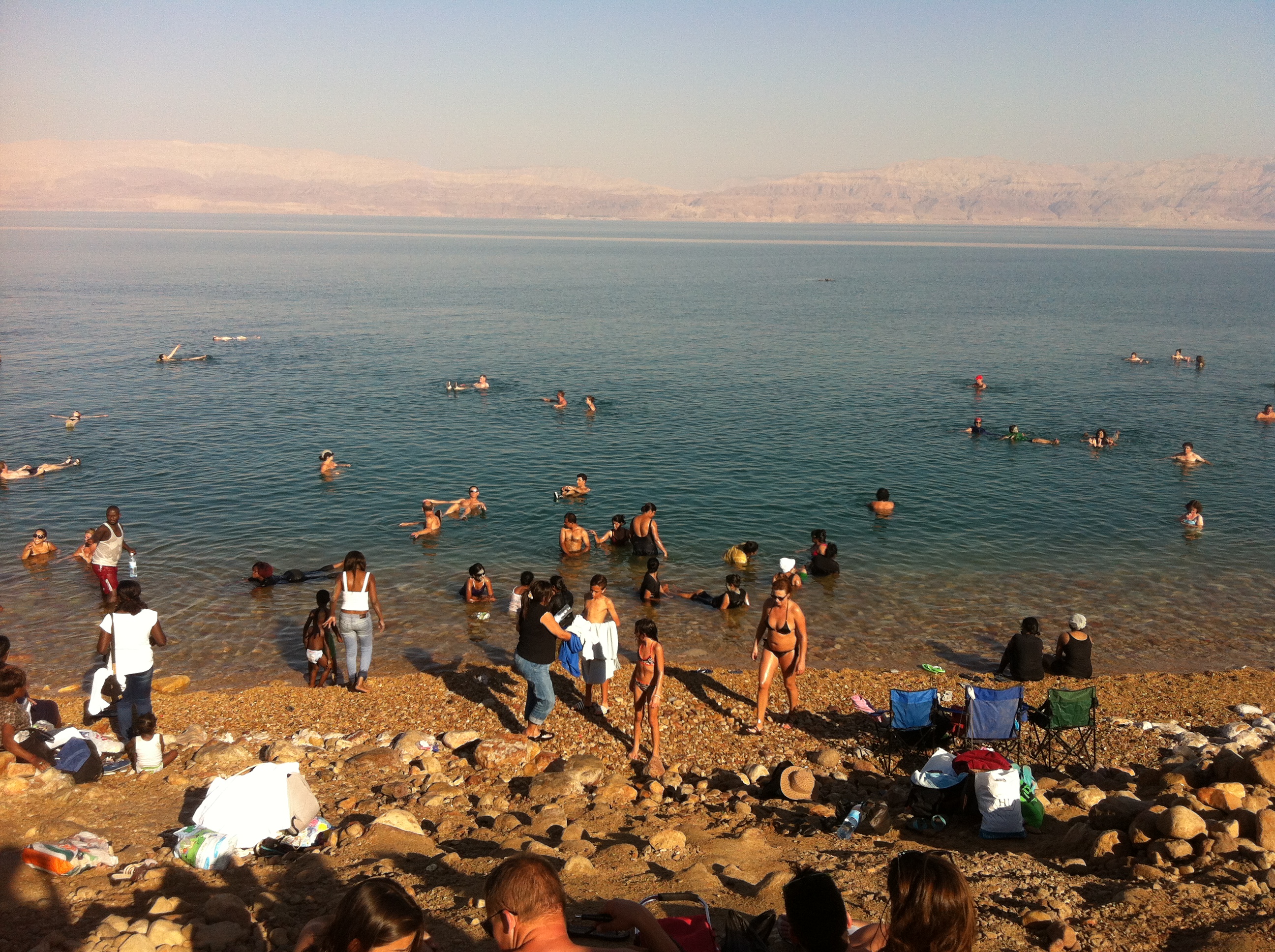
At long last, we reached the shores of the sea.  The beach, which was more of a rocky hill, was full of tourists, some of them painted with mud, some of them floating.  I could see that some of the rocks on the shore were actually covered with large salt crystals.

Beach

I tentatively stepped into the water.  My flip-flops escaped my feet and shot to the surface.  Ok, new plan: unshod, I waded into the water, wincing over the bumpy rock bottom.  I crouched down, then let myself float up to the surface.  Now, I’m not much of a beach goer.   As you know, the double threats of sunshine and drowning prevent me from getting seduced by that scene.  But I have found my perfect body of water in the Dead Sea.  You can’t swim, but only float–perfect!  I don’t need to fear going past my depth because I physically cannot sink!  You can’t put your head underwater unless you want to damage your eyes–wonderful!  I dislike the sensation of submersion.  I let myself float a little deeper, watching the pink, dry mountains on the Jordanian shore and the quiet desert sky above.  The water was warm and oily–I could see the shadows of the oil projected on my hands underwater.  Once I actually wanted to move, this proved complicated.  I tried a few strokes, to little avail, and started to wonder what would happen if I just never got back to shore, floating immobilized, a victim of buoyancy?  Finally I found a very slow breaststroke worked.

And I must have gotten back to shore eventually if I’m writing this now.

I heard it’s your birthday

My boss returned from leave a few weeks ago.  It’s good to have him back.  He has an encyclopedic knowledge of the world, spanning everything from international relations to how to make the perfect cup of hot chocolate.  His mind works in surprising ways–he concluded a conversation on space exploration and extraterrestrial colonization with,  “I wonder how Bahá’ís living on Mars will know where the Qiblih is to face when they pray?” And of course he knows all about archival matters as well.

I arrived on Sunday to find a note on my keyboard in the handwriting of one of my officemates: “Sunday is Ted’s birthday.”  My immediate reaction was concern.  As his assistant, am I the birthday planner?  Should I have baked a cake?  Made a card?  I proceeded to put his birthday on my Outlook calendar so that at least next year I’ll be prepared.

It turned out I needn’t have worried.  One colleague, at our office devotions, wished him a happy birthday, leading to the group singing to him, leading to his reaction:  “Thank you.  Everyone needs to turn twenty-five at some point….and I’ll let you know when that happens to me.”  And then she went home for lunch and baked him a cake.  And then another colleague sent an email inviting everyone to the break room at 3:30 for a surprise party.  So that’s how it’s done, I thought.  But I noticed a problem.  How would we ensure he came at that time without directly inviting him?  I asked her, and she recommended that I take care of that.

Now, I’ve coordinated surprise parties before, but never on such short notice.  And never for my boss.  So I found myself getting a stress tummy ache trying to figure out how to get him in the break room without letting the proverbial cat out of the bag.  Finally, utilizing yet another of Outlook’s many wonderful functions, I sent him a meeting invitation to “work on correspondence” at 3:30.  But he didn’t reply.  And didn’t reply.  He was away from his office.  Finally, slightly panicked, I bumped into him in the hallway and we agreed on the meeting time.  But the hardest part was yet to come.  Once we met, how would I get him to the break room?  “Um, can we maybe discuss the space allocation of the break room cupboards?  Can we go do some fieldwork there?”–or, stagger into his office, pallid and weak–“I’m actually super hungry now, can we go take break first?”

The fateful hour arrived.  I heard his footsteps go into his office, then out–wait, what…and then from the break room, a collective shout of “Surprise!”  It turns out Ted, probably in innocent pursuit of a drink of water, surprised his surprise party.  He kindly came to fetch me, inquiring, “Well, are you ready for our ‘meeting’?”

The best laid schemes of mice and men, eh?

Monsoon, monlater

On the walk to lunch, I felt it: raindrops!  Just a few tentative beads falling from an ambivalent sunny-cloudy sky, barely tangible.  I stretch out my arms and stop for a moment, turning to my friend–“This is the first rain I’ve felt in three months!”  Reportedly, it’s been raining in Akka and two weeks ago for a few minutes in Haifa, but I missed it.

After lunch, I step outside and it’s raining in earnest, fat drops and the fragrance of ozone.  I hesitate under the overhang, considering taking the tunnel back to my office.  But I choose to be impractical and to take a walk through the garden in the rain.  It’s deserted, and I appreciate my solitary stroll, pretending that my skin is like the soil thirstily drinking up the rain.  By the time I get to my building, my shirt is dappled and my hair has curled into messy ringlets.  I might work indoors all day, but that doesn’t mean my existence must be hermetic in either sense of the word.

Navel-gazing, but arboreally.

Navel-gazing, arboreally.  It’s only natural.

It’s been a while since I’ve written about awkward interactions, hasn’t it?  I’m sure they’re still happening to me (or more aptly I’m happening to them).  Maybe I’m just acclimated and no longer even notice.   Maybe I’ve finally broken out of my chrysalis of shyness into a gorgeously non-awkward social butterfly (lolz, yeah right).  Or maybe I’m getting too contemplative–goodness, I keep writing about lying in the grass and soaking up the rain, even though the majority of my time is spent in the land of Excel spreadsheets!

The Birds of Bahjí

Speaking of birds, here’s a poem I wrote last month.

Gardens at Bahjí

I want to know all your names
for if I can pin your species
maybe I’ll evolve wings like you
to ascend on this sacred air.
 
Some I know:
the crows who skulk and swoop heavily
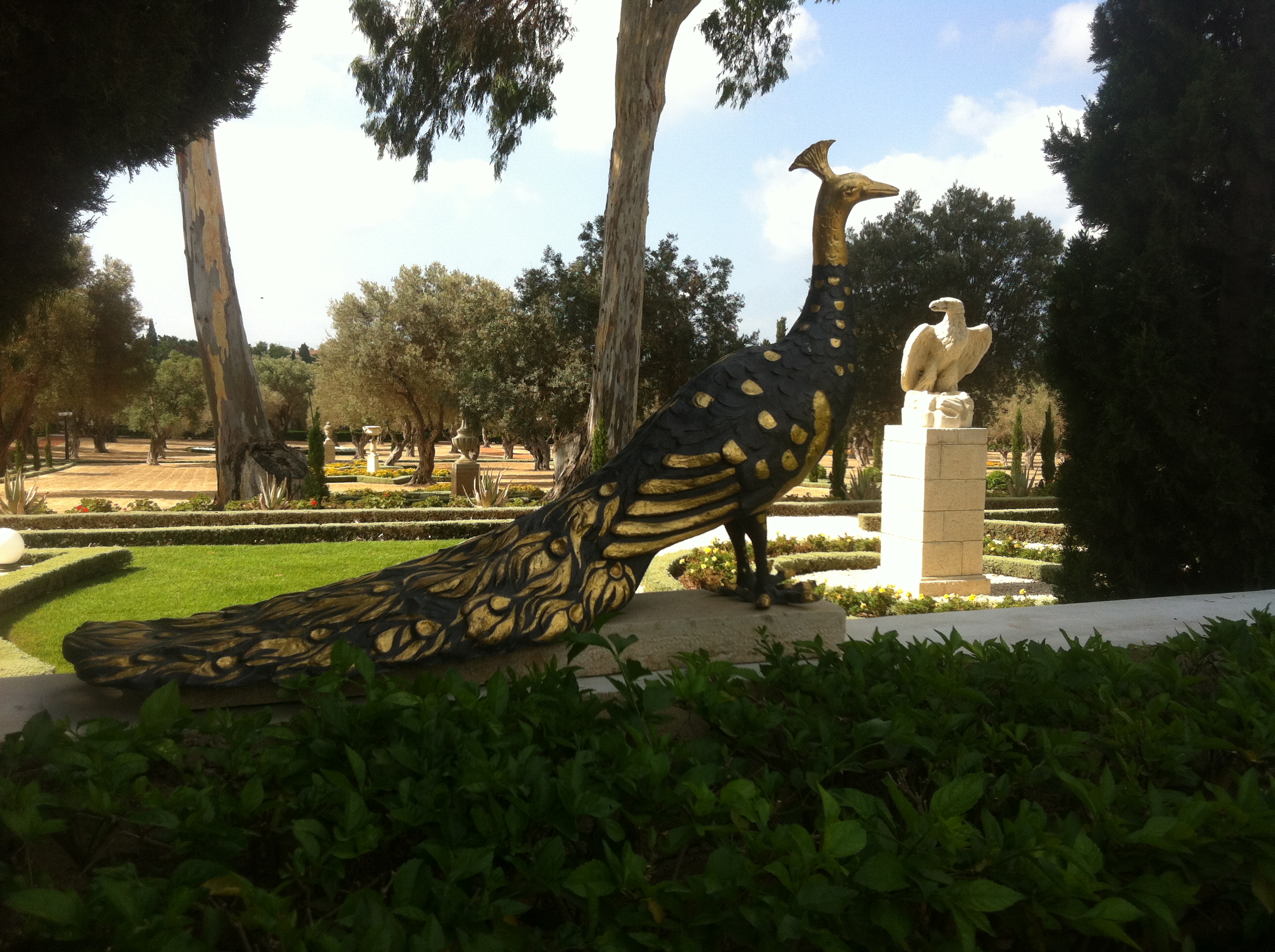
the gilt peacocks and stone eagles
            perched steadfastly
the parrots, the hummingbirds,
and a Nightingale—
                        this is Paradise—
 
But you long-legged careless ones
that squawk and hop across the lawn
and you, bird of prey, dagger eyes.
            You have to be a peregrine falcon,
            A pilgrim like me.
 
Give me all your names,
            you birds of Bahjí,
            and let me collect your brilliant feathers
            here, in the kingdom of my heart.

When birds need passports

When I walk across the arc around 6:00, there are dozens of crows feeding on the pristine lawns.  One friend compared this daily descent to a scene from The Birds.  So far, though, these birds don’t seem as bent on world domination as Hitchcock’s were.   I watch one sip from an irrigation pipe, and another carry a piece of gravel in his beak.  I wanted to see what he was going to do with it, but then I got self-conscious about my very public birdwatching and continued on my way.

Animals are a frequent subject in break time conversation.  That, and food.  (Recent topics: the healthiness of peanut butter, the popularity of Nutella in the US, and how the effects of eating pomegranate vary by your blood type.)   But let’s stick with animals.

The other day, one of my colleagues was telling us about a talk ‘Abdu’l-Baha gave in California to the Materialists Club.  According to the dictionary, the philosophy of materialism holds that “nothing exists except matter and its movements and modifications.”  Or, that “consciousness and will are wholly due to material agency.”  Basically, to my understanding, it denies spirituality.  So, ‘Abdu’l-Baha joked with these materialists that while they had spent decades thinking and studying and researching to arrive at the conclusion that there’s only a material world, cows know this from birth.  To paraphrase, “The cow is superior!”  He recommended that a cow be brought to give the club a lecture. The audience roared with laughter.

Then the break time conversation turned to birds and the freedom they represent.  While human mobility is limited by national borders and natural boundaries, birds can transcend that all.

Or can they?  I had to be a contrarian on this point and relate a story I heard from an Israeli zoologist, Avinoam Lourie, when he gave a talk in Madison.  There has been an effort to reintroduce vultures into the wild in Israel.  The challenges to this project abound.  For instance, farmers will lace the carcasses of livestock with poison to kill the predators that attack their flocks.  Vultures, as they eat carrion, find these carcasses, consume this poison, and die.  The zoologists track these birds with little computers strapped to their bodies.  Now, as has been pointed out, birds don’t respect national borders, and these vultures have a habit of exiting Israel and entering neighboring countries.  I don’t have to tell you about the less than friendly relationship between Israel and its neighbors.

So, some vultures, winging their way into diplomatic history, flew into Lebanon, where their suspicious-looking tracking devices were spotted.  The Lebanese assumed these birds were spies for Israel, taking aerial footage, and shot them down.

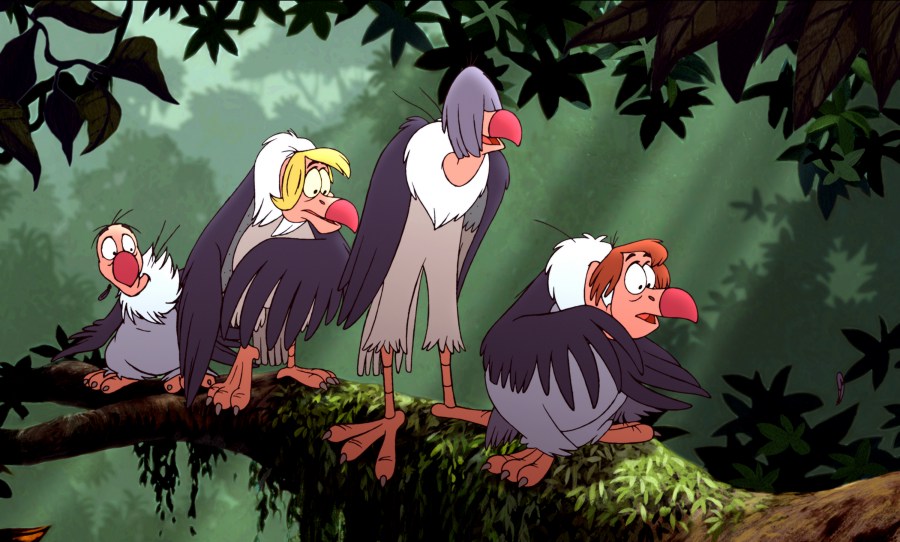
So do we smuggle ourselves through customs, or what?

“So do we smuggle ourselves through customs, or what?”


It’s a reminder of how pervasive our system of borders has become.  The walls, the security forces, the bureaucratic obstacle course to crossing–well, don’t get me started.  But someday–yes, someday, vultures won’t need passports to take a trip north, and bovines will earn tenure in philosophy departments.

Equinox

I was told that on Yom Kippur, the streets would be absolutely desolate.  The Day of Atonement is a very solemn Holy Day for Jews, who keep a 25 hour fast.  Yet, a few cars pass by.  Kids shriek as they play on their bikes and toy cars.  And there are a lot of firecrackers.  When I first arrived, I was unsure what to make of the sounds of explosions that punctuated the evening.  I mean, it didn’t exactly reassure me about the security situation here.  It turns out that the people here use a lot of fireworks to celebrate engagements, which, given how many fireworks get set off, means that there must be hordes of fiances filling this city.  But Yom Kippur and fireworks don’t go together so well.  Two theories were circulating about why the day was so noisy.  (1) The Arabs were trying to annoy the Jews or (2) the Jews were celebrating their atonement.  Somehow I find the latter a bit less likely…

***

Even though I spend most of my time under fluorescent lights in an air conditioned office, I can tell the air is changing.  I no longer fully thaw out on my walk home.  The highs are only in the low eighties.  Yesterday, some clouds hung over Mount Carmel, promising rain with their gray underbellies.  Nothing yet.  When I was walking across the Arc at sunset, I paused to take in the thunderheads poised above the bay, edged with pink.  I wasn’t the only one impressed; I passed two others who pulled out their camera phones to record the sky.  I gave up on using the camera in my phone as it blurs everything, so I try to capture the vista in my mind.

Yesterday I stood on grass for the first time in a while.  It was a small patch of lawn in front of an apartment building.  I rarely have the opportunity to leave the pavement or the gravel paths I take through the gardens to my office.  I need to find a quiet city park and just lie in the grass for a while like I sometimes do, close to the dirt and the bugs and the earth.  Humility, from humus, soil.  Getting close to the soil.  Walt Whitman knew the sanctity of those leaves underfoot:

A child said, What is the grass? fetching it to me with full hands;
How could I answer the child?. . . .I do not know what it is any more than he.
 
I guess it must be the flag of my disposition, out of hopeful green stuff woven.
 
Or I guess it is the handkerchief of the Lord,
A scented gift and remembrancer designedly dropped,
Bearing the owner’s name someway in the corners, that we may see and remark, and say Whose?
 
Or I guess the grass is itself a child. . . .the produced babe of the vegetation.
 
Or I guess it is a uniform hieroglyphic…
 
Read more!

The carnivore

I just killed a fly.

See, with insects and really all creatures, I usually follow an ideology close to the Jain tenet of non-violence.  I remember hearing about how Jain priests sweep the ground in front of them as they walk so they won’t harm any little animals in the dirt.  Ok, so I’m probably guilty of accidentally crushing a few ants as I walk, but there was a time when I couldn’t even bring myself to slap the mosquito indulging in my O-negative.

Those days are over.  I grab a pack of baby wipes, which is the best flyswatter I can locate in our kitchen, and smack that fly hard.  The fly gives up the ghost and falls into a pan soaking in the sink.  After staring at the floating corpse and muttering “ew” repeatedly, I fish it out and dispose of it sans eulogy.  I’m just not cool cohabiting with flies.  Besides their dirty little feet, I’ve heard too many horror stories here about maggots found growing in jars of Nutella.  The Haifa climate is a great nursery for all sorts of bug babies.

This willingness to murder flies must be connected to my recent forays into the world of meat.  While I’m not a vegetarian, I usually eat meat only a few times a week, and almost never beef.  I read Ruth Ozeki’s My Year of Meats when I was eighteen, and that turned me off to the meat industry.

Plus, I’ve been warned about the chicken here, which reportedly has preternatural powers to expand one’s waistline.  “Stay away from the chicken,” they say.  “My sister came here, and she gained 25 kilos in a year.  It was the chicken.”  Apparently Israel pumps their birds full of hormones.  I shrug, a little insulted that Israel is trying to outdo the States in unethical meat practices.

Love handles?

Love handles?

Yet chicken is the only raw meat I’ve brought myself to cook.  I’m still terrified I’ll poison whoever I’m feeding by thawing or cooking it wrong.  Honestly, I don’t think I’d ever fully observed chicken being cooked before I attended an Indian cooking class here.

Now I find myself preparing  butter chicken for eight guests, wondering if eight departments will find themselves one staff member short tomorrow morning.

Butter chicken


Please note that not only did the chicken turn out to be non-poisonous but also delicious.  Can you see the almost-tadik on the right side?

Maybe I should learn to cook tofu–or better yet, seitan.  I like seitan, I think, despite it consisting of “high protein wheat gluten,” which sounds like “nutritional yeast” and other weird vegan products I’m not alt enough to touch.  The word is Japanese, and I don’t really know how to pronounce it, so I call it “satan.”   As in, “I bought satan today.  I put satan in the freezer, and later, I will cook satan.  Have you tried satan before?”  Well, have you?

Office star

Dear rock stars of the world,

While you might feel pretty cool shredding your guitars onstage, I’m rocking out admin style, shredding these papers…like Jagger?

Love,

Layli

Actually, when it comes to office tasks, I’m anything but a star.  A simple trip to the shredder reminds me that while my Mount Holyoke BA covered everything from the epidemiological paradox to sestinas, it failed to educate me on the finer points of office supplies.  So I find myself once again repeatedly jamming the shredder with an overload of documents.  The shredder chokes for the fifth time in the past four minutes.

I kneel down and tell it, “Hey, you should know I’m not such a dunce–I graduated summa cum laude, alright?”

The shredder considers, wondering how my fancy diploma would taste, and how it would look digested into strips of Latin.

A colleague asked me how I was doing with my new duties.  I hesitated, considering how much time I had spent struggling to fix a stapler or to coerce the photocopier into submitting to my will.  (It won.)  Or how difficult it had been to find that room where according to legend there would be stacks and stacks of bond paper.  After wandering around one building, asking everyone I encountered about “the room with lots of paper,” I found one sympathetic soul who joined me for my quest.  Up the elevator, down the stairs, I got my first thorough tour of this building.  It was an actual paper chase.

Does anyone know where I can find the big boxes of bond paper?

“Enough with this Socratic nonsense.  Does anyone here know where I can get ten reams of bond paper?”

There are these simple tasks that aren’t so simple for a newbie.  And then there are the bug traps–or, as Catchmaster calls them, “adhesive pest control products”–and the unfortunate lizards that stroll inside.  I saved that first one, yes, and a few more.  One of them I only partially saved, as in his eagerness to escape me, he abandoned his tail, which flailed around on the ground in front of me until I tossed it into the bushes.  But there are those tragedies when I’m too late.  Or the ancient bug traps I’ve found when I explore the creepier passages of my building, that were set out years ago and have been collecting diverse little bodies since.  I enacted the story of Pandora’s box with one such trap.  I just had to know its contents, so I unfolded the box cautiously and found a desiccated gecko and what I swear was a fossilized tarantula.  Shiver.

Oh, Pandora...

Oh, Pandora…

But these brushes with kingdom animalia have endowed me with a certain prestige in the office.  One day I was doing something administrative, possibly wrestling with some staples, when I heard a cry for help: “Is anyone here not afraid of lizards?”  Already excited, I stood up: “I’m not!”  My colleague led me into the ladies’ washroom where a tiny lizard was hiding behind the toilet.  I got down on the floor and after a little graceless scrambling around caught it by its tail and, cradling it in my palm, took it out to the garden to release it.  When I returned, the women I had rescued greeted me as a hero.  Literally, “You’re so brave!  You’re our hero!”

Really, folks, it’s nothing.  All in a day’s work.