Happy (belated) Ayyam-i-Ha!

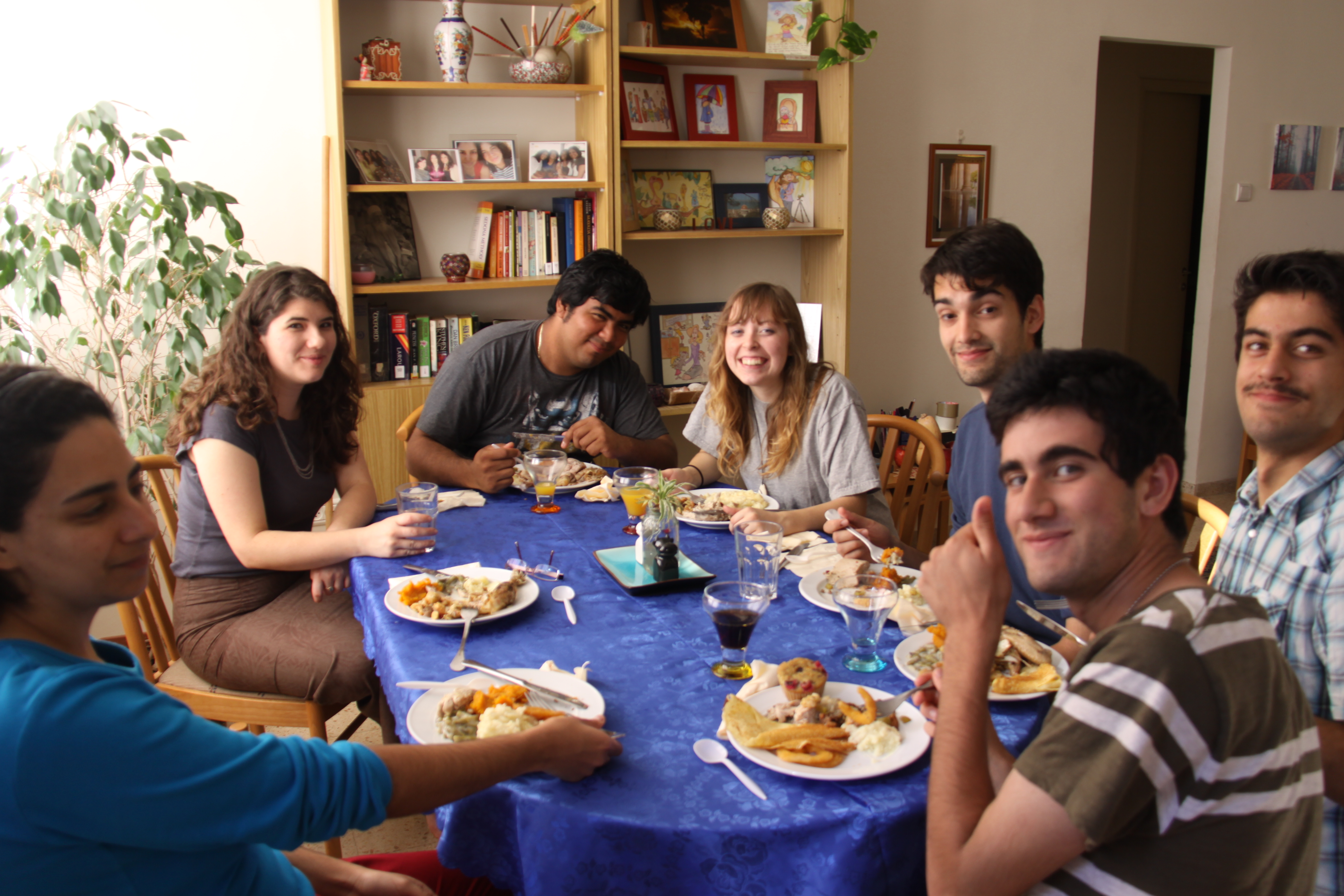
Ayyam-i-Ha is the period of 4-5 intercalary (between calendars) days in the Bahá’í calendar.  It is a time for generosity, hospitality, and fellowship.  Here, there is an opportunity to host “Special Dinners” in celebration.  You sign up for a type of cuisine and a date, then get assigned a guest list.  Sergey and I decided to host one of these dinners (Tex-Mex themed, because I have no idea what Wisconsin-Moldovan cuisine would entail) for two reasons.  One was to extend hospitality to our colleagues and friends.  The other was to study our behaviour under pressure.

It proved to be a great test for that latter point.  From a beginning guest list of ten, we eventually inflated to 25.  Now, I’ve done most of the cooking for 15 before (Thanksgiving dinner), and had 25 people over (for the weekly study meeting), but this was my first time cooking solo for so big a crowd.  Calculating how much food I would need to feed 25 people bulking up for the Fast, I began to mildly panic.  Would polvorones and tres leches cake (which was almost autocorrected to the less appetizing “tres leeches cake”) sate the many sweet teeth?  How many gallons of horchata to brew?  Four kilos of chicken?  Ten avocados for guacamole, twenty tomatoes for salsa?  And how much caffeine for me?

And then there was the cleaning and organisation to be done.  Sergey recently moved into a flat that was previously occupied by an artistic nature lover.  Therefore, scattered around the flat were odd arrangements involving bamboo poles, rocks, houseplants, and an iron tub.  My favourite was in the dining room, where in a corner several bamboo poles and rough white rocks sat on a dais of tree trunk, with a lamp and a houseplant nestled in the middle.

Eventually we got the place looking less like an eccentric’s greenhouse, and I merrily went about watering the many plants.  One giant plant seemed especially thirsty, so I kept watering it.  Several minutes later, I noticed a yellow puddle spreading under the refrigerator from the plant saucer and realised that I might have been overenthusiastic in my plant care.  While mopping it up, I thought of an incident years ago during my toddling days when I had also overestimated my green thumb.  In our living room, we had some big potted jasmine plants.  In my childish ignorance, I guess I thought soil contained seeds, and all one had to do was sprinkle dirt around and, poof, plants would grow.  So, after enlisting poor Jasmine in my plan, we scooped handfuls of soil out of the pots and sowed a mess on the carpet and couches.  Our harvest was two peeved parents.

Anyway, despite our nerves–mine manifested in excessive baking sprees–and obstacles like a contrary oven, the night was a success.  (There were a few jalapeño issues, but no trips to the ER.)  After eating, we had an anonymous gift exchange, and then a musical portion with sing-alongs and call-and-response.  Although by this point I was collapsed on the floor, I really enjoyed hearing the voices of our guests joined in song.  People were happy.  There’s a quote of ‘Abdu’l-Bahá about how a gathering can transform a home into a house of heaven, and indeed, it was one heavenly flat.

Blushing

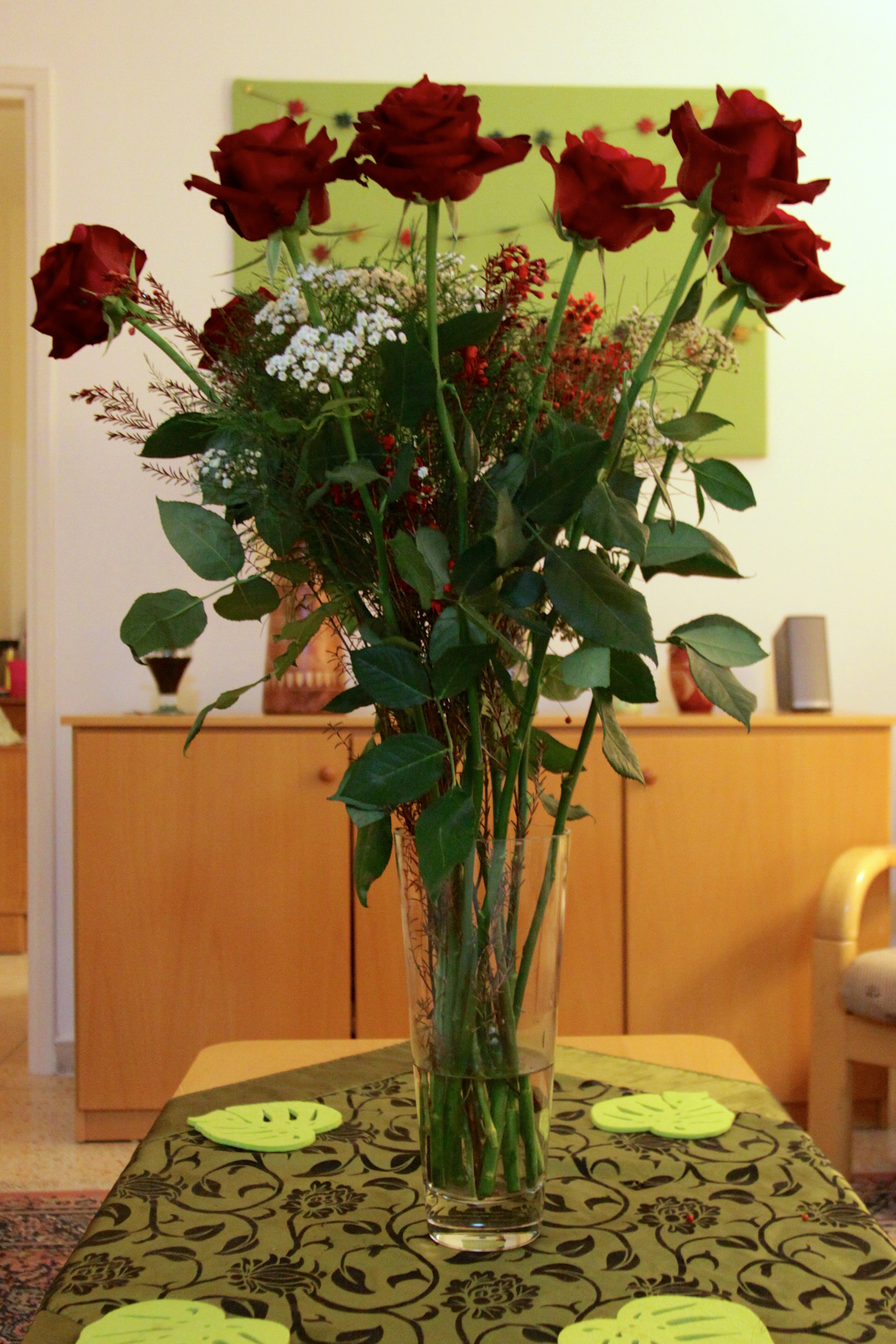
Nine roses

Nine roses

Do you blush?  Maybe you’re one of those cool and collected types.  Actually, I’m usually one of those types, except when my “personal life” comes up.  In those cases, I am the most bashful of them all.  I couldn’t actually tell you what colour I turn, but beet red sounds like an accurate description, as all the blood in my body rushes to my face.

I brought a love poem to share with my poetry group this week.  As lunch started, I found myself goring increasingly nervous and regretting that I’d cheekily subtitled the poem “Yes, this is a love poem.”  (One of my friends in that group is constantly accusing my poetry of being about love.  No.  It’s about birds.)  When that time came–“Did anyone bring anything?”  I reluctantly admitted I had…and started blushing.

“Uh, it’s a poem I wrote for Valentine’s Day, so it’s kind of embarrassing,” I said.  (I mean, who wouldn’t bare her heart in gratitude for a bouquet that perfectly colour coordinates with her red and green themed living room?)  I promised that if my face returned to the more pallid end of the pinkness spectrum, I would share.  At some point I steeled myself–blushingly–and distributed the poem.  If I could manage that, then I can handle sharing one with you, dear reader.

Oh, and yes, this is a love poem.

 Your name is a lamp

for the flame of my tongue

and to call out to you

through the dark

sends sparks

through the lacework

of night

I wonder, did the saint

of the alphabet

know the brightness you would be

when he invented the

wheeling majuscule

and smile-capped conclusion

of your name

Sing it or say it, you make me

live every day

radiantly

Mysterious calcareous encrustations

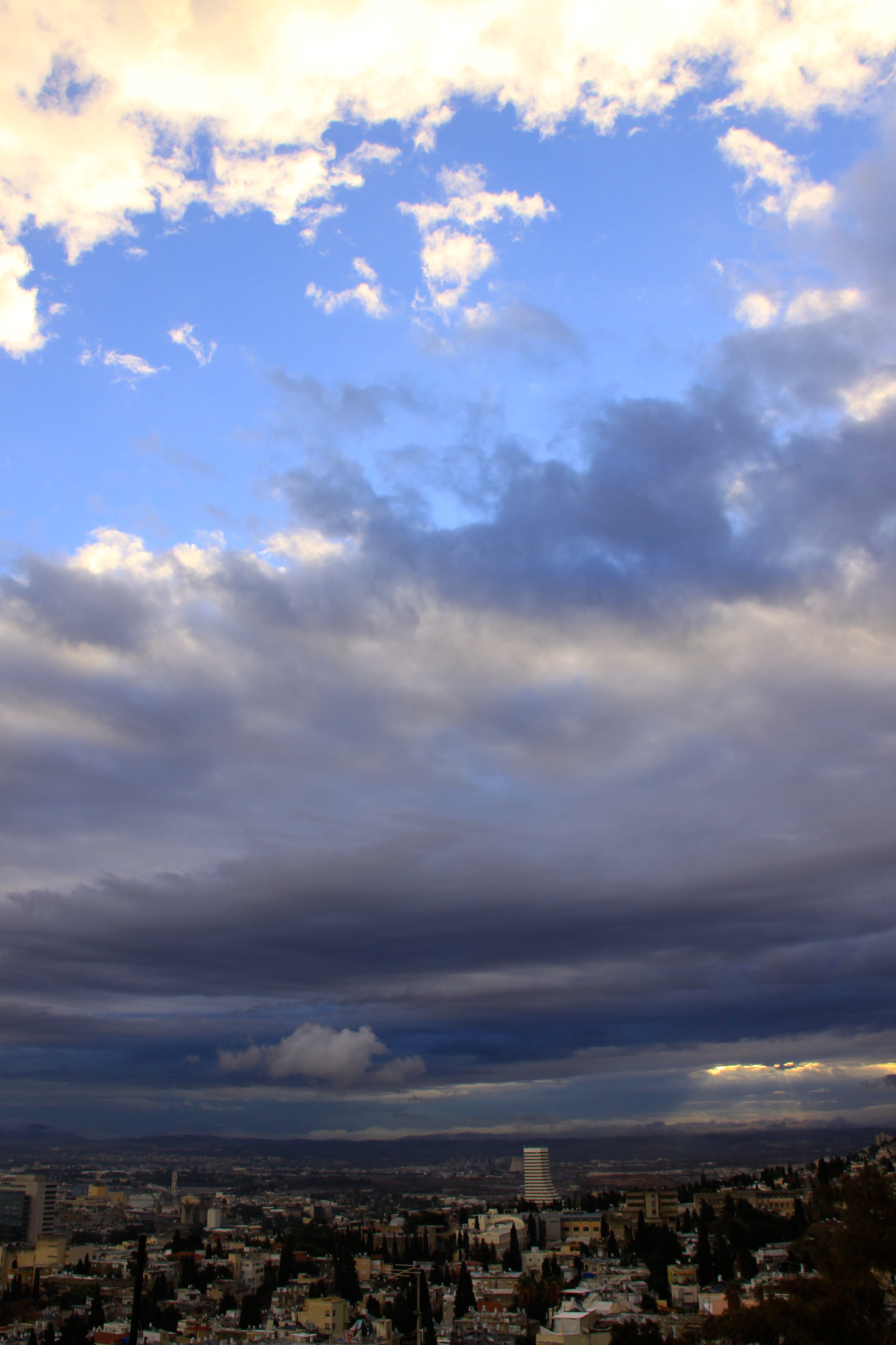
Haifa in the morning

Haifa in the morning

It’s been a busy week.  Sergey and I went up to Nahariyya, a seaside town on the border with Lebanon.  After a ride on a public sherut, we stood on the pier, watching schools of skinny fish and a line of fishermen lackadaisically dipping their lines into the Mediterranean.  In what is typical of our relationship, I got suddenly hungry before we reached a restaurant, and demanded that we stop for ice cream.  I decided to wait for the frozen yogurt line, while he went for ice cream.  He got his before I was helped, and I proceeded to “safeguard” the ice cream while he put his wallet away.  Then I ate most of it, all the while apologizing for my greed.

“It’s okay,” he said as I contritely attacked the chocolate ice cream.  “Really, I’m letting you eat it out of self-defence, because I know how you get when you’re hungry.”

Once I had consumed my pre-lunch dessert, we sat down in the restaurant, Penguin.  Then suddenly I felt a strange sensation, a slackening around my neck.  One of the strings of my beaded necklace had broken and beads were cascading down.  I clutched at my neck, but already a number were spilling onto the floor.  Our server approached and wordlessly handed me a doggie bag for my accident.  While I managed to slip off the necklace, some rogue beads slipped down the front of my dress.  Observing my discomfort, Sergey suggested I “want to go to the washroom.”  And stand up like a maraca with beads pouring out of my skirt in front of all the nice families around us?  No thanks.  So I sat primly paralyzed until the barista started grinding coffee… “Now!” Sergey said.  I stood up, releasing my incubated cargo beneath the din of the grinding, and scooped up the beads from my chair like a clutch of tiny eggs.  It was the sort of thing that would have had me blushing myself ablaze on a first date, but luckily now it just sparked laughter.

***

Hey, maybe you can help me with my homework.  Last week, I hosted my orientation group’s weekly deepening.  Wait, let me clarify.  My orientation group in the Serving the Divine Plan program has embarked on a three-month study of a course called “A Discourse on Social Action,” and I managed to cram 23 of these souls into my tiny flat for dinner.  It is at times like this that I know I owe Chandu, who taught an Indian cooking class, a great debt of gratitude; because of him, I learned how to make the most delicious dish known to man (butter chicken) with zero chopping and minimal prep, allowing me to feed a crowd on short notice.

Anyway, tackle these and send me your answers to these questions from the Discourse on Social Action material:

What is the purpose of friendship?

The purpose of certain things is truly complex.  Yet it is often possible to find a sentence that expresses this complexity in a beautiful and profound way. Consider, for instance, the statement that “The purpose of our lives is to know God and to worship him.”  How does this statement embrace all the praiseworthy aims of our lives, for example, to acquire knowledge, to find true happiness, to serve others, to love and to be loved?

To engage in a process of societal transformation requires faith–the assurance that such transformation is possible.  How does one acquire this faith?

***

In recent days my work has taken me into a chilly room with two objects conservators who share a number of interests, from archaeology to beading to Dr. Who.  My total ignorance about such topics makes me feel like a bit of a third wheel–they sympathetically apologized for my situation trapped in a room with the two of them–but by the same token, I’m learning a great deal about old things, for which they have unbridled enthusiasm.

One of them is a metal conservator.  She looks like she stepped out of an Orientalist painting, with a long black braid that flows down her back, glittering jewellery, and striking features, an appearance counterposed by her Californian accent.  From her I’ve learned some of the poetry of metal conservation–terms like “mysterious calcareous encrustations.”  Suddenly, everything has a “healthy patina,” from relics to lab coats.  The other, a collection specialist, has bright red hair, and pert British accent that perfectly complements her sharp wit.  She described how, in “uni,” she spotted the top of a skull sprouting in her flower garden and was immediately filled with excitement.  What being did this belong to?  To the horror of her “mainstream” roommates (“I think we call them ‘muggles'”), she excavated the skeleton, which turned out to be a cat.  A few more credit-hours with these two ladies, and I expect to earn my own degree in conservation.

The tamarins of Tel Aviv

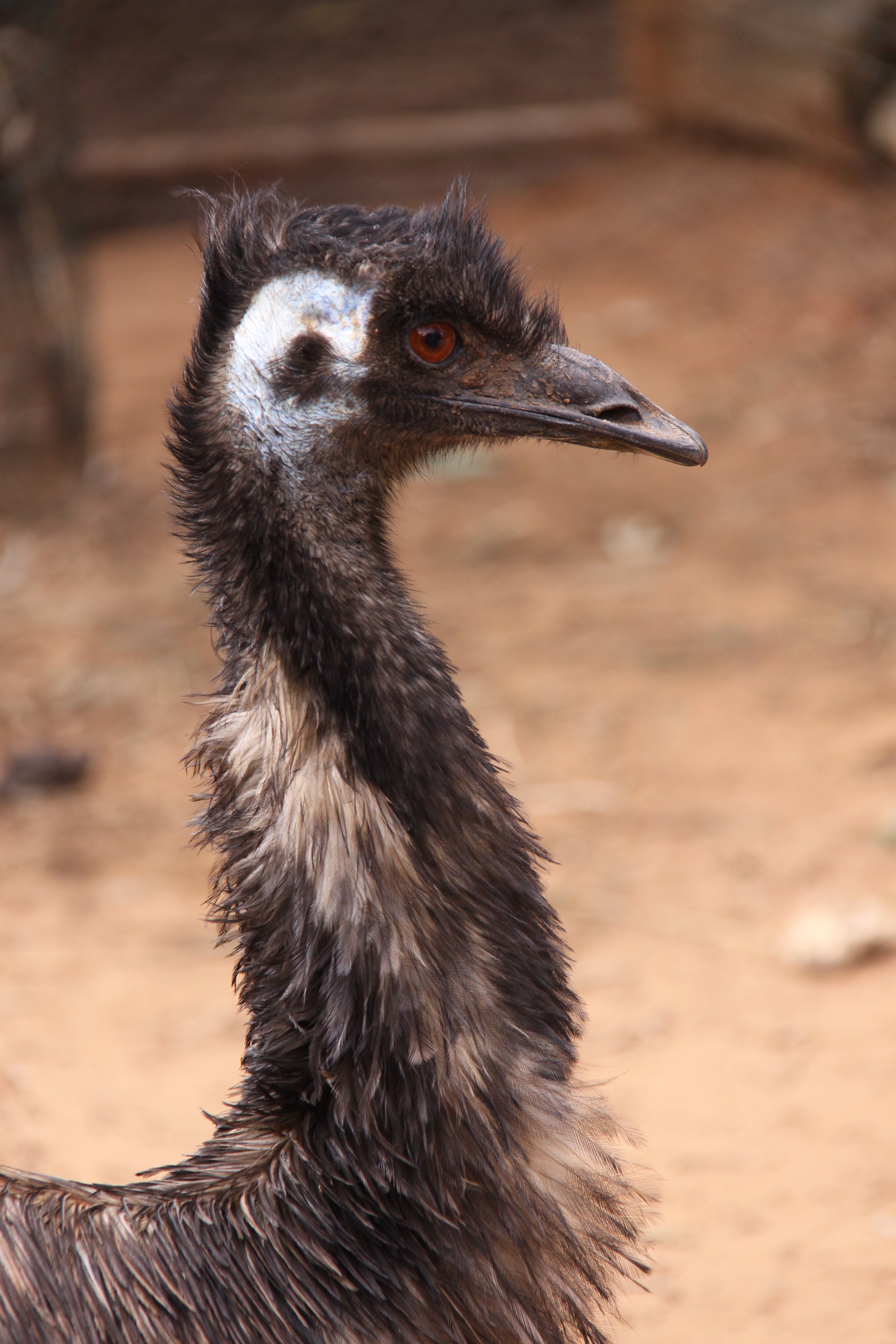
Rhea!

Blue sky, warm sun.  The burbling hum of hundreds of excited children, the pungent musk of animals.

This is the second zoo I’ve been to in Israel.  The other is in Haifa.  My clearest memory of it is the single honey badger pacing furiously in its small enclosure, swinging its head back and forth, all in an eternal oscillating search for an exit.  Oh, and the hobo kittens living with the otters.  Then there were the pop songs pumping over speakers, because apparently listening to the sounds of the animals would be much too boring for zoo patrons.  Needless to say, I wasn’t overly impressed, and I left feeling guilty about all those trapped creatures.

The Tel Aviv zoo, Ramat Gan Safari, however, provided a far happier vista.  It boasts the largest collection of animals in the Middle East, a Noah’s ark in the midst of an urban sea.

To enter the zoo, we first drove through an expansive park where herds of African savannah animals roam–zebras, antelopes, elands, wildebeest, scimitar horned oryx, hippos, and rhinos, among others, including the greedy ostriches that poked their bald heads toward the drivers’ windows of the passing cars.  It was pretty neat to watch a whole herd of hippopotami nap standing up like boulders in the sun.

Sleeping in, hippo style

Sleeping in, hippo style

The most impressive scene was, of course, the lions, which played, stalking and ambushing each other, even leaping over one another, in an exhilarating game of big cat tag.

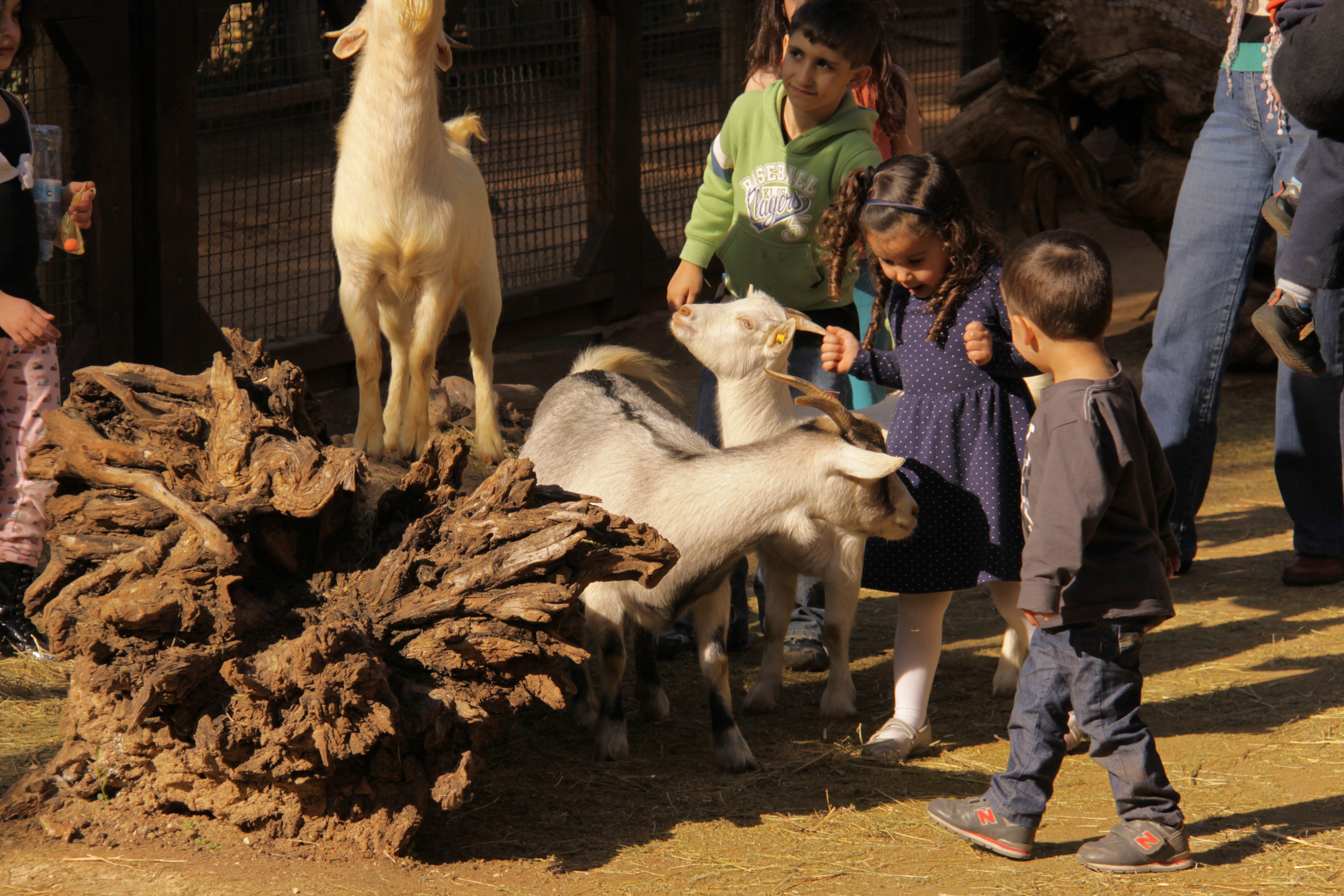
Within the zoo, the most striking exhibit was Israeli family life.  The paths were flooded with children and their parents to the point that I was concerned about moving too fast for fear of accidentally trampling a toddler.  Then there were the frequent stroller traffic jams.  I felt a bit out of place without a child, or at least a stroller, in tow.

The kids...haha, pun!

The kids…haha, pun!

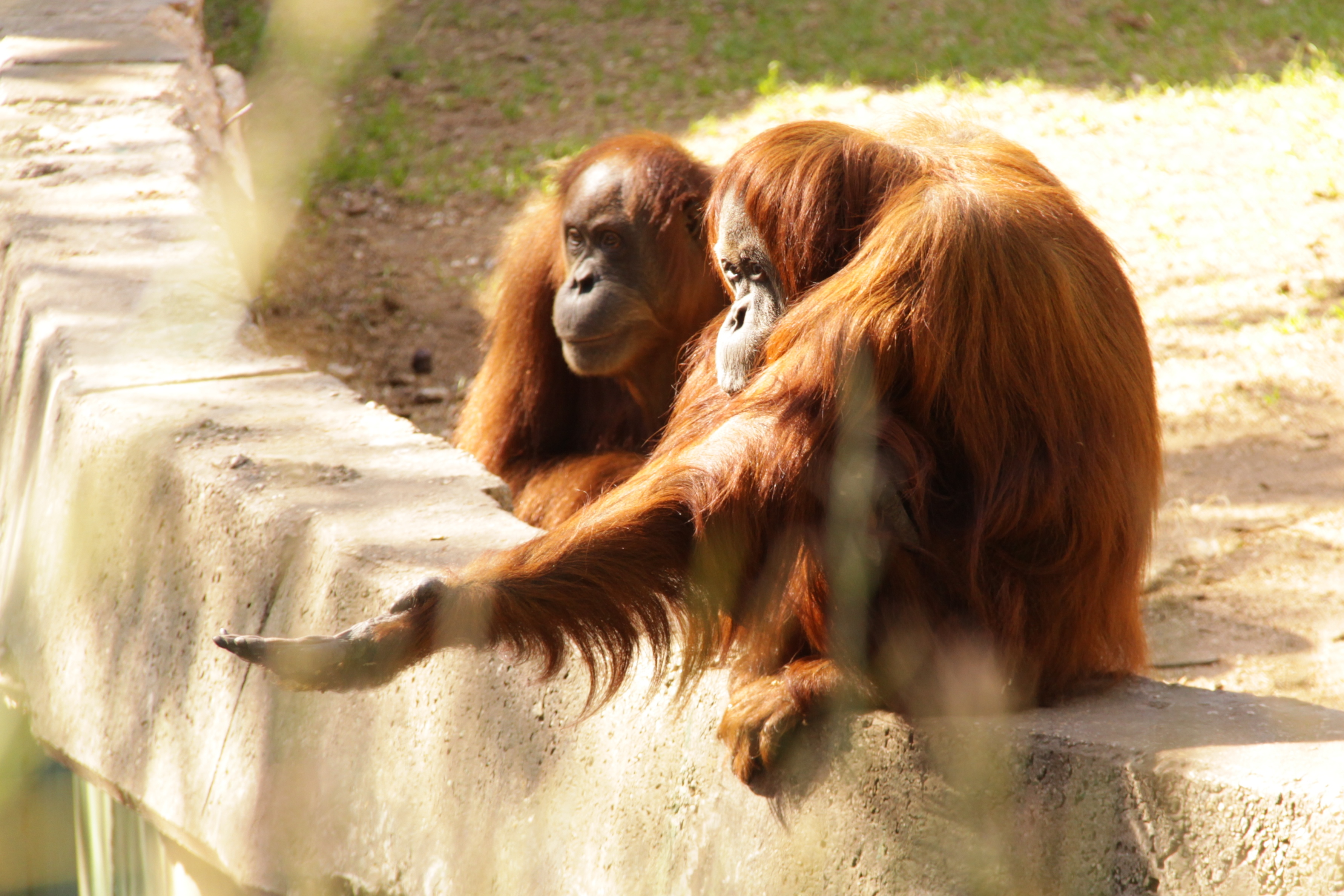
Besides the impressive collection of homo sapiens cubs, there were the monkeys–so many primates!  Tamarins, baboons, capuchins, orangutans, gorillas, lemurs, colobus, monkey A, monkey B, monkey see, monkey do…  One orangutan sat still on the edge of his enclosure’s moat with a hand outstretched as if waiting for a long overdue gift.  On the whole, they were better behaved than the children.

Hand it over…

It was an apt time for me to visit a zoo, having finally finished an excellent book my mom recommended to me years ago called The Zookeeper’s Wife.  The prose in this vividly written history was so delicious, I wanted to slurp it up.  The story, on the other hand, is one of sorrow and struggle, as it follows the true story of a zookeeping couple in Warsaw through World War II as they survive the destruction of their city at the hands of the Nazis and help to hide Jews on the grounds of their zoo.  I shan’t say more, because you should really just read it yourself, but Diane Ackermann’s painstaking research introduced me to the complex politics of zoos.  For instance, even this Ramat Gan Safari has some involvement in the ongoing Israel-Palestine conflict.  After a Palestinian zoo in the West Bank, Kalkilya Zoo, lost three of its zebras to violence, Safari gave it several animals in a gesture of peacemaking.  Animals are not spared in war, but their return can, it seems, help to rejuvenate a nation.

A caravan of three

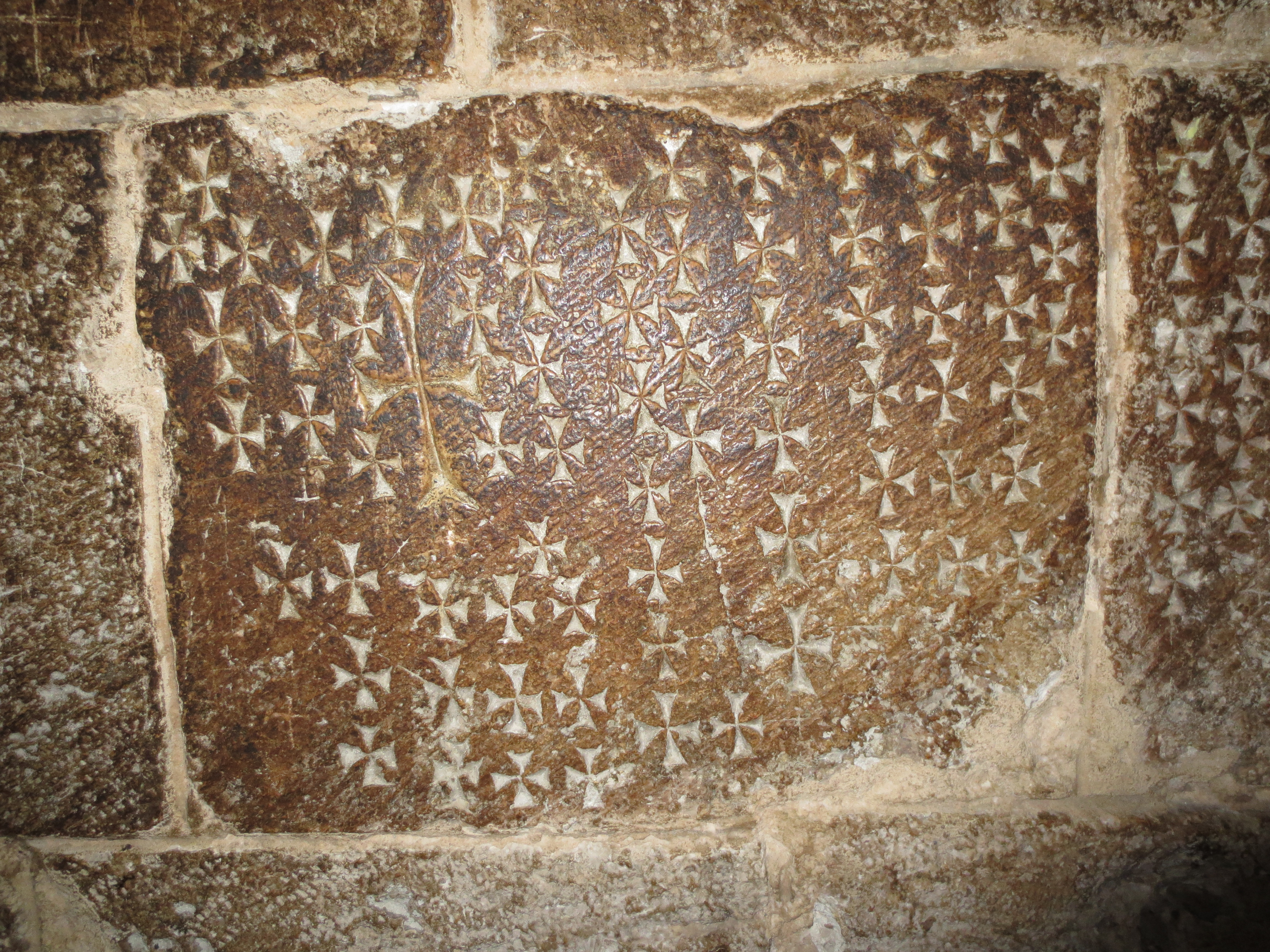
Crusader "signatures" in the Church of the Holy Sepulchre

Crusader “signatures” in the Church of the Holy Sepulchre

It is 5:45 in the morning and Haifa is still darkly asleep.  This is a time I rarely see–only during the Fast, really.  But today, we are on our way to Jerusalem, a caravan of three travelers.

We take a bus and then another bus, and have a layover at the central station in Jerusalem, which is full of young soldiers, fresh-faced in their fatigues.

“DONUTS!”  I haven’t seen donuts in six months and I’m pretty excited that this huge bus station sells them.  (Now I know where to go when craving hits, and it’s a mere three hours of buses away!)  Jasmine and I share a big one with sprinkles that stain my lips while Sergey drinks some coffee sludge.  Finally we make our way to a tram that takes us near to one of the gates of the Old City.

I have a plan of attack.  First the Church, then the Wall, then the Dome, then the Mount.  En route to the Church of the Holy Sepulchre, we pass by several Stations of the Cross, and pause to touch the spot believed to bear the handprint of Christ.

“I touched this before,” I comment, showing off my worldliness.  “Yes, I’ve touched everything in Jerusalem.”

“No wonder you’re sick,” Sergey replies.  Indeed, I wasn’t the classiest travel companion, what with my wad of tissues and plugged ears.

When we get to the Church, we go through the various sites—the anointing stone, Calvary, the Armenian chapel with the Crusader imprints on the walls, that subterranean chamber… I try to recount the fragments of history I remember.  Something about Saint Helen and Constantine.

Next stop: the Western Wall.  The female side proves less interesting than the male section, where a number of simultaneous bar mitzvahs are happening.  Lots of Torah scrolls, boys in yarmulkes, and tossed candy give the place a jubilant spirit.  We climb onto unwieldy plastic chairs that seem placed there for the express purpose of letting female visitors ogle the masculine goings-on.  I’m pretty sure I ended up in at least one lad’s bar mitzvah video.


Bar mitzvah(s)

Bar mitzvah(s)

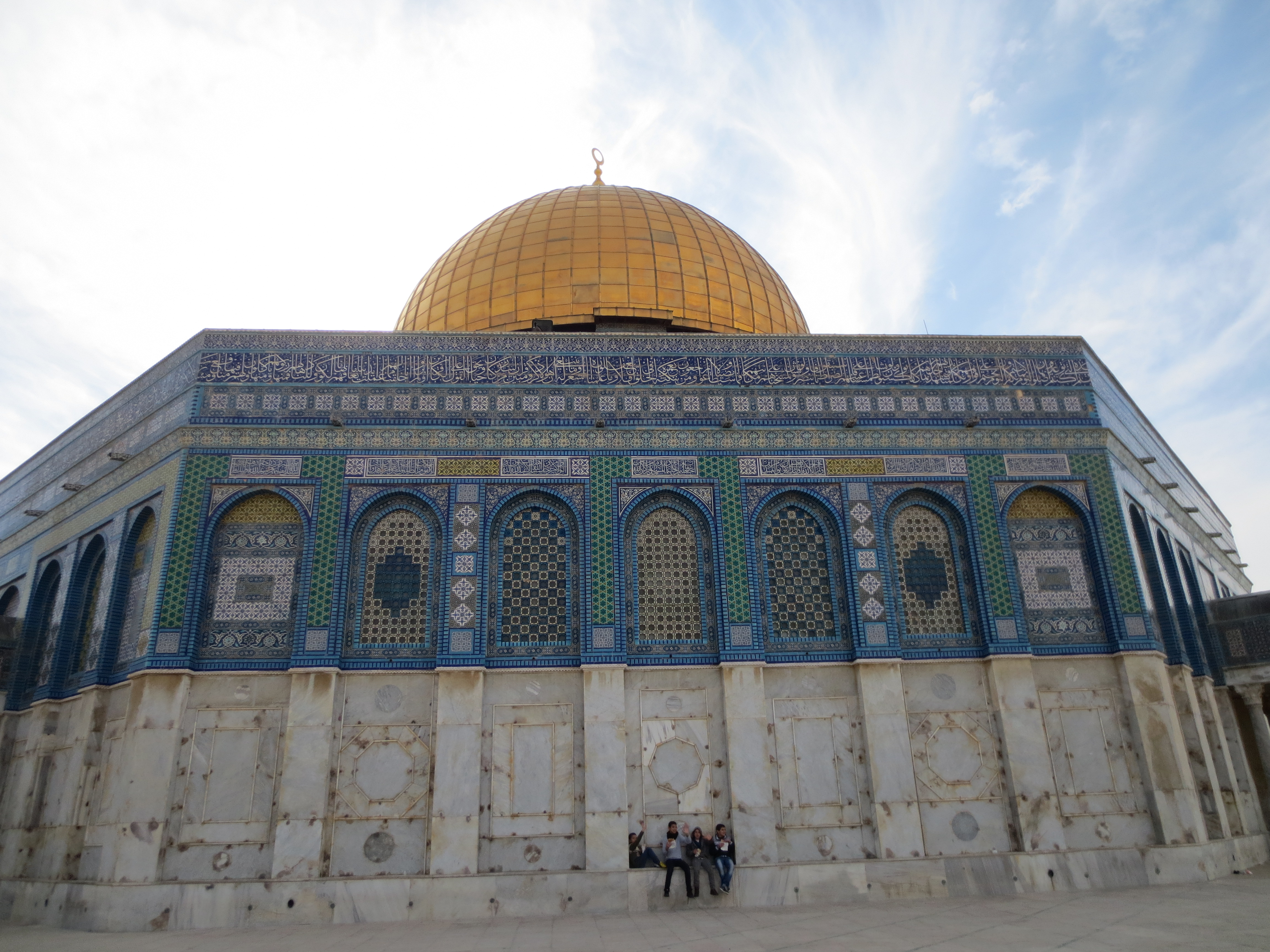
But the stop I’ve been eagerly awaiting is not the Church or the Wall—it is the Dome.  If I learned anything from the documentary that eased Jasmine into dreamland, it is that the Temple Mount is super important historically.  I hadn’t gotten to see the Dome of the Rock on my last visit because its hours are so limited, but this time, I was ready.

After a long wait in line, we walk up a sheltered bridge to the mount, where we find ourselves in a large open space with a long mosque to our right, the al-Aqsda.  Like moths to a flame, we are drawn up some wide stairs to the Dome itself, resplendent with delicately painted greenish blue walls and its shining gold dome.  Inside (off-limits to non-Muslims) is the rock from which it is believed Muhammad ascended to Heaven during His mystical night journey; apparently His footprint remains.

We wander around the huge plaza, which dates to the time of King David.  The area is surprisingly casual—some young women in hijabs study in a circle on the ground, while boys kick around a soccer ball.  Four young boys, munching on their lunch in an alcove of the wall, beg Jasmine to photograph them, then come to assess the result.  “Facebook!” they demand happily.

Facebook! WordPress!

Facebook! WordPress!

After lunch, we headed to the Mount of Olives to visit Gethsemane and the Church of All Nations…or the Agony, I’m not sure what its proper name is.  It is quite a different experience from last time, when it was thronged and someone came over the loudspeaker repeatedly to instruct “Silence”; this time, I feel at peace sitting in a pew, looking at the nighttime garden scenes on the huge mosaics around the walls.

It is sunset by the time we entered the Valley of the Dead, which is between the Mount of Olives and the Old City.  A funeral unfolds with Jewish men swaying in black robes; the muezzin pipes a call to prayer.

Eventually, exhausted, we got on the bus back home and realized with sighs of relief that the most comfortable seats had been reserved for us: the floor.  Yes, apparently it’s a-ok in Israel to allow people to stand for two hours on the highway.  After about 15 minutes of swaying over an IDF soldier and watching another passenger giggle at cat videos, I succumb to gravity and wedge myself and my backpack down into the narrow aisle, with my cohort following suit.  Soon, at my offer, two sleepy heads loll against me.  In a weird way, it was cozy, the three of us snugly squeezed onto the floor with views of people’s shoes, the lights through the windshield, and the diminishing kilometers to Haifa.

Guess who’s back?

Thus I return shamefacedly to the blogosphere after a truly prolonged one-month absence.  It has been far too long, my friends.  I know you’ve all been biting your nails to the quick, desperate for news of my life.  Has she been wandering in the desert of Israel?  Dallying with her hordes of suitors?  Or working in an office by day and doing more Bahá’í activities by night?

Ok, all three have been a little true, but mostly the latter.  But I did have a very important break from my routine: Jazzy came!

That’s right, and I’m just now recovering.  As of a few days ago, no longer does putting on my jacket chafe my elbow wound excruciatingly.  No longer am I partially deaf.  Just kidding, Jasmine, it was precious to be with you and suffer multiple physical privations together, one of them the cold that you brought for me (imported from the good ole U.S. of A.!).

The elbow–ah, yes.  When I knew that Jasmine was coming, several months ago, I started planning our itinerary.  She would volunteer while I was in the office, and then when out of the office, we would go to the Bahá’í Shrines and then explore Haifa and Israel with my boundless energy.  Seriously, this was the most amazing, compulsive itinerary, with a full spectrum of color codings.

Jasmine gets a taste of Israel

Jasmine gets a taste of Israel

One of my goals was to have Jasmine visit the Dead Sea.  It was such a strange, otherworldly experience for me to float upon the water and look across the sea to the mountains of Jordan.  So Jasmine would float there too.  Thing is, it’s rather far from Haifa–three hours one-way–and I’m too dangerous a driver to rent a car here.  So I organized a ten-person sherut trip.

I had been the concerned about the temperature.  I mean, “beach in January” sounds rather unappealing, unless you’re a penguin.  But thankfully, the temperature was as cooperative as possible.  The real problem was the wind, which stirred up waves–not whitecaps or anything, but still, steadily rolling, hyper-saline waves.

As we walked down to the beach, we passed two other members of our group.

“How was it?” I asked.

“I would not recommend going in,” one replied.  “I got water in my eye.”

After that ringing endorsement, we went in.  I think we managed to get at least a few moments of calm floating in, although the waves made me nervous.  Jasmine glommed onto me and we floated side-by-side like a human raft.

We were actually moving quickly away from our point of departure, pushed by the waves.  “Let’s try and get back to the shore,” we decided.  So we “swam” Dead Sea style, doing a slow, splash-less backstroke.

Five minutes later, my friend Reggie, who was accompanying us, said, “Hey, remember when we said ‘let’s get back to the shore?’  We’re actually farther out now…”

And now I was tired.  Thankfully he offered us a lift back, grabbed my leg, and pulled me (with Jasmine in tow) back to the shallows, where I managed to get water in my mouth and eye.  We at last hefted ourselves out.

My other friend joined us onshore.  “You’re bleeding,” he pointed out.

“Oh, interesting,” I said.  There was a scratch on my back, scrapes on my elbow, and little scratches on my forearms from a run-in with a salty rock formation.  And poor Jasmine’s feet were wounded, which was not helped by the extremely painful barefoot journey across the sharp stones of the shore back to our things.  I clenched my teeth and pretended I was one of those silly people who test their resolve by walking across hot coals.  Actually, hot coals might have been preferable.

Eventually, two freezing public showers later, we got back in the sherut.  I examined my wounds.  “Souvenirs,” I concluded.

“Well, I’m glad I got to see the Dead Sea,” Jasmine said, “because now I know I don’t need to go back there.”

I smiled, dabbing some dried salt off her cheek.  That’s my girl.

Season’s greetings

Dearly beloved, we are gathered today to mourn the loss of my 52-month old MacBook Pro, upon whose recent demise I shall blame my prolonged absence from the blogosphere.

But guys, the craziest thing happened.  The season changed, seemingly overnight, from summer to winter.  I suppose there were a few brief weeks of “fall,” when I could look super cool in my pleather jacket.  Then suddenly the rains came and soaked us for a fortnight, dropping the temperatures outside and, more noticeably, indoors.

Yes, this is the season of chocolate, I’ve decided.  For evolutionary reasons, once the damp cold seeps into my bones, I begin to crave cocoa in all its forms.  This has happened before, during my sojourn in the Chilean winter. Similar to Israel, the winter there is short but vicious, turning everything damp and gloomy.  The buildings, designed for a summery clime, lack insulation and central heating.

Speaking of which, did I ever tell you about the time I almost killed my host mother?  No?  Well, mi’ija, in Chile, estufas are the space heaters of choice.  These clunky heaters run on big natural gas canisters.  To light one, you turn on the gas and hold a match to the grate.

One day, I came down to eat an early lunch before heading to the university.  I turned on the estufa in the dining room.  Nothing happened when I tried to light it.  Late for work, I scarfed down my meal and headed out.  Once I arrived in the English pedagogy building, I realized my error.  A sick feeling sunk through me–I remember gazing helplessly at the dark paneled walls of the corridor as I foresaw my sad future, the headline scrolling across CNN–“American intern murders elderly Chilean host mother with gas poisoning/explosion.”  Would I be extradited?  Would Mount Holyoke disown me?

Desperately, I dialed Isabel’s number, and said something along the lines of, “ARE YOU ALIVE?  I left the gas on!  Please don’t light any matches or turn on any lights!”  Except in mangled, breathless Spanish.

She was alive, and told me the gas canister had been empty–therefore the lack of flame.  And that is how I nearly killed my Chilean host mother.

Anyways, chocolate.  In Chile, Isabel would buy me giant milk chocolate bars, and I also spent many of my own pesos on them.  I would carry around these embarrassingly huge bars in my purse, constantly nibbling.  It turns out that chocolate is a great accompaniment to anything, be it a cup of thick Nespresso, flank steak, or a lesson on Henrik Ibsen.  (Although macaroons suit the latter best.)

Let’s face it, I lack personal insulation, and my body wants me to pack on some blubber to get through the chilly months.  So I find myself bending over the oven on a Saturday night, the heater cranked to 30 degrees Celsius (I think the average high on Mercury), making the chocolatiest double chocolate zucchini bread ever (Betty Crocker does it again), or dreaming of a steaming mug of hot chocolate paired with a toasty s’more.  I should go have dinner…

My body’s scheme is working.  I think I have a tummy!  If I keep chowing down on the sweet stuff, maybe I’ll even be able to feel my fingers again.

Thanksgiving

My extended family

My extended family

For the weeks leading up to the fateful day of 30 November 2013, my life revolved around one thing: Thanksgiving.  You see, there was never any question in my mind that I would host Thanksgiving.  It is, as a recent New York Times article put it, the most important meal of the year.  And I think that’s all the more true for expats like yours truly.

First came the invites.  Once I had fussed over sending the most beautiful Outlook invitation I could make to fifteen friends, I realized I needed some food.  I asked my Moldovan friend Sergey to help me go grocery shopping.  He was puzzled by most of the foods on my list.  Squash?  Currants?  Celery?  Worcestershire sauce?  But mostly by French-fried onions, which I struggled to explain.  I mean, explaining them as, “The crispy onions that go on the green bean casserole, along with cream of mushroom soup and milk,” would surely cast doubt on American cuisine.

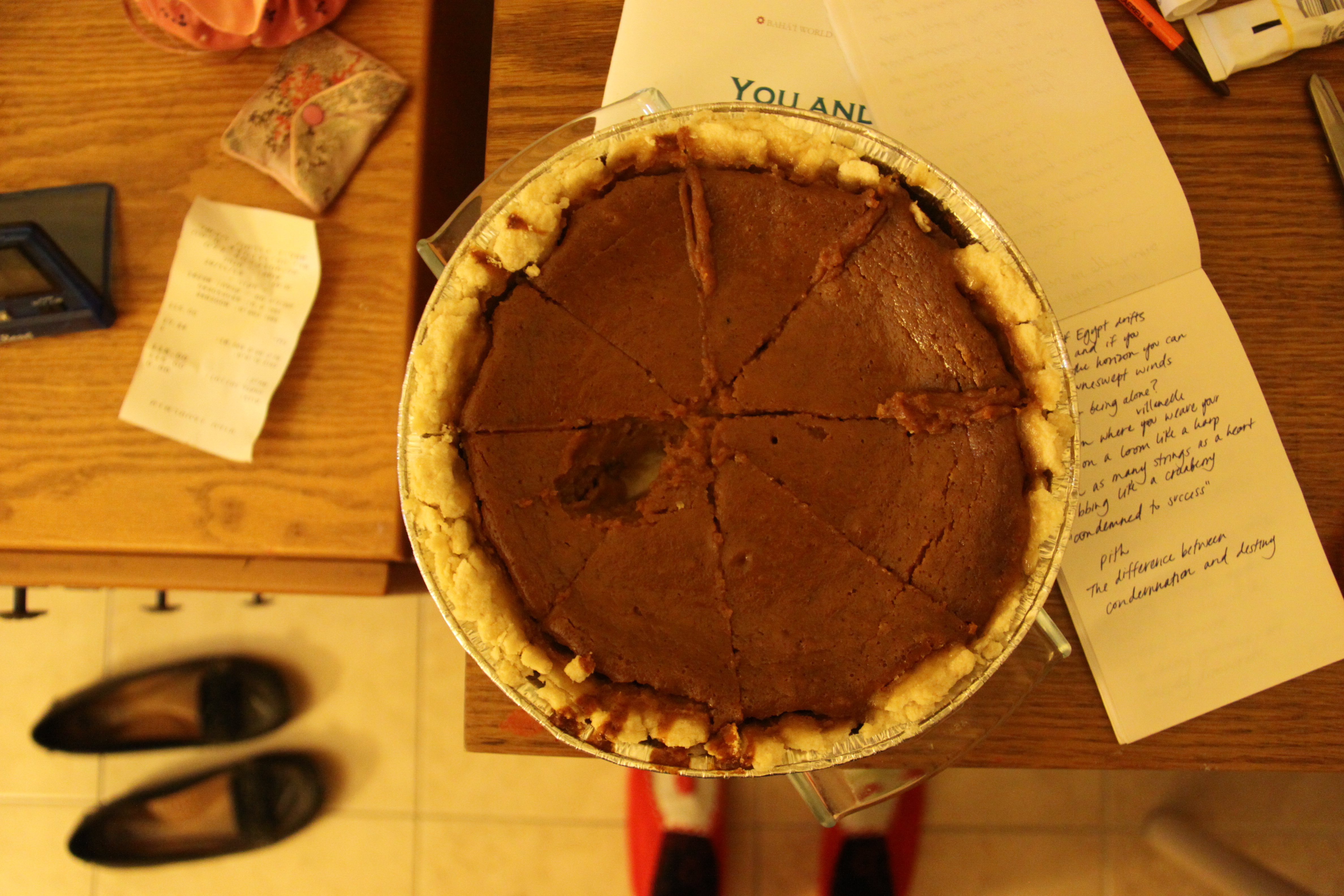
Well, I could not find those special onions, nor could I find the turkey, or breakfast sausage for the stuffing (solution: kebab with maple syrup).  Nor could I find whipped cream or pumpkin puree.  My dear American readers, I want you to appreciate how lucky you are to be able to crack open a can, dump in some cream and eggs, and basically have your pie, as opposed to chopping, then boiling, then blenderizing fresh pumpkin.  And don’t even get me started on trying to manually whip cream.

Nura’s World-Famous Spicy Pumpkin Pie, post-sampling

Oh, I did find butternut squash.  When I cut it open, I found that all the seeds had sprouted, giving the inside the look of a nest of white worms.  I stuck it in the fridge and haven’t looked at it since.  I probably should go deal with that…

There was a turkey leg for sale, but somehow, that did not seem right.  First, I considered going to Haifa Zoo, hoping they might display some American fowl.  Alas, I didn’t get a chance.  So I went to the butcher shop to buy some whole chickens.  A truck was being unloaded out front, and when I entered, there were crates full of apparently recently deceased chickens.  I bought three, and nearly fell over when the clerk handed me the bag.

“Um, do these have guts?” I inquired.

He shook his head, not understanding.  I shrugged and resigned myself to my fate.

I staggered up the hill back to my flat under the weight of fifteen pounds of meat, feeling like the Demon Barber with my cargo of carrion.

The day of Thanksgiving, I pulled out the birds, hesitantly grabbing them by the legs.  There…was…blood.  Ew.  I brought the first bird to the sink to rinse its cavity, and noticed the cavity wasn’t entirely deserted; two tiny kidneys dangled, and beneath, something dark red that I assume was the liver.

“Dear God, please give me strength,” I said.  If I were more in touch with nature, I probably would have said a prayer for the bird with whom I was enjoying intimate communion.  As it was, I grabbed a knife and started sawing away, thinking back to the cat dissection I did in high school.  I did poorly, but not because I was grossed out by the formadehyde-drenched feline.  I’m just not very good at cutting things.  But I do remember one thing: fasciae.  So much fasciae to slice, and here was fasciae once again.

Eventually, after submerging the chickens in olive oil and tethering their legs, I stuck them in the oven.  Actually, I crammed them in.  And then I bleached the entire kitchen.

Two and a half hours later, after I had manically swept, mopped, dusted, and decorated, the guests began to arrive.  The first one pronounced my cooking skills “legit.”  I told him he should wait to actually try the food.  The next guest I dragooned into carving up the chicken.  “How do I do this?” he asked.  “Here’s a book that tells you how,” I said, thrusting Betty Crocker and a knife into his hands.  I hovered nervously nearby, hoping the juices would run clear, as Mommy said.  The juice seemed clear.  The flat was filling with friends.

And then there were two.

And then there were two.

Everyone seemed to enjoy the meal, even if the greenhorns (your usual World Centre mix of South African, Dominican, Ugandan, Kenyan, Norwegian, Mauritian, and Moldovan) were a little puzzled by all the strange dishes.  “So what is with the orange food?” the Ugandan asked, poking at the candied sweet potato.  “You Americans like orange, both on Halloween and Thanksgiving.”  Hm.

All I can say is, I broke only two glass items and nearly started only one fire, and I am very thankful for that.   Happy Thanksgiving!

Dearly beloved

I just had to share with you my latest and most hilarious bout of “lost in translation.”  I had told a friend about some flower shops in the commercial district, and he called me to ask about them.  Here is the conversation I thought we were having:

Sergey: Hello Layli, how are you doing?

Me: Good, good.  What’s up?

Sergey: [in his usual blithe tone] Well, I found out today that my uncle is dying, and I need to get some flowers–then maybe he will survive.

Me:  Oh!  I’m so sorry!

Him:  I remember you told me you knew some flower shops…

So I gave him directions in my most condoling manner.  Strange, I thought, that he hoped to remedy his uncle’s demise with flowers… Also, he sounded so nonchalant.  But cultural sensitivity is my aim, so I didn’t question this odd mourning/offering custom.

Later I realized that when I heard “uncle,” he was saying “anthurium.”  According to my investigations, that’s a flowering ornamental plant, not the brother of Sergey’s parent.  You know, sometimes context clues just don’t cut it.

Pomegranate

Sweet as a low voice wafting up to my window, that
pomegranate my father brought in a Pyrex
custard cup, puckery tart as a perfunctory
 
peck on the cheek, bright as ten fingers wearing
red nail polish waving in the sunshine.  Mysterious,
too, pile of rubies walled inside the thick hide
 
of a red rhinoceros, and I never realized
the lengthy mining trips Daddy went on
to bring those bright seeds in the clear glass
 
until I fight the whole creature on my own.
Slice and pull, wiggle the seeds loose like baby teeth;
they collapse and bleed, and soon red spatters stain
 
the counter, the wall, the floor, and me.  This is
a good fruit to teach patience, I think, my impatience
increasing while the seeds drop into a bowl
 
like sand in an hourglass.  And I try to picture
Daddy doing this invisible exercise with his long
pink fingers, maybe slow, surely neat,
 
and me receiving the glowing seeds, the teaspoon
ready, savoring the flavor but never quite
tasting their message: This I give for love.