I just had to share with you my latest and most hilarious bout of “lost in translation.” I had told a friend about some flower shops in the commercial district, and he called me to ask about them. Here is the conversation I thought we were having:
Sergey: Hello Layli, how are you doing?
Me: Good, good. What’s up?
Sergey: [in his usual blithe tone] Well, I found out today that my uncle is dying, and I need to get some flowers–then maybe he will survive.
Me: Oh! I’m so sorry!
Him: I remember you told me you knew some flower shops…
So I gave him directions in my most condoling manner. Strange, I thought, that he hoped to remedy his uncle’s demise with flowers… Also, he sounded so nonchalant. But cultural sensitivity is my aim, so I didn’t question this odd mourning/offering custom.
Later I realized that when I heard “uncle,” he was saying “anthurium.” According to my investigations, that’s a flowering ornamental plant, not the brother of Sergey’s parent. You know, sometimes context clues just don’t cut it.
Sweet as a low voice wafting up to my window, that
pomegranate my father brought in a Pyrex
custard cup, puckery tart as a perfunctory
peck on the cheek, bright as ten fingers wearing
red nail polish waving in the sunshine. Mysterious,
too, pile of rubies walled inside the thick hide
of a red rhinoceros, and I never realized
the lengthy mining trips Daddy went on
to bring those bright seeds in the clear glass
until I fight the whole creature on my own.
Slice and pull, wiggle the seeds loose like baby teeth;
they collapse and bleed, and soon red spatters stain
the counter, the wall, the floor, and me. This is
a good fruit to teach patience, I think, my impatience
increasing while the seeds drop into a bowl
like sand in an hourglass. And I try to picture
Daddy doing this invisible exercise with his long
pink fingers, maybe slow, surely neat,
and me receiving the glowing seeds, the teaspoon
ready, savoring the flavor but never quite
tasting their message: This I give for love.
Mr. Jamshid Arjomandi, custodian of the House of Abdu’llah Pasha in Akka, is a beloved figure at the Bahá’í World Centre. His whole life has been devoted to the Faith, and he is full of stories. Sadly for us, he is leaving the World Centre shortly. Luckily for us, he gave a farewell talk on Enoch Olinga, who was one of the Hands of the Cause. I’m going to do my best to paraphrase the story he told. Of course, my write-up cannot convey the emotion and reverence he expressed–often, he would have to pause to gather himself and wipe his tears. But here goes.
“A few weeks ago, I was showing some of the friends around Akka, giving them a tour, telling them stories. One young lady in the group said to me, “Jamshid, your cup is so full!” Now I puzzled over what she had said. I was full? Then I looked back over my life, and I realized that yes, my cup is full! And I figured I should share it with all of you, because keeping it to myself would be greedy.
When I was a boy, I lived in a small town in Iran–it was so small, in fact, that if you ran fast enough you wouldn’t even notice that you had passed it. It was very sandy. The buildings and streets were the color of sand, and so were the people. But the Bahá’ís had their local Haziratu’l-Quds (center). The inside was so huge! And just imagine, having a big, beautiful hall in a town like that.
Well, it was October 1957. I remember I was at a Bahá’í gathering in this hall, and a telegram from the Guardian, Shoghi Effendi [head of the Faith at that time], was read. In this cable he announced the final contingent of Hands of the Cause. One name struck me: Enoch Olinga! Enoch Olinga, from the mysterious land of Africa! It was a strange name, and from the moment I heard it, I knew that he was my Hand of the Cause.
Later, in the early 1960s, I was in university in Ireland, and I had the opportunity to help at the convention in London, ushering delegates at the resting place of the Guardian. So, in between ushering, I rushed to the hall where the convention was being held. But I arrived late, and all the doors were closed–all except the entrance to the gods. Yes, that’s actually what they call it in the theater–the highest balcony, so high you can’t go any higher! So there I was, miles above the stage. And there I saw two people, one the blackest black imaginable, so black he was sparkling, and one whiter than the most precious flower ever to bloom, with streaks of yellow and gold. Yes, the black one was Mr. Olinga, and the white, Amatu’l-Baha Ruhiyyih Khanum [the wife of Shoghi Effendi and a Hand of the Cause]. And to behold those two souls standing together!
In 1963, I had a special hope. You see, this was the hundredth anniversary of Bahá’u’lláh’s declaration, and I wanted so badly to go to the convention in the Holy Land. But I was a student and very poor. I worked in a canning factory just to keep studying–not that I was a particularly good student! Only by the grace of God did I graduate–I guess He wanted me to have my degree in theology so I could go teach! Anyway, I received a message from the National Spiritual Assembly inviting me, if I wished, to attend the convention as assistant to Mr. Faizi. ‘If I wished!’ I had just enough to cover costs. It was quite a lot of work, arranging flights and hotels for the British delegates, about 200 of them–because you know, if we put them all on one plane and something happened, there goes our British community!
By the time I got to the Holy Land, I was quite tired. I wasn’t even able to get to the first day of the convention because I was staying far outside Haifa. But that week, I was walking down the stairs at one of the holy places, and to my astonishment, at the foot, I came across Mr. Olinga! He was telling some friends about the place, and they were nodding along, positively enraptured by his warmth and the way he spoke. But they could not understand him–they spoke no English! I humbly went up to him and said, “Mr. Olinga, they do not speak English and can’t understand you–do you want me to translate?” He said yes, and that was the first time I ever translated. Once we were finished, my knees went so weak I had to hold myself up against a pillar. I dreamed of one day returning to give pilgrims tours of the holy place, and thirty years later, I did!
After I graduated college, I was asked to pioneer to Guyana. That didn’t work out–they thought I was a British spy! So I went to Suriname. One day, I got a message that Enoch Olinga would be visiting, and would I please arrange his stay. He wanted to go visit the tribes there. You see, many slaves escaped and each tribe established a settlement along one of the five main rivers. They call themselves Bush Negroes, and each tribe, which is dispersed among various villages, has a paramount chief toward whom they show complete deference.
Getting to these villages was a long journey up the river in very long 45-foot dugout canoes that occasionally had to be taken out of the water and pushed over land were there were rapids. We would stop at a village for the night, and they were very hospitable, always giving us a place to stay and a meal. Enoch Olinga, somehow he always had plenty of food for all the children. Give him one plate, he could feed twenty–it was like the loaves and fishes.
Eventually we reached the paramount chiefs. They were fascinated by Mr. Olinga, the visitor from Africa. He told them about the new Revelation, how we are all equal in the sight of God. The chief said to Mr. Olinga, ‘I cannot blame anyone for bringing my ancestors as slaves, for if that had not happened, I would not have met you.’ Imagine! One day, while Mr. Olinga and the chief were talking, a woman came wandering up, very distressed and wild. “Paramount Chief, you must cure me! I am possessed by a bad spirit!” The chief said to the woman, “Sit down. I am talking with a very important visitor from Africa–and he will cure you.” What!? When this was translated to Enoch Olinga, I expected him to react with surprise, but he took it calmly. He turned to me and told me to recite the Prayer for the Dead. It was communicated, “Our guest has ordered his assistant to chant a prayer in a foreign language to cure you.” Luckily, I had one from Abdu’l-Baha memorized, and I chanted it in Farsi. (Enoch Olinga would say to the friends who always relied on prayerbooks, ‘In the next world there are no prayerbooks! We should learn prayers now so we can say them there.’) It sounded very good, I must say! The woman calmed down.
Later I had to ask Enoch Olinga what that was all about. He explained, ‘There are many spirits in the afterlife–those who died peacefully or violently, and those who led terrible lives and have not come to rest yet. We were praying for the restless soul who was tormenting the woman to find peace.” This is amazing, no? We understand very little of the spirit world.
Oh, how he loved to laugh. He had an incredible laugh–he could laugh for fifteen minutes straight, until tears poured from his eyes. I knew lots of Irish jokes, and I told him this one on that trip. ‘Patty went to the pub one night and had a bit too much. As he staggered down the street, the pastor looked out at him. “Patty, where are ye goin’, my son?” he asked. “Home,” Patty slurred. “Well, God go with ye!” the pastor said. Patty continued walking, then stumbled and fell into the gutter. He lifted himself, and wagging his finger, said, “You can come with me, but don’t push!”‘ Enoch Olinga roared at that one! And on this trip, as we would walk behind him, he would tell us, ‘You can come with me, but don’t push!’
At the end of this journey, he told me I should come to Africa. I promised. Things did not work out. It was 27 years until I went to Africa, and then I visited his grave. ‘I came, my Hand, but too late,’ I told him, kneeling there.
But Enoch Olinga always wanted the friends to be happy. He struggled greatly, living the peaks and valleys, but still, he was happy.”
Now that I’ve concluded my day-trips for the season, I’m back to quotidian life–the office, some volunteering, study groups, laundry, cooking, cleaning, collecting houseplants, the regular. But even the routine is not quite routine here.
Part of it is just that living adultly is still new to me. I’m doing all sorts of things on my own, hey! And so what if mopping sometimes results in breaking the shower, or dusting in a sore hamstring. This week, I cooked rice for a study group. It didn’t turn out as fluffy as I wanted, yet for the first time my tadik was unscorched. “Hm,” I thought. “Well, tadik’s not very good as leftovers. And I’m the only one around.” Standing by the kitchen sink looking up the mountain toward the Dan Carmel, eating a bowl full of fresh tadik, I realized the joy of independence.
But a lot of it is my environment. The air is different, for one. Hamseen has arrived. While it’s not as if I can see motes floating in front of me, looking out to sea, the horizon is obscured by a thick haze. Apparently this dust has traveled up to Israel from the Egyptian desert in a climatological Exodus. Maybe the hovering dust is the Middle Eastern equivalent of Midwestern leaves falling in autumn?
Even the simple act of walking is different here. You know, being on a mountain, everything is steep. Plus, in the Bahá’í gardens, most of the paths are gravel. I have two pairs of shoes that I wear to the office: my flats and my heels. They are both practical shoes, unobtrusive black leather with plenteous arch support. Even so, walking in heels on gravel poses a challenge–I mean, walking in heels is a challenge, period. So I do an ungraceful slow march. It’s rather like trying to walk on snow with a veneer of ice–I need to dig in my heels but also keep moving. I thought I was doing a pretty good job until the other day when not one but two people, after watching me, commented sympathetically on the difficulty of walking with heels here. “It’s such a challenge! Your poor heels!” And then someone pointed out to me that one heel is actually broken, causing a distinctive “clip-clop” whenever I walk on hard floors. She recommended a cobbler. My experience with cobblers is limited to the shoemaker and the elves.
Fruit. Let’s talk about fruit. The Persian coworkers at my office are wonderful people for all sorts of reasons, and one reason is that they always bring fresh fruit to break time. (I, on the other hand, contribute the occasional sugary, buttery baked good.) Mango, pomegranate, oranges, grapes, apple, pear, peach, nectarines… and recently, we’ve entered fruit territory that is foreign to me. There’s lychee–inside the bumpy red skin is white flesh with a subtle fragrant taste. Figs are delicious in dried, jam, or Newton form. In natural form, however, they are just weird, mushy and seedy. And guava. I tried it because I thought it was a strange seedy pear. No–with its overripe scent and nearly salty flavor, it is definitely not to be compared with pears. There is pomelo, a huge citrus (actually, citrus grandis) with a super thick rind that needs to be practically sawed off and a bitter membrane around the flesh that also needs to be peeled off. It’s not for the lazy fructarian! It tastes like a tentative grapefruit and looks like it belongs among the many balls from gym class that always threatened me, maybe a yellow medicine ball or the enlarged tennis ball that smacked me in the face. “Ok, guys, today we’re going to play pomelo.”
Jerusalem. A city precious to the three major Abrahamic religions, and still a magnet for flocks of pilgrims and the occasional sherut-load of Bahá’í tourists.
Once again, I am straining to understand the explanations of Abboud, the sherut company owner/tour guide extraordinaire who is shuttling us around like a flock of ducklings. We are approaching Jerusalem on a highway that apparently featured in the Six-Day War in 1967. Several hollowed-out army trucks stand in the median strip as a memorial to those lost in the fighting.
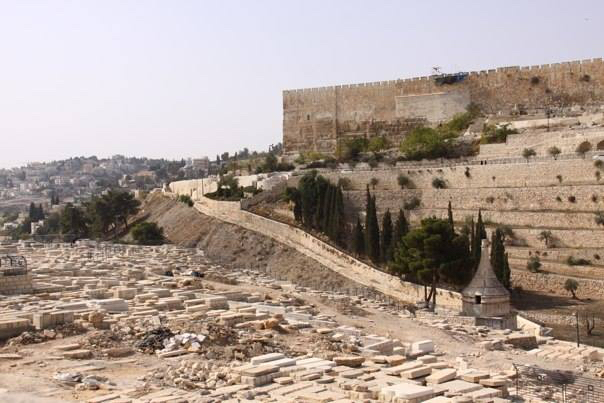
The newer parts of Jerusalem look much like any other larger Israeli city, with sandy-colored buildings and wending roads. We stop to visit All Nations Church by the garden of Gethsemane. From here, on the Mount of Olives, we have a clear view of the walls around the Old City, the golden bulb of the Dome of the Rock peeking above, and the Valley of the Dead below. Abboud tells us that according to some tradition, the people buried in this valley will be resurrected half an hour early come Judgment Day, so spots go for $150,000 a pop. “I ask, ‘What can you do in that 30 minutes that you couldn’t do all your life?'” he quips. In Islam it is believed that on Judgment Day a bridge as thin as a hair will stretch between the Mount of Olives and the Dome of the Rock, and everyone will walk across. The unrighteous will fall to their deaths in the valley below. I’m probably too much of a literalist, but does this valley really look like it could fit all the unrighteous?
Valley of the Dead
We get into the Old City through a thriving marketplace in the Muslim quarter. Here is what I mean by thriving. At first, it is merely bustling, a mixture of tourists and residents going about their shopping, vendors hawking their wares in loud Arabic. But then we take a turn and the crowd grows thicker, until we are squeezed shoulder to shoulder, barely moving. I hang on to the person in front of me, wishing that we had one of those ropes preschoolers hold on to to when they walk outside to keep everyone together. This recalls riding the Metro at rush hour in Santiago, when there was always a distinct possibility that, unable to push through the packed bodies to the door quickly enough, I would miss my stop. Now barely moving turns to unmoving. Eventually the culprit behind the traffic jam appears, a young man pulling a cart loaded with what seems to be about ten giant boxes, three times his width, shouting hoarsely for people to get out of his way.
We saw the Dome of the Rock from a distance, because it is not open to non-Muslims. But we were able to see the holiest places for Jews and Christians, the Western Wall and the Church of the Holy Sepulcher, respectively.
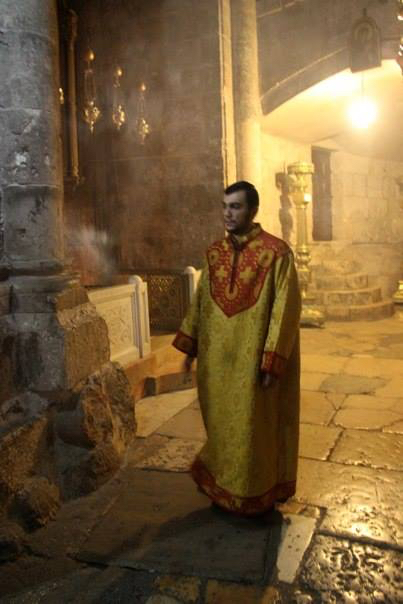
To get to the heart of the Holy Sepulcher, we wove our way through a maze-like succession of chapels. Various sects have a (tense) agreement to share different bits of the church. After we had touched the spot believed to be where the Cross stood and gone down to the underground chamber where St. Helena discovered the buried Cross, we went upstairs to a different chamber with a short passageway, where Abboud invited us to look at some tombs. The first clump of our group clambered into the small space. I stayed outside and watched a priest we had encountered energetically waving his censer near the Armenian section reappear. Apparently this was also part of his scenting territory. He approached the little tomb grotto and nearly yelled at our group, “EXCUSE ME! What are you looking at?” Then he swung his censer around in front of the cavern, as if trying to smoke out some unwelcome moles. Soon he swept out of the room, leaving us baffled and smoky.
Guess he was incensed about something…
Now my turn came to go into the passage. This was the second time I whacked my head on a low overhang, so to be honest I couldn’t really gather what Abboud was saying, other than that there were four tombs around us, carved into the stone. Two were open and empty; two were closed. “Wait, so does that mean someone’s in there?” someone asked. “Yes,” he said, causing her to whimper. “Don’t worry, they don’t bite!” he said. I wonder what zombies from the years BC would be like…
In the end, it’s as much about the little things as the super famous sites. For instance, at lunch we were brought falafel fixings. Among the various dips was fool, a bland dip of mushy cold fava beans, which I would not recommend. “What is this?” someone asked. The server, a young teenage boy, responded monosyllabically, “Fool!” The inquirer heard “Food!” and burst into laughter. But even if he had heard right (fool!) it would still have been hilarious for us poor fools.
The past month, my mild case of wanderlust has also pulled me out of Haifa. First there was the Dead Sea. Next there was Carmel Forest, where I observed picnicking Persianly: kebabs, backgammon, and tea. (My take on picnicking requires Bananagrams.) And next came Galilee.
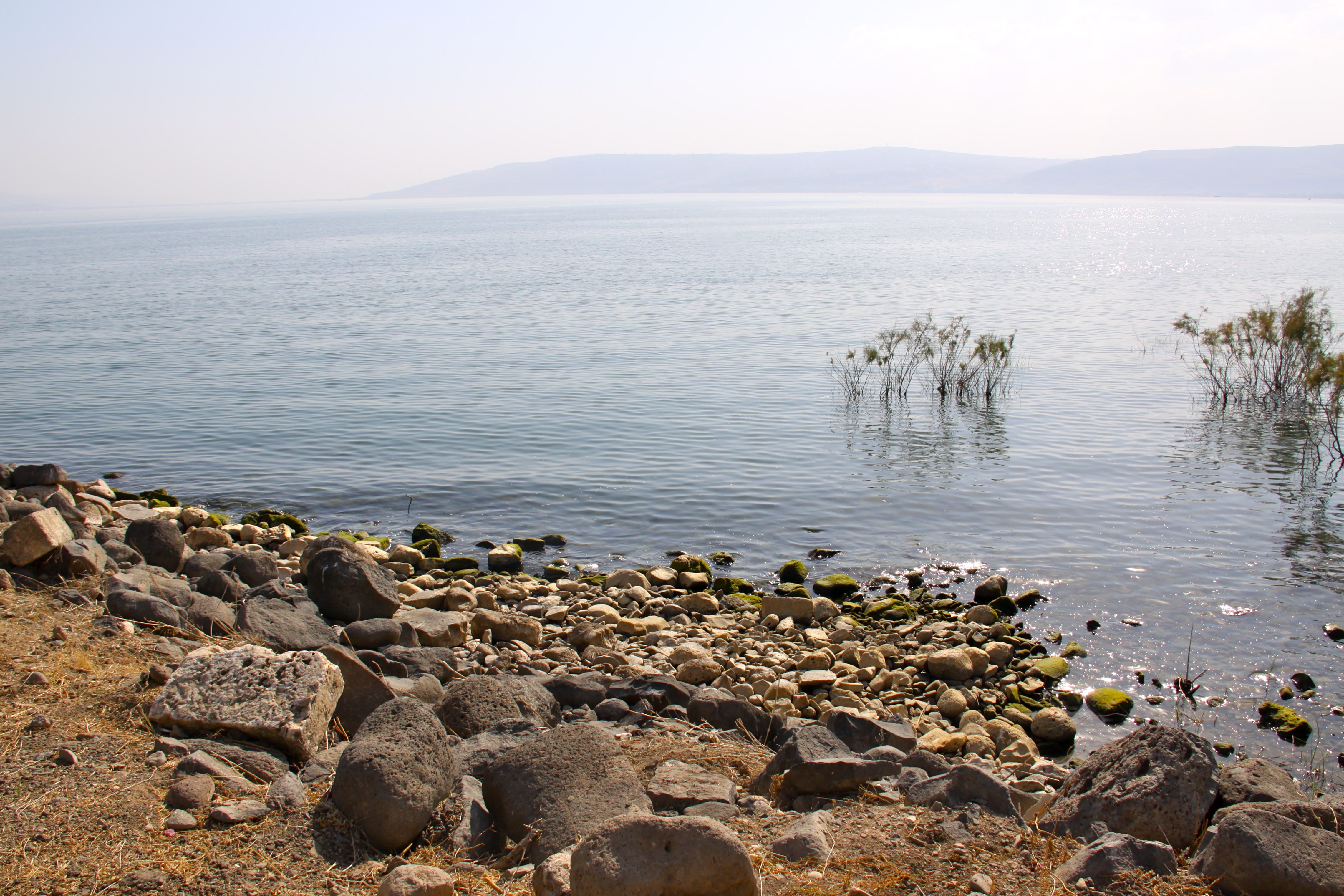
The Sea of Galilee, where the disciples of Jesus fished.
Galilee is a region with many sites associated with the life of Christ, many of them in the form of ruins encapsulated in grand churches like the Basilica of the Annunciation in Nazareth, which holds the house of Mary. Across the way from the Basilica is St. Joseph’s church, which holds the remains of his carpentry workshop. There we observed an ancient wonder of Israel, the money pit flooded with eery green light.
Actually this is a view down to the original level of the structure, or something like that…
We drove through Cana where Jesus turned water into wine. We saw the Sea of Galilee (actually a lake). We saw the boat of Galilee (it’s a super old boat). We saw Capharnaum where Jesus lived for a few years and where the ruins of an ancient synagogue still stand. We saw the church built where Jesus preached His Sermon on the Mount. And we saw so, so many pilgrims, massive groups on tour buses.
Our final stop was the Jordan River, which to me proved the most interesting item of our busy itinerary. Christians come here for baptism. I watched a number of these baptisms, the pilgrims in white tunics having a private spiritual experience in a very public place. I felt guilty for ogling them like zoo animals, but I have never before witnessed a baptism and I was intrigued, especially when a Nigerian ruler and his entourage showed up, giving all us onlookers something else to watch.
Baptisms at lower left; Nigerians, upper left; dudes chilling and fishing, upper right.
Eventually someone in our group had the innovative idea that we should go down to the river (cue “Down to the River to Pray”). In the water were enormous slow-moving catfish and dense schools of minnows in the shallows. We took off our shoes and let the minnows tickle our feet with their hungry mouths.
It was a full day, and I felt we must have exhausted all the sacred Christian sites in Israel. However, Jerusalem beckoned…
There is a flâneur inside all of us. If I recall my art history classes well enough, once Paris was Haussmanized–many of the charming little streets were converted into wide, orderly boulevards–a new species of pedestrian emerged: the flâneur. The flâneur was a window shopper, an idler, an urban vagrant who did not necessarily set out with a destination in mind; he walked around to see the city and maybe stop for a croissant every once in a while.
My flâneurism (which sounds like a dangerous combination of flan and aneurysm) manifested in some exploration of the Hadar, a commercial and residential district which, according to the map, my street borders. I can’t tell you how much time I’ve spent examining maps of Haifa in a fairly futile attempt to commit the general layout of the city to memory. There’s the tourist map I keep in my purse at all times, and the one on my bulletin board at home, and there’s even one up in the office. So I had my route planned out, and I successfully found the main shopping street with its endless noisy clothing stores and the department store wherein I found this happy couple. Please take a moment to note his rakishly angled spectacles and her receding hairline. Aren’t they cozy.
They do say love is blind…
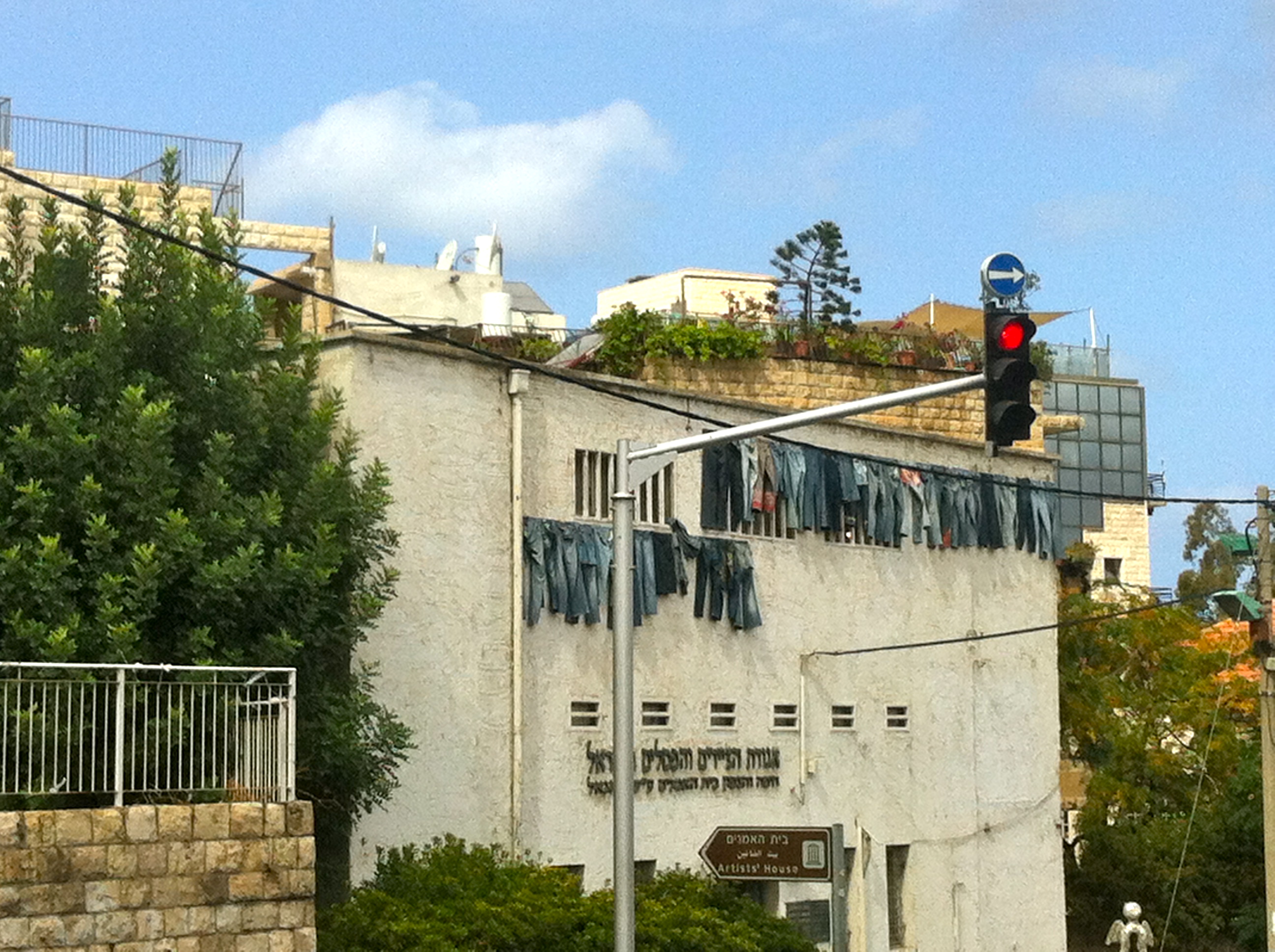
And this–jeans as art, or maybe the dryer broke:
Artists’ house
Once I had procured some houseplants and a muffin tin, I decided to retrace my route. If I could accomplish that, I figured that would mean I actually knew the Hadar.
I did not accomplish that.
I suppose I was distracted by the unusually cool weather, the streets damp with rain, or maybe it was the dead cat in the street. Anyway, I forget to take a turn and found myself in an unfamiliar area. Unwisely, I decided to keep walking. I suppose I hoped my “intuition” would lead me aright and my apartment building would suddenly appear in front of me. Eventually, I swallowed my pride and found the friendliest looking person around (not a particularly easy task–Haifans are not the smiliest bunch) and asked for help.
“English?” I asked. Over the course of the morning, I had gotten accustomed to the answer to this question being a shake of the head. But it turned out she spoke very good English. After she explained where I needed to go, she pointed at my map and asked, “Does it help?” Good question. As soon as I pull it out, I mark myself as an outsider, a foreigner. But when I try to navigate without it, I end up seeing more of Haifa than intended. Perhaps trying to make me feel better about my orienteering failure, she said, “The streets in Haifa are like the home of a spider.” A very messy spider, I might add, the kind who eschews neat webs in favor of tangled nests where he stores his victims, including young women carrying Tourist Board maps.
Sometimes I like to put my apron on and make a mess of the kitchen, or as some people call it, “bake.” (Please note that I have not yet broken the oven in my second flat.) Today I would like to share with you a favorite recipe.
Here’s how to start. Plan to host a few friends for dinner. Find out a few hours before the event that one of these friends has his birthday and “you should really bake a cake.” Try not to panic. Luckily, of course you have a stock of the staples dark chocolate and raspberries, so decide to make raspberry brownies. Google “raspberry brownies” and go with the first hit, because time is running out. The recipe description is: “Squidgy and super moreish, these gorgeous foolproof fruity chocolate bakes will be snapped up in seconds.”
Try to get over the way the words “squidgy” and “moreish” make you think of squids and Othello, the Moor of Venice. In fact, try to get over that whole sentence with its bubbly British English.
Shakespeare and Nickelodeon. I get them confused sometimes.
(Also, foolproof? Just saying, have you ever met this fool?)
Follow the recipe. It’s pretty simple, really, except that simultaneously you should also be trying to use a rice maker for the first time ever and chopping veggies for the stir fry.
Check the brownies after the allotted 30 minutes. Discover that they’re still molten. Replace in oven. 10 minutes later, they are a bit more magma than lava. Take them out and let cool.
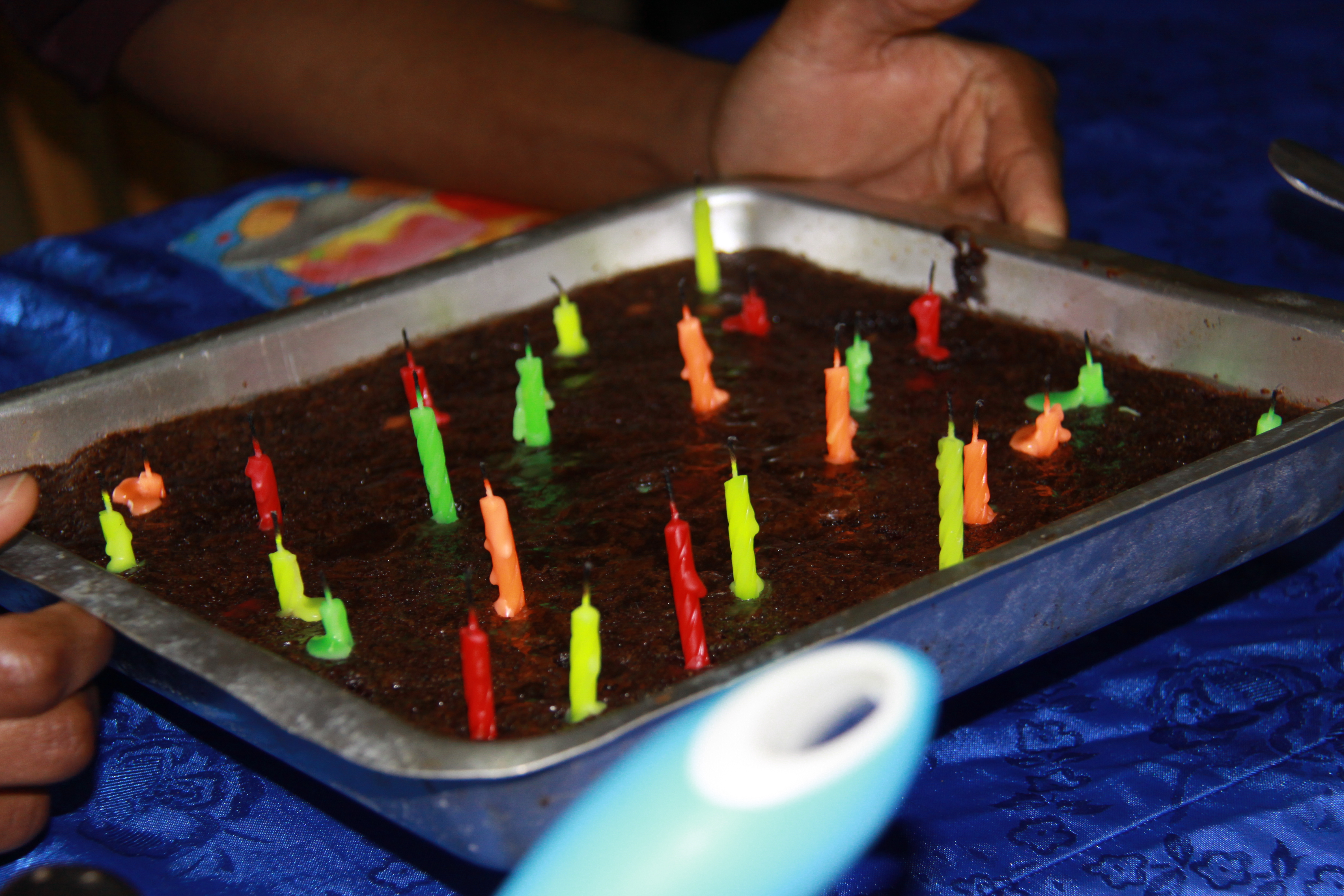
Now, “let cool” to you means “let cool for five minutes.” And you’re impatient to get those birthday candles affixed, so stick ’em in. Then realize they are melting into the brownies. Remove.
Once actually cooled, reinsert the candles and light. There are 26 candles; the friend is turning 27. 26 is still a lot of candles even if it is a lie. Use approximately 10 matches and nearly burn your hands trying to light them all. The candles are mere fluorescent stubs by the time you sing the birthday song and the wish is made. When extinguished, the candles make a lot of smoke. Luckily, you don’t have to worry about setting off smoke detectors, because you don’t have any. And the birthday candles will provide a colorful layer of frosting.
Now wait for all the wax to be picked out, leaving the surface of the brownies pockmarked. When it comes time to serve the brownies, they are, well, squidgy, which you now know means “floppy and pudding-like, refusing to maintain any shape.” One of the friends inquires politely, “Are these fully cooked?” They are. They’re simply mislabeled, because you billed them as “raspberry brownies” when in reality it’s chocolate pudding with paraffin enhancements.
Thank you for joining me for another baking lesson. There will be more to come as I pursue a truly “foolproof” (Layli-proof) brownie recipe.
I’m back in the office, and my back muscles are sore. It’s from all the floating over the weekend.
That’s right: for the first time since my train pulled into Haifa, I stepped foot outside the Haifa-Akka area. When I signed up for the Dead Sea trip, allured by the promise of adventure, I knew one thing: it was salty. And also dead, as anything that tries to live in the sea would probably become quickly pickled. I had a feeling it had some biblical significance, like, wasn’t that where Jesus walked on water? Or where Moses parted the sea? (I assume your Bible knowledge is better than mine and you know that would be the Sea of Galilee and the Red Sea, respectively.)
It was a rather long ride in the sherut, as we must avoid the West Bank. I plugged in my earbuds and listened to Devendra Banhart. I wish I had chosen someone more pronounceable and less indie to listen to, because when questioned about my music choice, my response provoked raised eyebrows. “Dev-end-ra-ban-heart, have you heard of him?”
If I didn’t pay too much attention, it would have felt much like the trip from Verona to Chicago–wide highways, green signs (except in Hebrew, Arabic, and English), gas stations en route. But after a while we entered the desert. I knew I had entered a strange land when I saw the camel crossing signs, and then the camels, a few clustered by the side of the road, probably waiting for a sherut with open seats to come pick them up.
“Alright, we’re about to go underwater,” Abboud, the sherut driver famed among the Bahá’ís, said. “You all ready to hold your breath?”
We were going below sea level, deeper and deeper “underwater.” The Dead Sea, Wikipedia tells me, is the lowest point on dry land in the world. It’s a sea below sea level. Interestingly, because of the great atmospheric pressure, you’re safer from the sun’s harmful UV rays there, despite the constant clear skies.
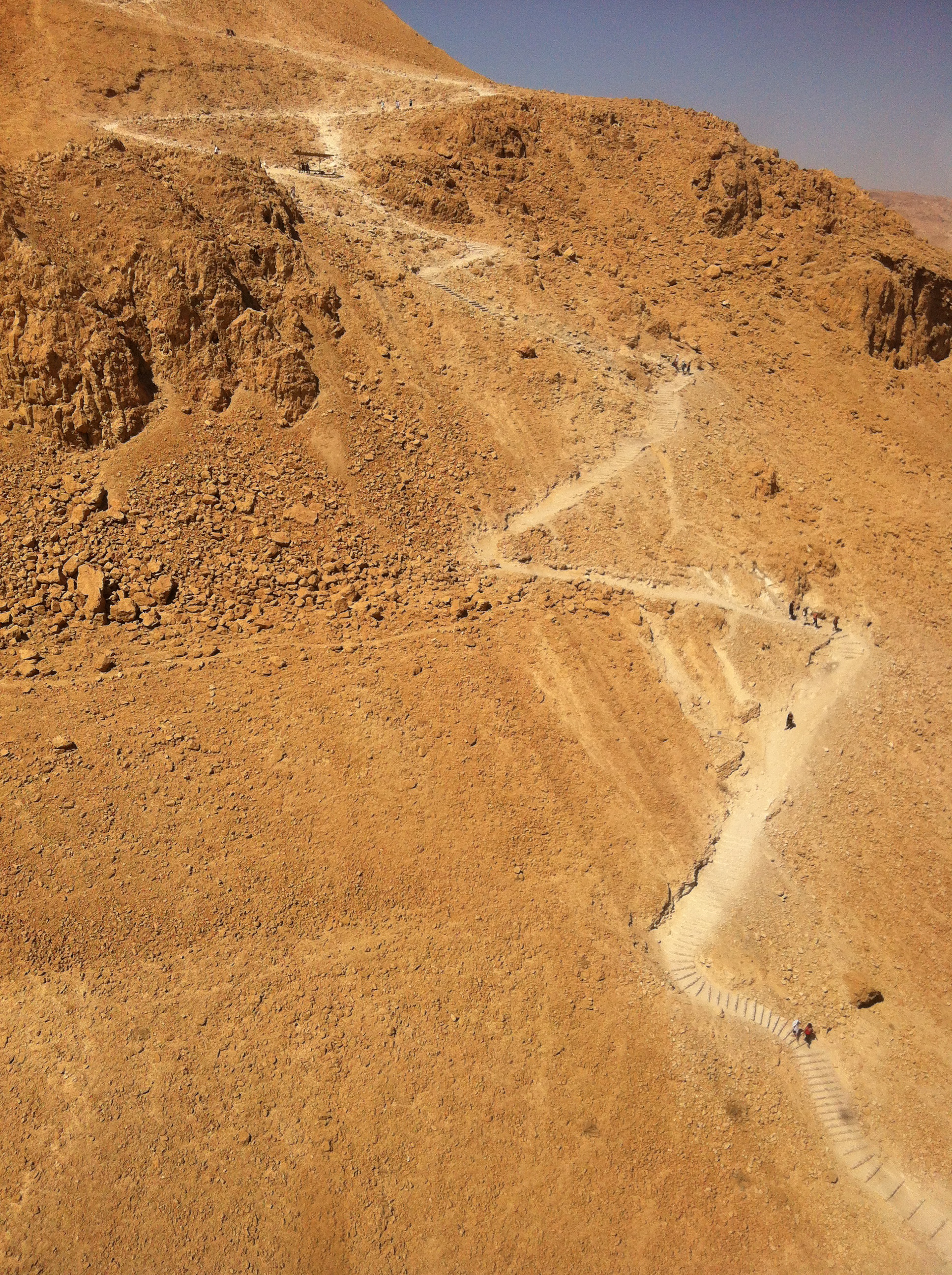
Hiking trail up to Masada. No thanks, I’ll take the cable car.
Our first stop was Masada, the ruins of a fortress and palace built on a plateau by Herod the Great. When the Jews rebelled against their Roman overlords, they made their last stand there, kind of like the Alamo except less Texan. In short, the Jewish men decided to commit mass suicide and die free rather than allowing themselves and their families to be captured and enslaved by their foes. When the Romans entered the fortress, they were greeted by hundreds of lifeless bodies.
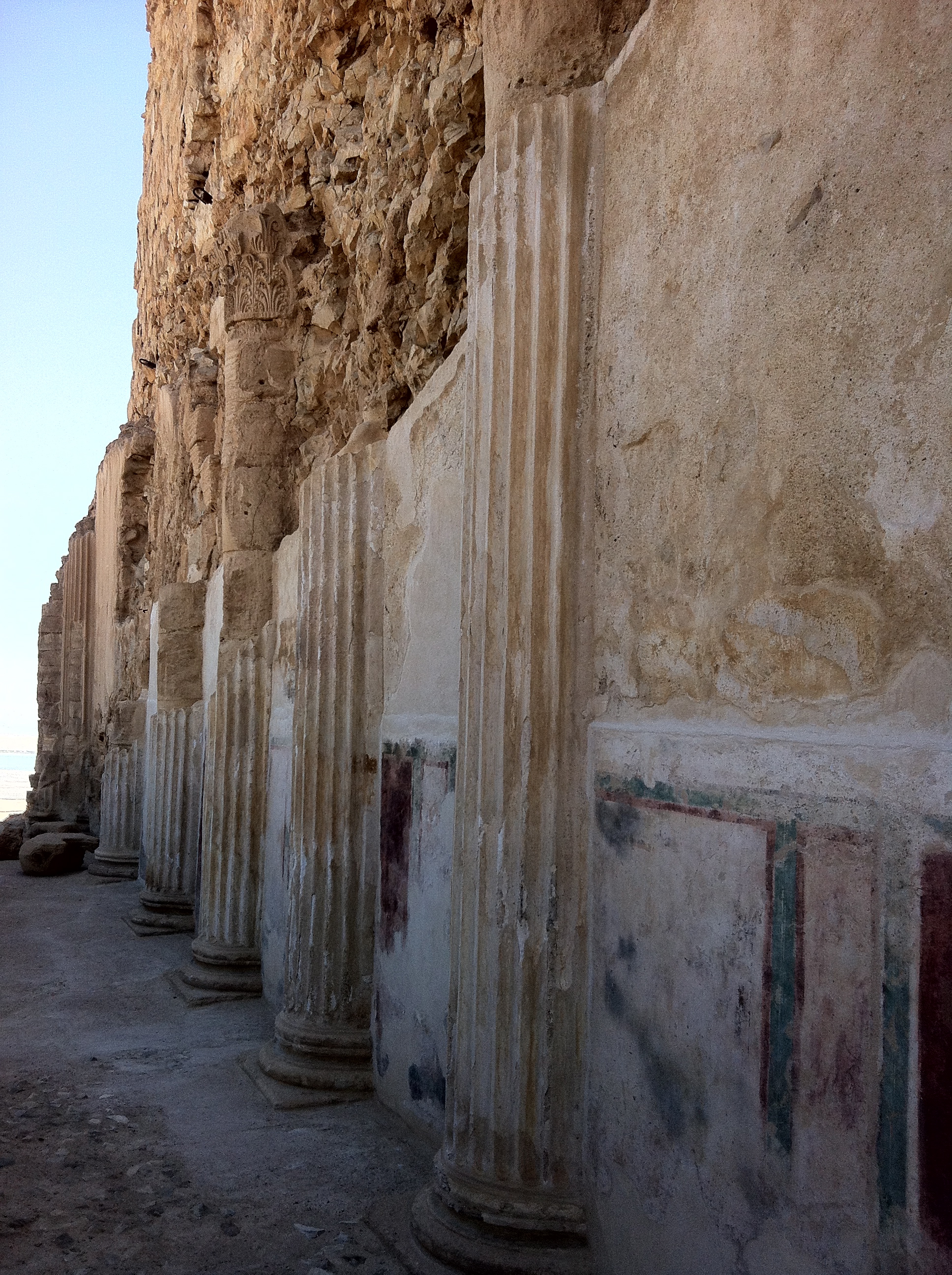
Ancient columns. A key part of ruiny décor.
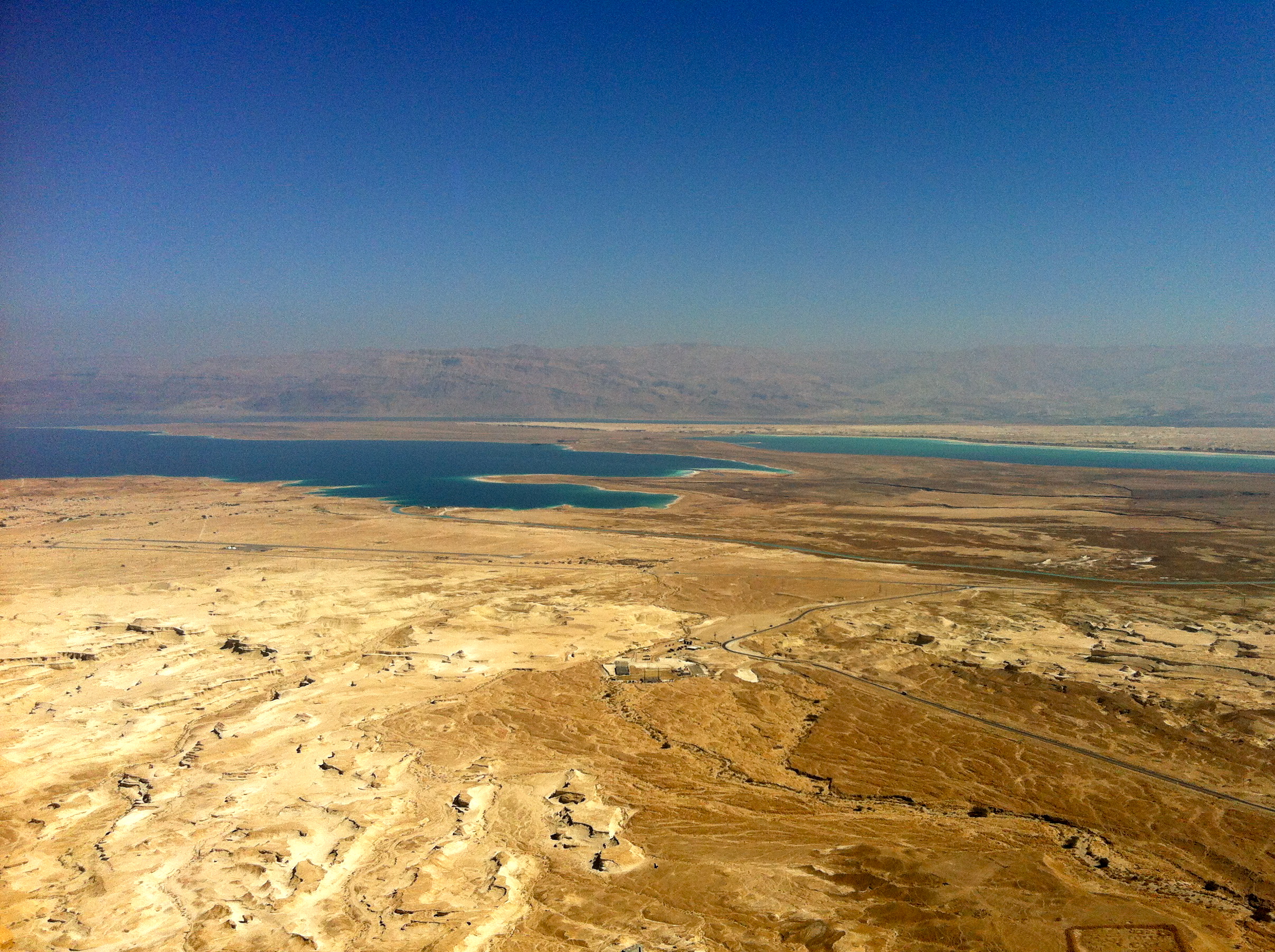
Mainly what I learn from visiting places like Masada is that I don’t have the mind of an archaeologist. I have a hard time looking at stone walls and envisioning Herod or the Jewish rebels. But the panoramas of the alien landscape were something to behold.
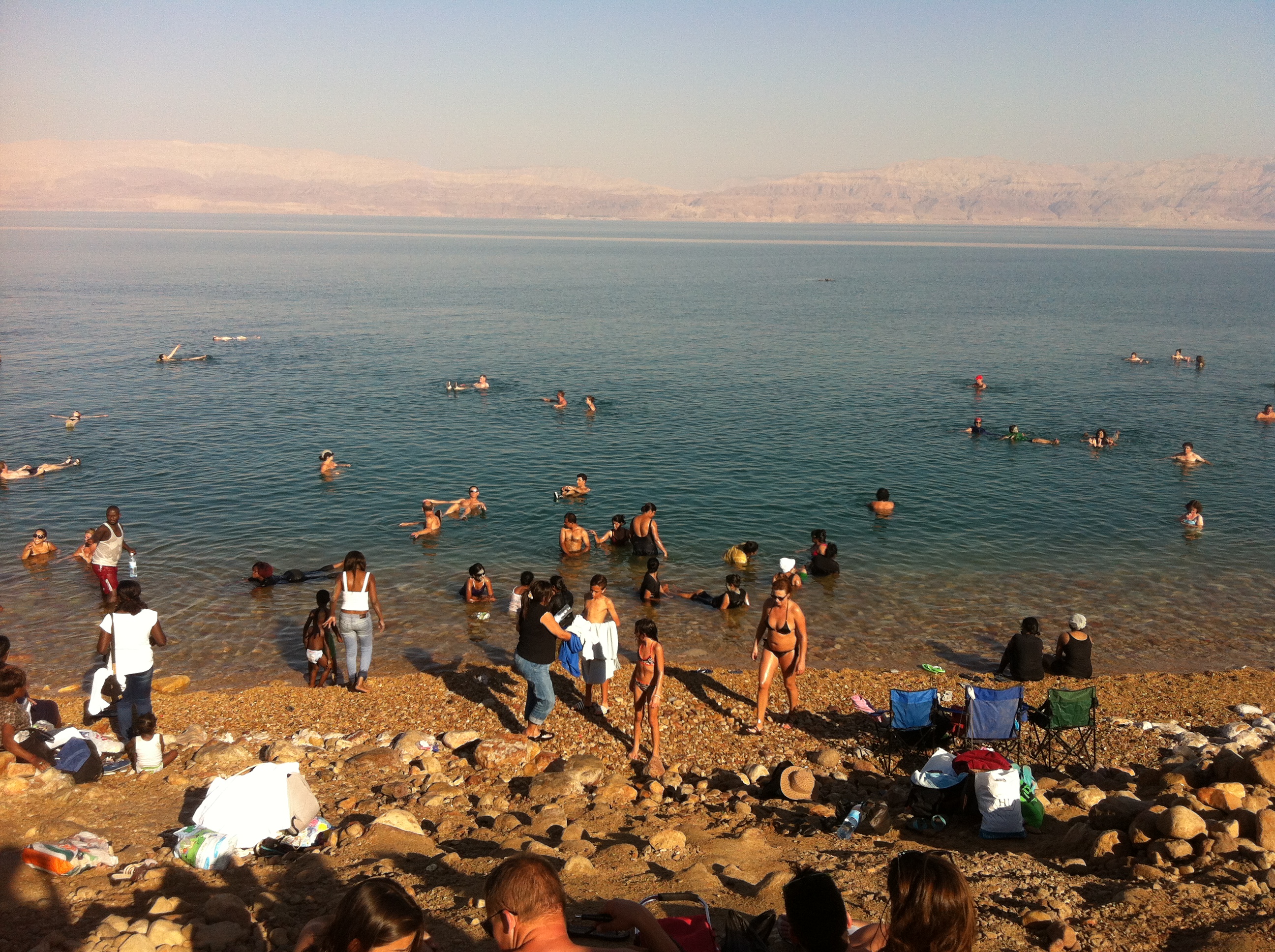
At long last, we reached the shores of the sea. The beach, which was more of a rocky hill, was full of tourists, some of them painted with mud, some of them floating. I could see that some of the rocks on the shore were actually covered with large salt crystals.
I tentatively stepped into the water. My flip-flops escaped my feet and shot to the surface. Ok, new plan: unshod, I waded into the water, wincing over the bumpy rock bottom. I crouched down, then let myself float up to the surface. Now, I’m not much of a beach goer. As you know, the double threats of sunshine and drowning prevent me from getting seduced by that scene. But I have found my perfect body of water in the Dead Sea. You can’t swim, but only float–perfect! I don’t need to fear going past my depth because I physically cannot sink! You can’t put your head underwater unless you want to damage your eyes–wonderful! I dislike the sensation of submersion. I let myself float a little deeper, watching the pink, dry mountains on the Jordanian shore and the quiet desert sky above. The water was warm and oily–I could see the shadows of the oil projected on my hands underwater. Once I actually wanted to move, this proved complicated. I tried a few strokes, to little avail, and started to wonder what would happen if I just never got back to shore, floating immobilized, a victim of buoyancy? Finally I found a very slow breaststroke worked.
And I must have gotten back to shore eventually if I’m writing this now.
My boss returned from leave a few weeks ago. It’s good to have him back. He has an encyclopedic knowledge of the world, spanning everything from international relations to how to make the perfect cup of hot chocolate. His mind works in surprising ways–he concluded a conversation on space exploration and extraterrestrial colonization with, “I wonder how Bahá’ís living on Mars will know where the Qiblih is to face when they pray?” And of course he knows all about archival matters as well.
I arrived on Sunday to find a note on my keyboard in the handwriting of one of my officemates: “Sunday is Ted’s birthday.” My immediate reaction was concern. As his assistant, am I the birthday planner? Should I have baked a cake? Made a card? I proceeded to put his birthday on my Outlook calendar so that at least next year I’ll be prepared.
It turned out I needn’t have worried. One colleague, at our office devotions, wished him a happy birthday, leading to the group singing to him, leading to his reaction: “Thank you. Everyone needs to turn twenty-five at some point….and I’ll let you know when that happens to me.” And then she went home for lunch and baked him a cake. And then another colleague sent an email inviting everyone to the break room at 3:30 for a surprise party. So that’s how it’s done, I thought. But I noticed a problem. How would we ensure he came at that time without directly inviting him? I asked her, and she recommended that I take care of that.
Now, I’ve coordinated surprise parties before, but never on such short notice. And never for my boss. So I found myself getting a stress tummy ache trying to figure out how to get him in the break room without letting the proverbial cat out of the bag. Finally, utilizing yet another of Outlook’s many wonderful functions, I sent him a meeting invitation to “work on correspondence” at 3:30. But he didn’t reply. And didn’t reply. He was away from his office. Finally, slightly panicked, I bumped into him in the hallway and we agreed on the meeting time. But the hardest part was yet to come. Once we met, how would I get him to the break room? “Um, can we maybe discuss the space allocation of the break room cupboards? Can we go do some fieldwork there?”–or, stagger into his office, pallid and weak–“I’m actually super hungry now, can we go take break first?”
The fateful hour arrived. I heard his footsteps go into his office, then out–wait, what…and then from the break room, a collective shout of “Surprise!” It turns out Ted, probably in innocent pursuit of a drink of water, surprised his surprise party. He kindly came to fetch me, inquiring, “Well, are you ready for our ‘meeting’?”




 Layli Maria Miron