Student-Consultant Interactions: From Single Visits to Partnerships

Logo saying the Peer Review, 10th anniversary, 2015 to 2025.

Smith, Zoe, Caroline LeFever, and Layli Miron. “Student-Consultant Interactions: From Single Visits to Partnerships.” The Peer Review, vol. 10, no. 1, 2025.

Abstract: What can consultants do to move students to return to the writing center? To identify strategies that accomplish this end, two undergraduate researchers and an advisor surveyed students who had repeatedly visited a single consultant. We then analyzed the data, coding consultant strategies and noting repeated occurrences. We also recorded appointments of consultants with high rates of returning clients, collecting transcripts detailing the strategies they use in first-time visits. Our research contributes to our field’s understanding of why some students return to the writing center and what students want from their consultant, intersecting with current conversations that acknowledge student writers as co-creators of writing centers and recognize peer tutors’ emotional labor. The consultation that we document and analyze may find use in consultants’ professional development.

Full Text: You can read the article or the full issue.

Sustaining and Incentivizing Tutor Education through Self-Paced Modules

WLN: A Journal of Writing Center Scholarship - Authors Bowles, Stowe, Miron, and Gilmore and Hudson

Miron, Layli. “Sustaining and Incentivizing Tutor Education through Self-Paced Modules.” WLN: A Journal of Writing Center Scholarship, vol. 49, no. 2, 2025, pp. 15–21.

Abstract: Most writing centers staffed by peer tutors undergo regular turnover of employees as they graduate. While a consistent training program for new tutors can ensure that the entire staff knows the essentials of one-to-one writing pedagogy, no such program can cover everything. Often, tutors continue their learning through professional development (PD) meetings that focus on more advanced topics chosen by the center’s leaders. To keep the entire staff engaged, including returning tutors, the PD curriculum must change from semester to semester. Yet, that means that some tutors will miss out on topics covered in a semester before their hiring. In contexts of high turnover, how can tutor educators sustain tutors’ knowledge? This article offers one solution: online PD modules that reward completion with badges.

Full Text: You can read the article or the full issue.

Developing Writing Consultants’ Multimodal Literacy through ePortfolios

Praxis: A Writing Center Journal - 22.1 - Writing Center Practices in Times of Flux

Basgier, Christopher, Layli Miron, and Richard Jake Gebhardt. “Developing Consultants’ Multimodal Literacy through ePortfolios.” Praxis: A Writing Center Journal, vol. 22, no. 1, 2024, pp. 47-61.

Abstract: Writing center consultant training must account for the multiple media and modes students use as they compose on new digital platforms. While most consultants come to writing center work already confident in traditional literacies, to advise on multimodal projects, they also need to understand how elements such as visual design, navigability, and accessibility play into the rhetorical situation. Starting in 2021, our writing center assigned an ePortfolio-focused professional development curriculum to our consultants, culminating with their creation of websites that integrated and showcased their knowledge, skills, and abilities. The authors studied the consultants’ responses over the first two years of implementation, collecting data from surveys, session observations, and interviews, which we analyzed through inductive and deductive coding. Our results indicate that consultants advanced their understanding of multimodality through their participation in the ePortfolio curriculum and applied their learning in consultations not only about ePortfolios, but also about other visually rich media and application materials. Other writing centers may consider incorporating ePortfolios into their tutor development programs.

Full Text: You can read the article on the Praxis website.

Looking back…and forward


Sculpey hearts I gave to World Centre friends upon my departure.

I gave these polymer clay hearts to friends upon my departure. (No, they are not edible!)

While I prepared for my departure from the BWC for months, it still felt strange to leave. I realized that up until now, graduations have marked the endings and beginnings in my work–saying farewell to fair Verona to go to Mount Holyoke, four years later leaving Mount Holyoke to fly to Israel. With those commencements, I shared the ritual of departure with hundreds of others. But of course, in real, non-academic life, there aren’t usually huge ceremonies to mark goodbyes. So leaving despite work bustling along as usual felt kind of like stepping out of a room thrumming with people–and then flying 6,000 miles away.

In those final two weeks, I was asked a few times about my experiences over the past two years. What had I learned? I found it hard to articulate, though marriage obviously topped the list. My relationship with Sergey defines my memories. Indeed, I re-read all my posts here, and stories of Sergey started to dominate in November 2013, a few months after we met.

Through experience in my office, I have also learned about–and hopefully improved–certain qualities. Humility and self-discipline proved indispensable in my daily work, and I found excellent exemplars of those qualities in my colleagues.

As I sought to connect my experience with my upcoming studies in rhetoric and composition, I realized that I actually was almost constantly writing in my office. Sure, I wasn’t composing beautiful works of prose analyzing Shakespeare or Dickinson–I was doing “transactional” composition, writing letters, emails, instructions, and memos to accomplish tasks. I suspect that my firsthand experience with business and technical writing will benefit me as I start teaching college composition (in a few weeks!). I’ll have a grasp of what awaits students destined for white collar careers. Further, I think I’ve learned to clarify and simplify my writing, knowing that many coworkers in our super-diverse organization were not native English speakers.

Speaking of which, one thing I failed to learn was a new language. I started with Farsi, which after a few months became an excuse for getting to know Sergey (we have now given my colleague’s Farsi class a reputation for matchmaking)…and our study habits deteriorated. Then together we thought, well, we couldn’t stick with Farsi, so let’s go for an even more complicated language–Arabic! I wish we could have stayed in the class, but I simply could not muster the energy for the required nightly studying. And what about Hebrew? The class started around the time of our wedding, so I was in no state to participate. Now I am trying to learn Russian, though given my track record…well, for this one I have a special motivation: to make Sergey smile with my clumsy attempts to sound out Russian words.

Needless to say, it is impossible to summarize these years of my life, but luckily, I don’t have to! This blog serves as a depository of my memories, a growing memoir; since memories will continue to be made in the new chapter of my life, I’ve decided to stick with writing it. So, I hope you will stick with reading!
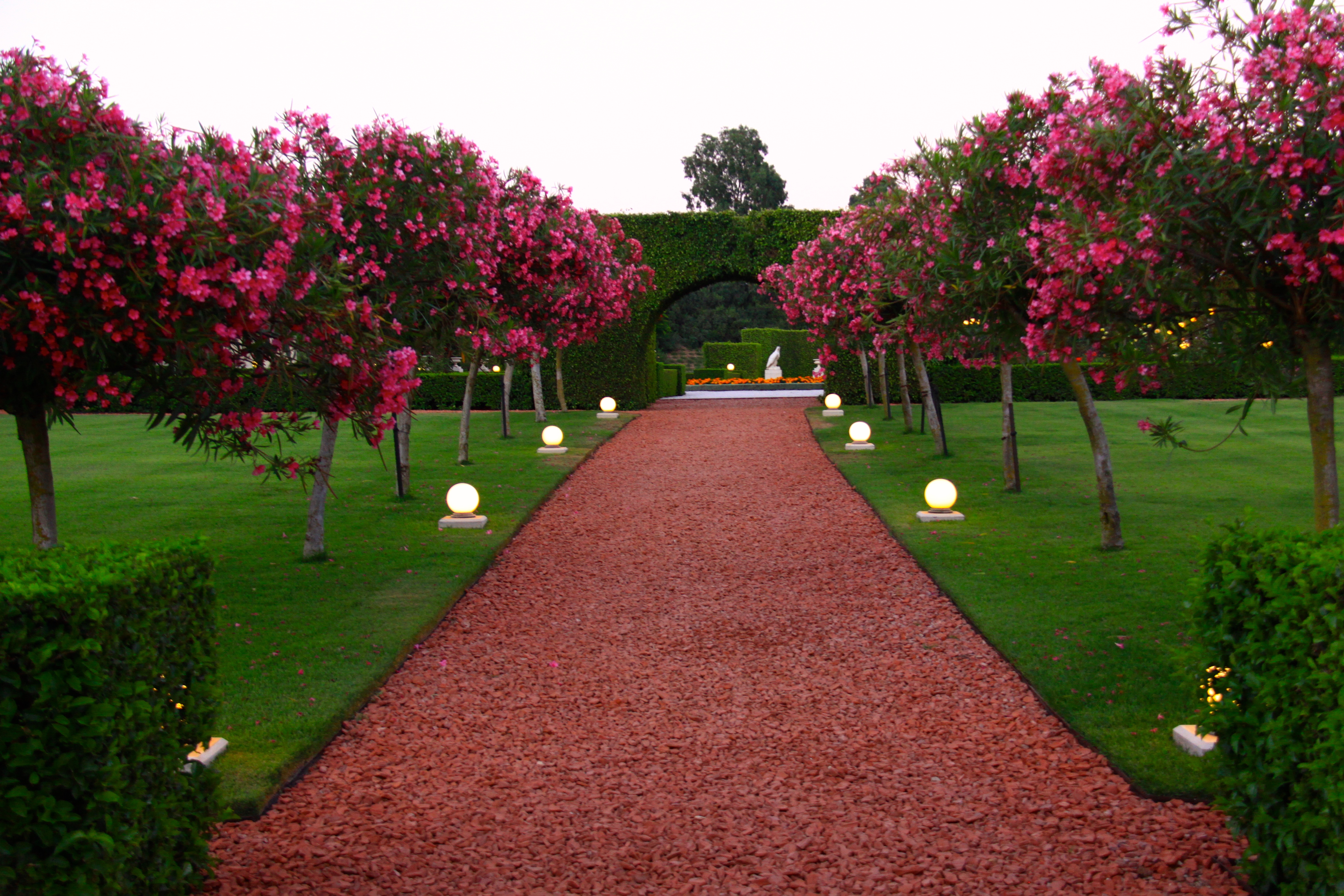
Path at Bahjí