A caravan of three

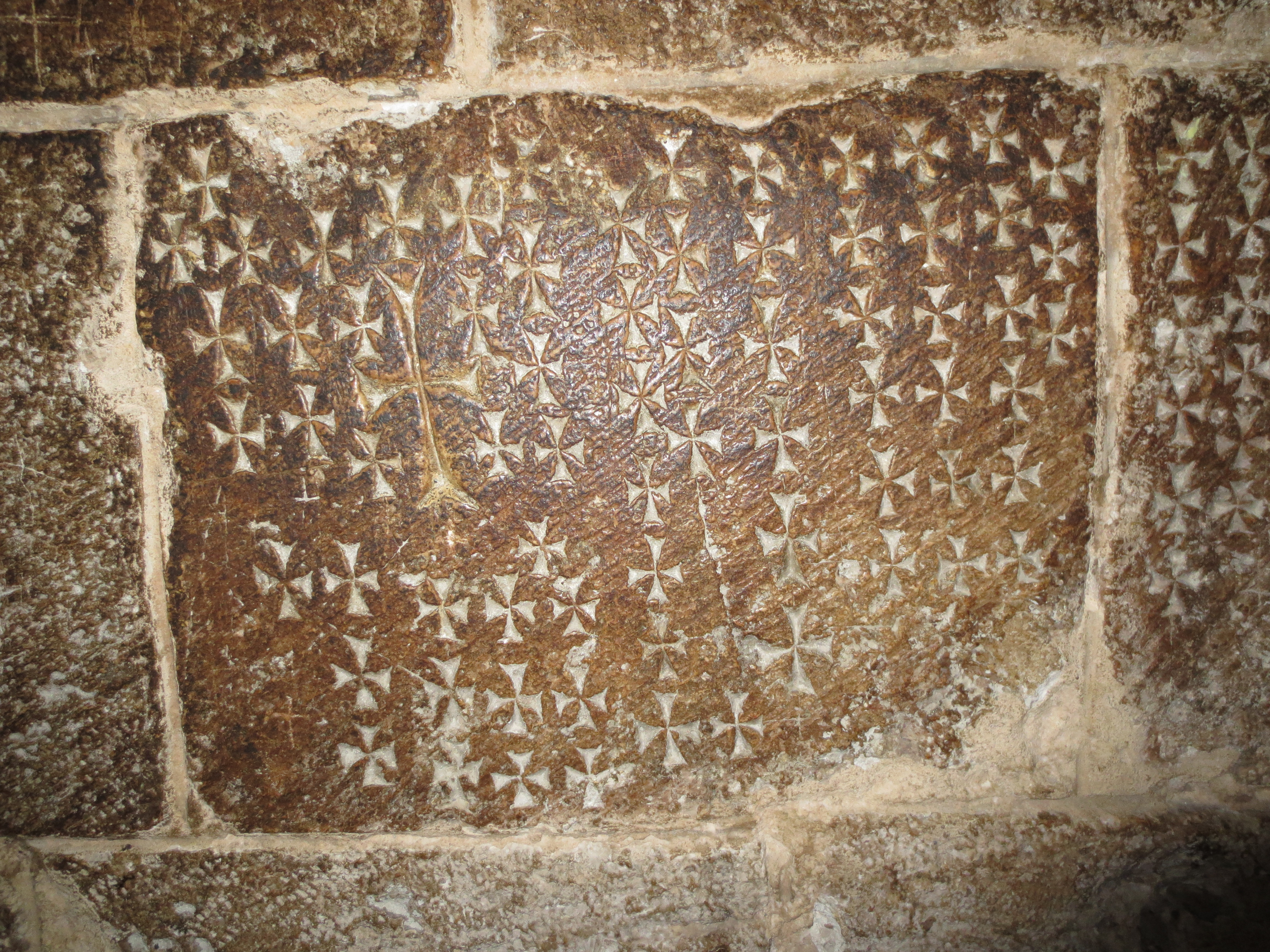
Crusader "signatures" in the Church of the Holy Sepulchre

Crusader “signatures” in the Church of the Holy Sepulchre

It is 5:45 in the morning and Haifa is still darkly asleep.  This is a time I rarely see–only during the Fast, really.  But today, we are on our way to Jerusalem, a caravan of three travelers.

We take a bus and then another bus, and have a layover at the central station in Jerusalem, which is full of young soldiers, fresh-faced in their fatigues.

“DONUTS!”  I haven’t seen donuts in six months and I’m pretty excited that this huge bus station sells them.  (Now I know where to go when craving hits, and it’s a mere three hours of buses away!)  Jasmine and I share a big one with sprinkles that stain my lips while Sergey drinks some coffee sludge.  Finally we make our way to a tram that takes us near to one of the gates of the Old City.

I have a plan of attack.  First the Church, then the Wall, then the Dome, then the Mount.  En route to the Church of the Holy Sepulchre, we pass by several Stations of the Cross, and pause to touch the spot believed to bear the handprint of Christ.

“I touched this before,” I comment, showing off my worldliness.  “Yes, I’ve touched everything in Jerusalem.”

“No wonder you’re sick,” Sergey replies.  Indeed, I wasn’t the classiest travel companion, what with my wad of tissues and plugged ears.

When we get to the Church, we go through the various sites—the anointing stone, Calvary, the Armenian chapel with the Crusader imprints on the walls, that subterranean chamber… I try to recount the fragments of history I remember.  Something about Saint Helen and Constantine.

Next stop: the Western Wall.  The female side proves less interesting than the male section, where a number of simultaneous bar mitzvahs are happening.  Lots of Torah scrolls, boys in yarmulkes, and tossed candy give the place a jubilant spirit.  We climb onto unwieldy plastic chairs that seem placed there for the express purpose of letting female visitors ogle the masculine goings-on.  I’m pretty sure I ended up in at least one lad’s bar mitzvah video.


Bar mitzvah(s)

Bar mitzvah(s)

But the stop I’ve been eagerly awaiting is not the Church or the Wall—it is the Dome.  If I learned anything from the documentary that eased Jasmine into dreamland, it is that the Temple Mount is super important historically.  I hadn’t gotten to see the Dome of the Rock on my last visit because its hours are so limited, but this time, I was ready.

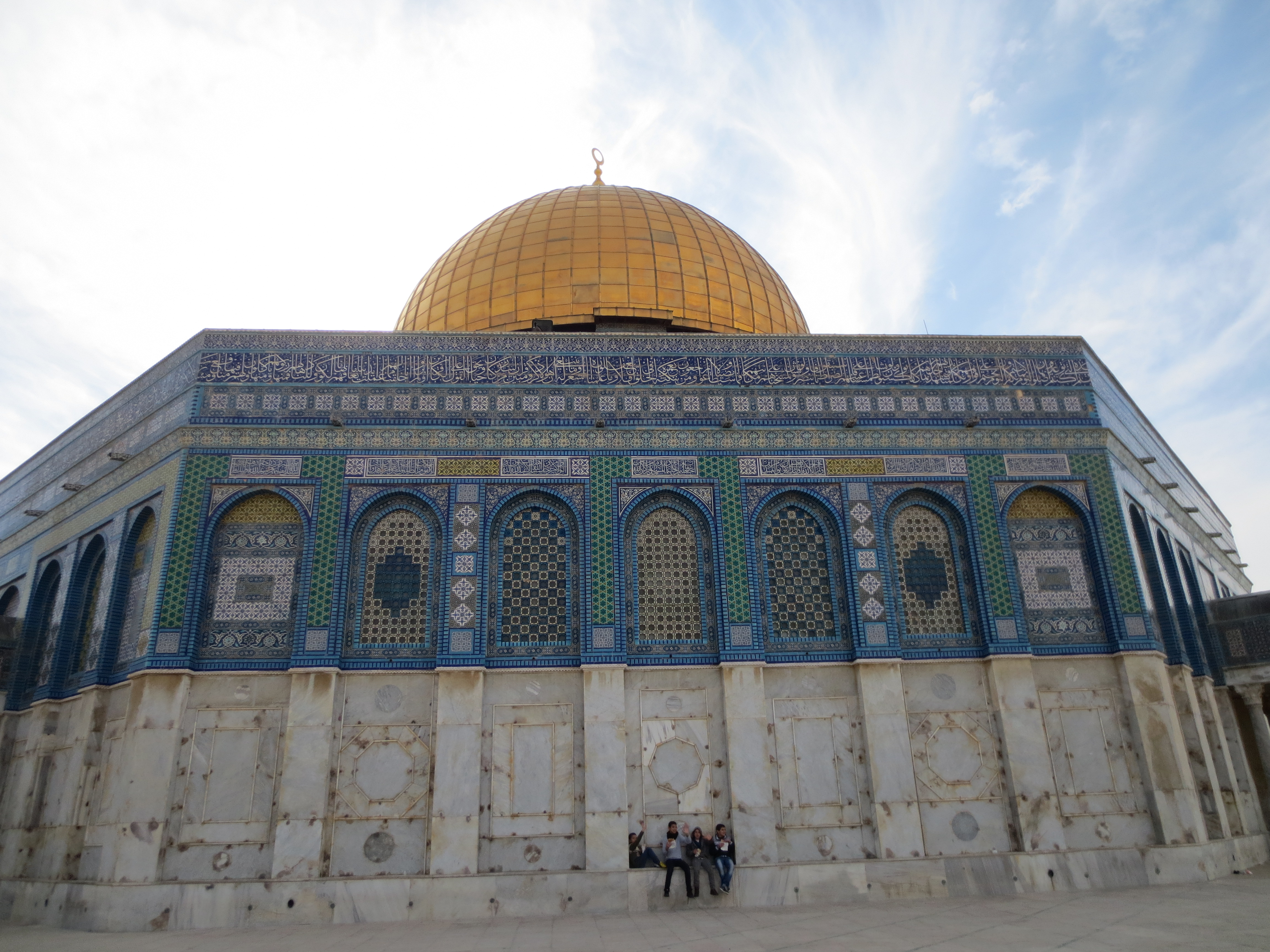
After a long wait in line, we walk up a sheltered bridge to the mount, where we find ourselves in a large open space with a long mosque to our right, the al-Aqsda.  Like moths to a flame, we are drawn up some wide stairs to the Dome itself, resplendent with delicately painted greenish blue walls and its shining gold dome.  Inside (off-limits to non-Muslims) is the rock from which it is believed Muhammad ascended to Heaven during His mystical night journey; apparently His footprint remains.

We wander around the huge plaza, which dates to the time of King David.  The area is surprisingly casual—some young women in hijabs study in a circle on the ground, while boys kick around a soccer ball.  Four young boys, munching on their lunch in an alcove of the wall, beg Jasmine to photograph them, then come to assess the result.  “Facebook!” they demand happily.

Facebook! WordPress!

Facebook! WordPress!

After lunch, we headed to the Mount of Olives to visit Gethsemane and the Church of All Nations…or the Agony, I’m not sure what its proper name is.  It is quite a different experience from last time, when it was thronged and someone came over the loudspeaker repeatedly to instruct “Silence”; this time, I feel at peace sitting in a pew, looking at the nighttime garden scenes on the huge mosaics around the walls.

It is sunset by the time we entered the Valley of the Dead, which is between the Mount of Olives and the Old City.  A funeral unfolds with Jewish men swaying in black robes; the muezzin pipes a call to prayer.

Eventually, exhausted, we got on the bus back home and realized with sighs of relief that the most comfortable seats had been reserved for us: the floor.  Yes, apparently it’s a-ok in Israel to allow people to stand for two hours on the highway.  After about 15 minutes of swaying over an IDF soldier and watching another passenger giggle at cat videos, I succumb to gravity and wedge myself and my backpack down into the narrow aisle, with my cohort following suit.  Soon, at my offer, two sleepy heads loll against me.  In a weird way, it was cozy, the three of us snugly squeezed onto the floor with views of people’s shoes, the lights through the windshield, and the diminishing kilometers to Haifa.

Jerusalem

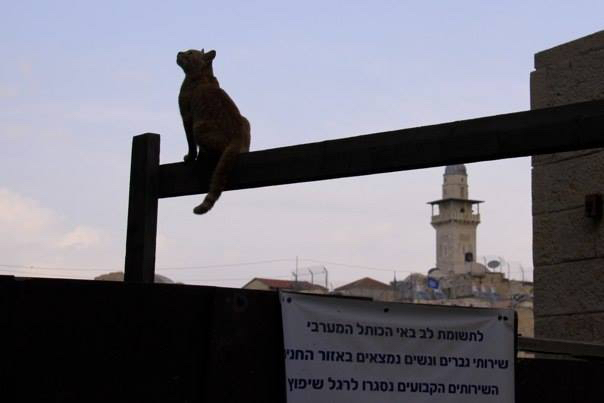
Cat

Cat near the Western Wall

Jerusalem.  A city precious to the three major Abrahamic religions, and still a magnet for flocks of pilgrims and the occasional sherut-load of Bahá’í tourists.

Once again, I am straining to understand the explanations of Abboud, the sherut company owner/tour guide extraordinaire who is shuttling us around like a flock of ducklings.  We are approaching Jerusalem on a highway that apparently featured in the Six-Day War in 1967.  Several hollowed-out army trucks stand in the median strip as a memorial to those lost in the fighting.

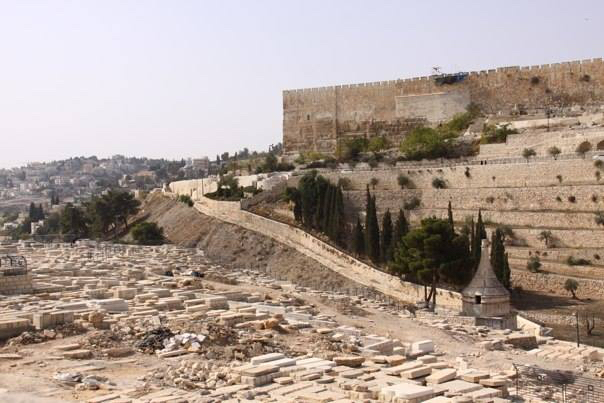
The newer parts of Jerusalem look much like any other larger Israeli city, with sandy-colored buildings and wending roads.  We stop to visit All Nations Church by the garden of Gethsemane.  From here, on the Mount of Olives, we have a clear view of the walls around the Old City, the golden bulb of the Dome of the Rock peeking above, and the Valley of the Dead below.  Abboud tells us that according to some tradition, the people buried in this valley will be resurrected half an hour early come Judgment Day, so spots go for $150,000 a pop.  “I ask, ‘What can you do in that 30 minutes that you couldn’t do all your life?'” he quips.  In Islam it is believed that on Judgment Day a bridge as thin as a hair will stretch between the Mount of Olives and the Dome of the Rock, and everyone will walk across.  The unrighteous will fall to their deaths in the valley below.  I’m probably too much of a literalist, but does this valley really look like it could fit all the unrighteous?

Valley of the Dead

Valley of the Dead

We get into the Old City through a thriving marketplace in the Muslim quarter.  Here is what I mean by thriving.  At first, it is merely bustling, a mixture of tourists and residents going about their shopping, vendors hawking their wares in loud Arabic.  But then we take a turn and the crowd grows thicker, until we are squeezed shoulder to shoulder, barely moving.  I hang on to the person in front of me, wishing that we had one of those ropes preschoolers hold on to to when they walk outside to keep everyone together.  This recalls riding the Metro at rush hour in Santiago, when there was always a distinct possibility that, unable to push through the packed bodies to the door quickly enough, I would miss my stop.  Now barely moving turns to unmoving.    Eventually the culprit behind the traffic jam appears, a young man pulling a cart loaded with what seems to be about ten giant boxes, three times his width, shouting hoarsely for people to get out of his way.

We saw the Dome of the Rock from a distance, because it is not open to non-Muslims.  But we were able to see the holiest places for Jews and Christians, the Western Wall and the Church of the Holy Sepulcher, respectively.

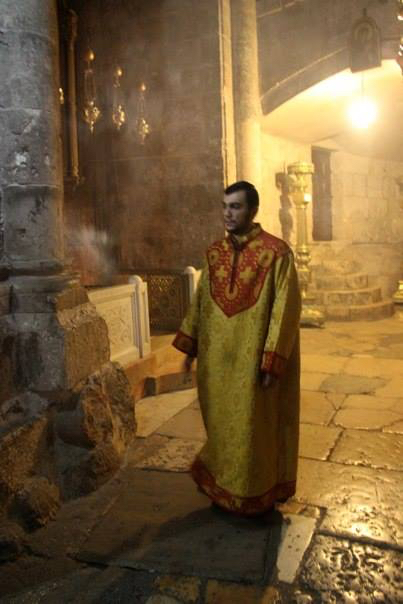
To get to the heart of the Holy Sepulcher, we wove our way through a maze-like succession of chapels.  Various sects have a (tense) agreement to share different bits of the church.  After we had touched the spot believed to be where the Cross stood and gone down to the underground chamber where St. Helena discovered the buried Cross, we went upstairs to a different chamber with a short passageway, where Abboud invited us to look at some tombs.  The first clump of our group clambered into the small space.  I stayed outside and watched a priest we had encountered energetically waving his censer near the Armenian section reappear.  Apparently this was also part of his scenting territory.  He approached the little tomb grotto and nearly yelled at our group, “EXCUSE ME!  What are you looking at?”  Then he swung his censer around in front of the cavern, as if trying to smoke out some unwelcome moles.  Soon he swept out of the room, leaving us baffled and smoky.

Guess he was incensed about something...

Guess he was incensed about something…

Now my turn came to go into the passage.  This was the second time I whacked my head on a low overhang, so to be honest I couldn’t really gather what Abboud was saying, other than that there were four tombs around us, carved into the stone.  Two were open and empty; two were closed.  “Wait, so does that mean someone’s in there?” someone asked.  “Yes,” he said, causing her to whimper.  “Don’t worry, they don’t bite!” he said.   I wonder what zombies from the years BC would be like…

In the end, it’s as much about the little things as the super famous sites.  For instance, at lunch we were brought falafel fixings.  Among the various dips was fool, a bland dip of mushy cold fava beans, which I would not recommend.  “What is this?” someone asked.  The server, a young teenage boy, responded monosyllabically, “Fool!”  The inquirer heard “Food!” and burst into laughter.  But even if he had heard right (fool!) it would still have been hilarious for us poor fools.

The sea below the sea

I’m back in the office, and my back muscles are sore.  It’s from all the floating over the weekend.

That’s right: for the first time since my train pulled into Haifa, I stepped foot outside the Haifa-Akka area.  When I signed up for the Dead Sea trip, allured by the promise of adventure, I knew one thing: it was salty.  And also dead, as anything that tries to live in the sea would probably become quickly pickled.  I had a feeling it had some biblical significance, like, wasn’t that where Jesus walked on water?  Or where Moses parted the sea?  (I assume your Bible knowledge is better than mine and you know that would be the Sea of Galilee and the Red Sea, respectively.)

It was a rather long ride in the sherut, as we must avoid the West Bank.  I plugged in my earbuds and listened to Devendra Banhart.  I wish I had chosen someone more pronounceable and less indie to listen to, because when questioned about my music choice, my response provoked raised eyebrows.  “Dev-end-ra-ban-heart, have you heard of him?”

If I didn’t pay too much attention, it would have felt much like the trip from Verona to Chicago–wide highways, green signs (except in Hebrew, Arabic, and English), gas stations en route.  But after a while we entered the desert.  I knew I had entered a strange land when I saw the camel crossing signs, and then the camels, a few clustered by the side of the road, probably waiting for a sherut with open seats to come pick them up.

“Alright, we’re about to go underwater,” Abboud, the sherut driver famed among the Bahá’ís, said.  “You all ready to hold your breath?”

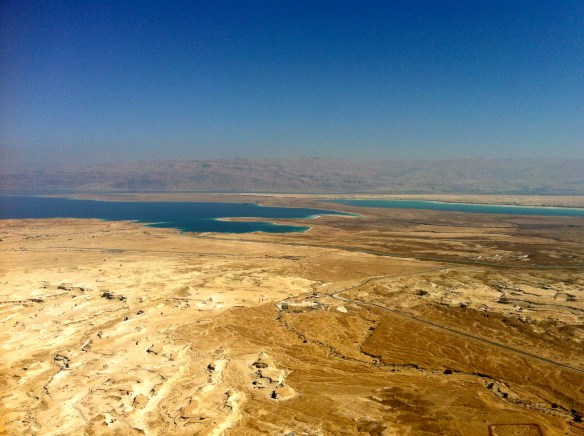
We were going below sea level, deeper and deeper “underwater.”  The Dead Sea, Wikipedia tells me, is the lowest point on dry land in the world.  It’s a sea below sea level.  Interestingly, because of the great atmospheric pressure, you’re safer from the sun’s harmful UV rays there, despite the constant clear skies.

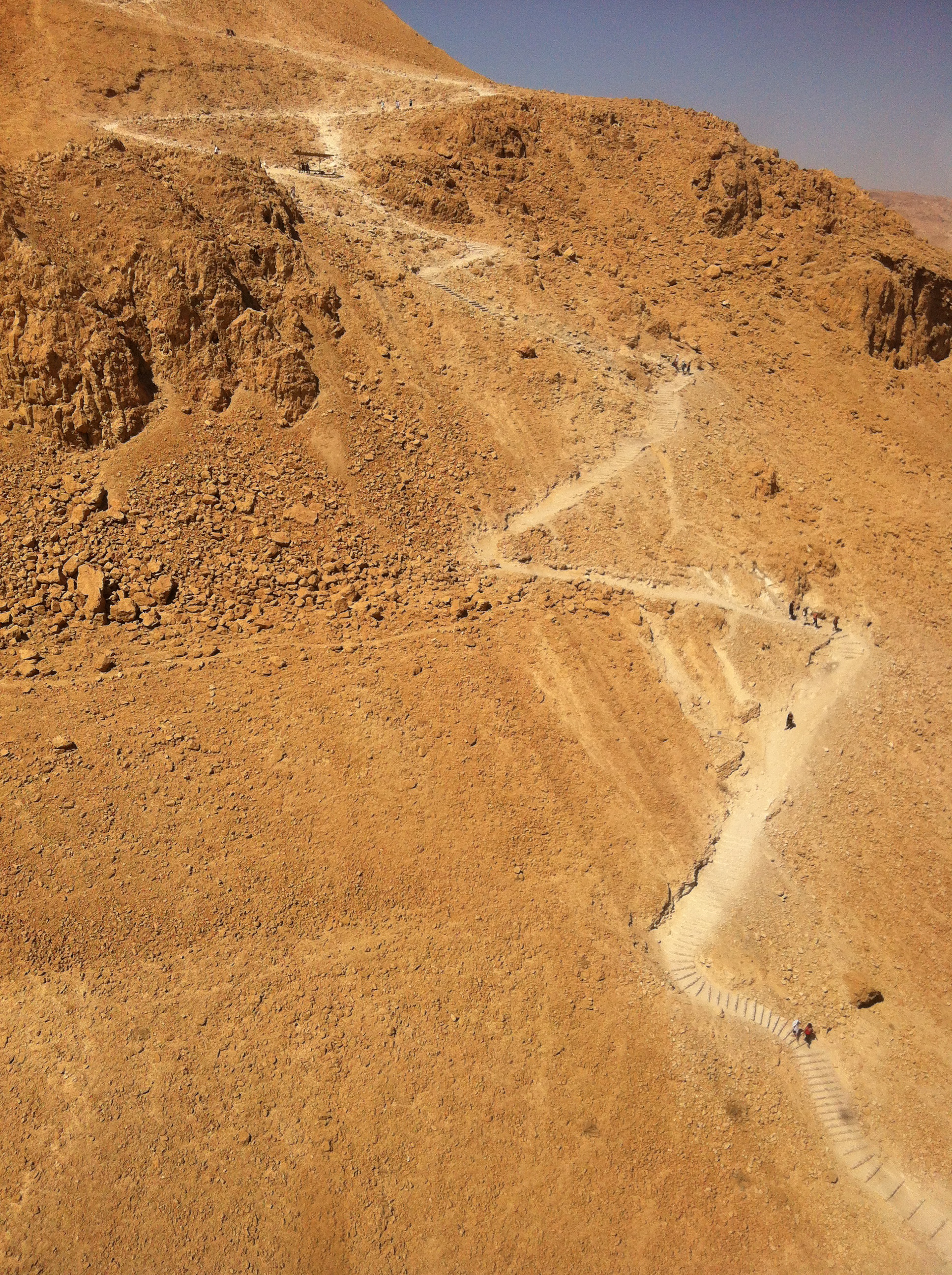
Hiking trail up to Masada.  No thanks, I'll take the cable car.

Hiking trail up to Masada. No thanks, I’ll take the cable car.

Our first stop was Masada, the ruins of a fortress and palace built on a plateau by Herod the Great.  When the Jews rebelled against their Roman overlords, they made their last stand there, kind of like the Alamo except less Texan.  In short, the Jewish men decided to commit mass suicide and die free rather than allowing themselves and their families to be captured and enslaved by their foes.  When the Romans entered the fortress, they were greeted by hundreds of lifeless bodies.

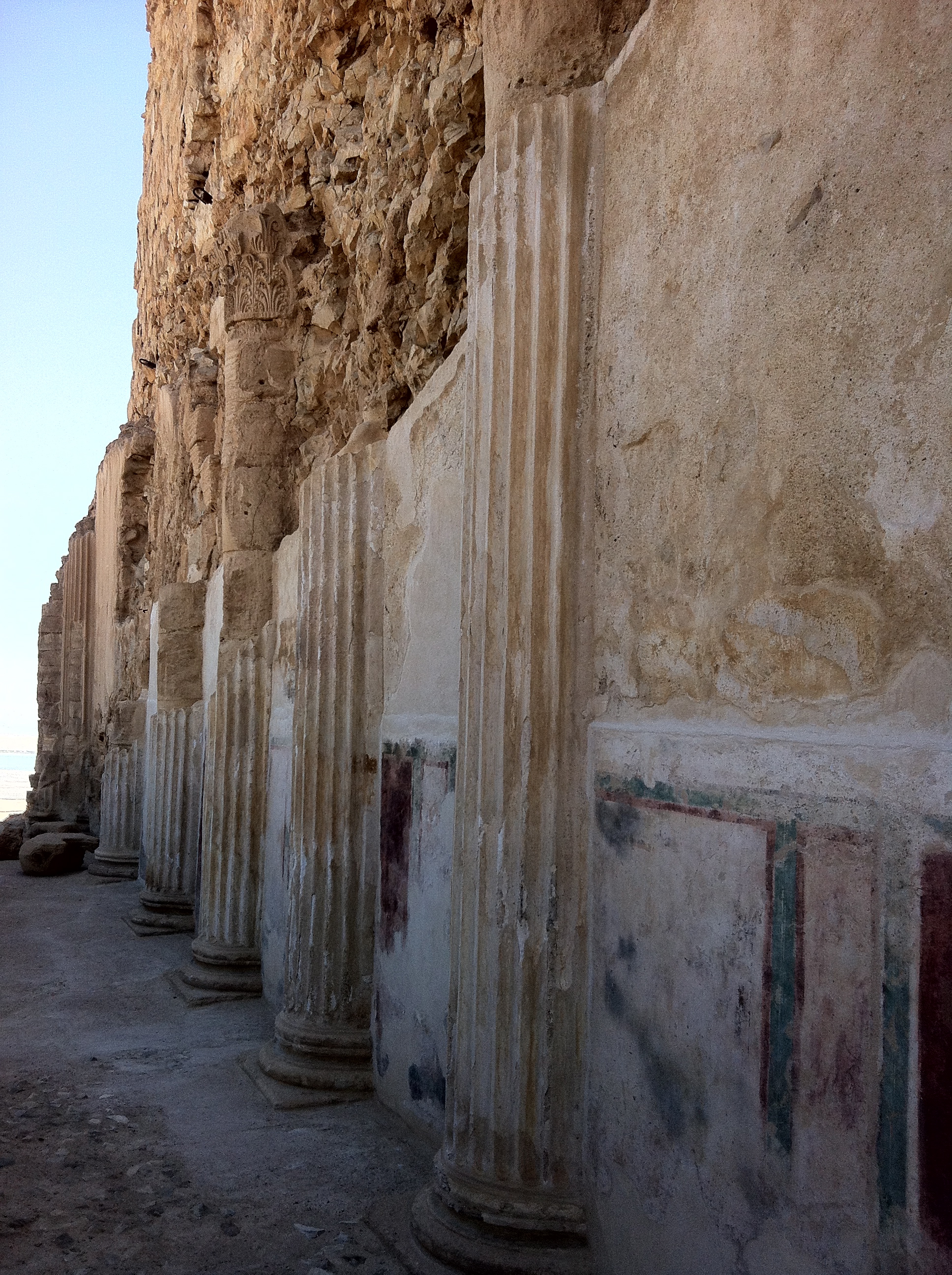
Ancient columns.

Ancient columns.  A key part of ruiny décor.

Mainly what I learn from visiting places like Masada is that I don’t have the mind of an archaeologist.  I have a hard time looking at stone walls and envisioning Herod or the Jewish rebels.  But the panoramas of the alien landscape were something to behold.

IMG_1282

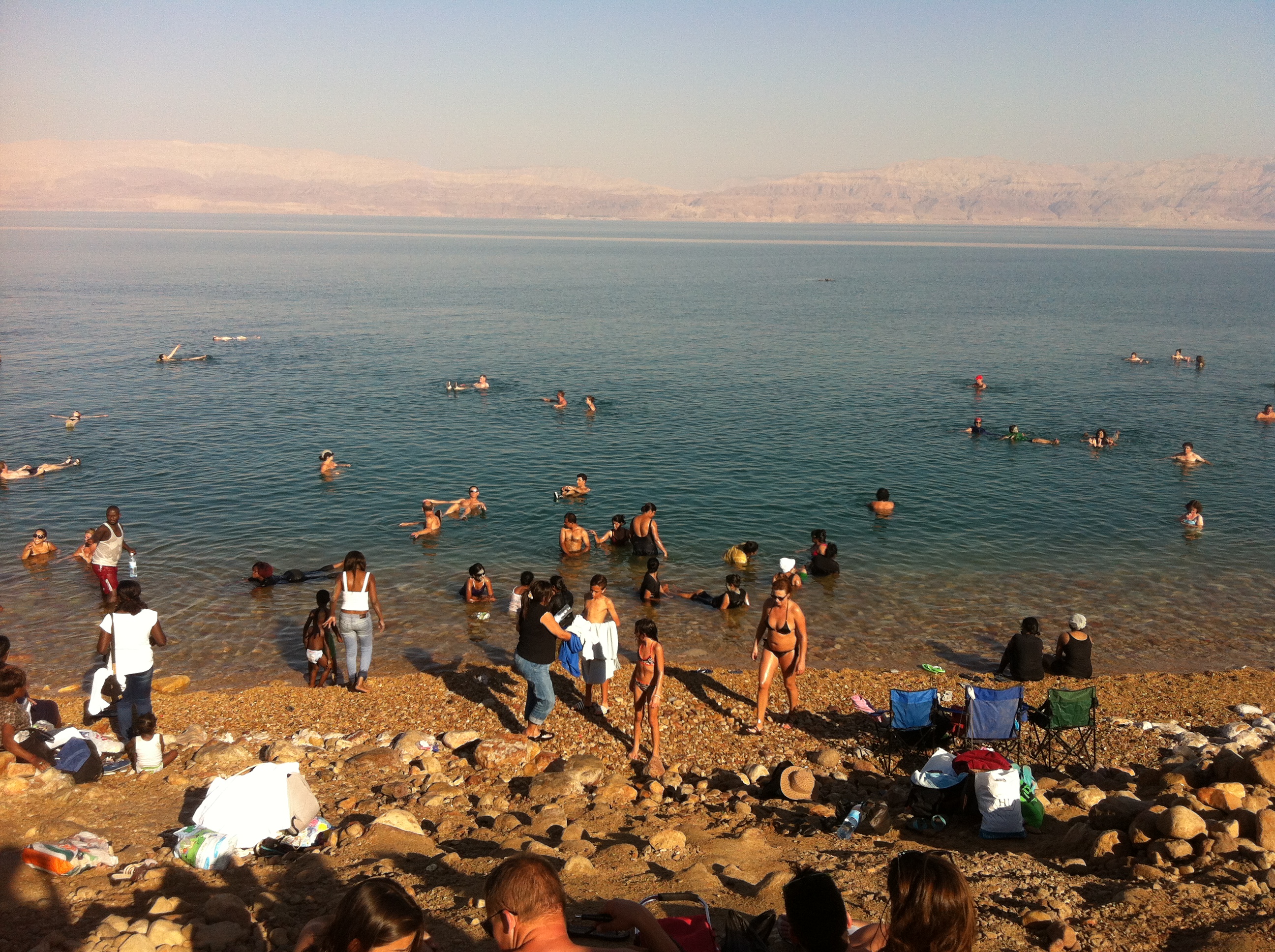
At long last, we reached the shores of the sea.  The beach, which was more of a rocky hill, was full of tourists, some of them painted with mud, some of them floating.  I could see that some of the rocks on the shore were actually covered with large salt crystals.

Beach

I tentatively stepped into the water.  My flip-flops escaped my feet and shot to the surface.  Ok, new plan: unshod, I waded into the water, wincing over the bumpy rock bottom.  I crouched down, then let myself float up to the surface.  Now, I’m not much of a beach goer.   As you know, the double threats of sunshine and drowning prevent me from getting seduced by that scene.  But I have found my perfect body of water in the Dead Sea.  You can’t swim, but only float–perfect!  I don’t need to fear going past my depth because I physically cannot sink!  You can’t put your head underwater unless you want to damage your eyes–wonderful!  I dislike the sensation of submersion.  I let myself float a little deeper, watching the pink, dry mountains on the Jordanian shore and the quiet desert sky above.  The water was warm and oily–I could see the shadows of the oil projected on my hands underwater.  Once I actually wanted to move, this proved complicated.  I tried a few strokes, to little avail, and started to wonder what would happen if I just never got back to shore, floating immobilized, a victim of buoyancy?  Finally I found a very slow breaststroke worked.

And I must have gotten back to shore eventually if I’m writing this now.