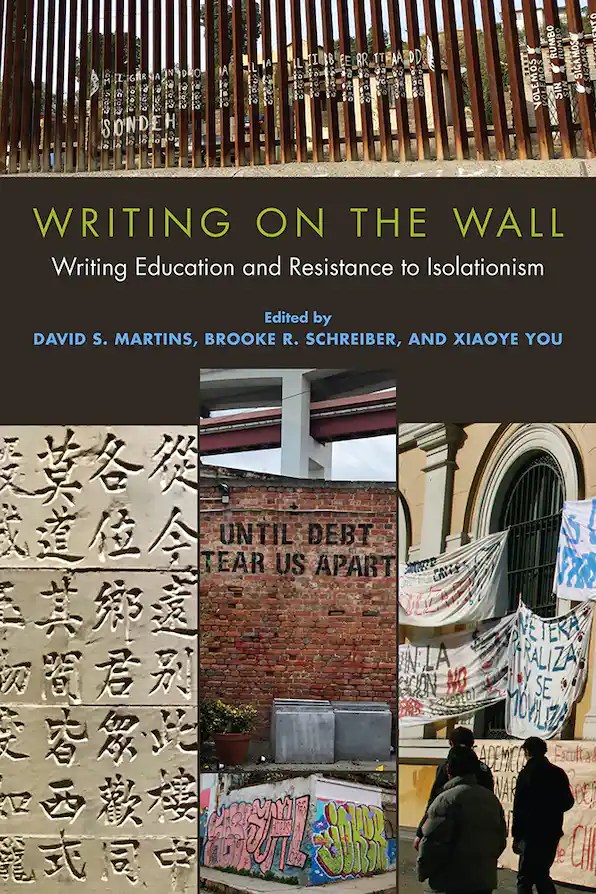
Miron, Layli Maria. “Public Pedagogy and Multimodal Learning on the US-Mexico Border.” Writing on the Wall: Writing Education and Resistance to Isolationism, edited by David S. Martins, Brooke R. Schreiber, and Xiaoye You. Utah State University Press, 2023, pp. 129-150.
My contribution appears as Chapter 8 in this edited collection, which considers how writing educators can challenge isolationism and xenophobia. You can read the introduction to my chapter below. The essay is drawn from Chapter 4 of my dissertation.
Excerpt from “Public Pedagogy and Multimodal Learning on the US-Mexico Border”
A wall, built of steel bollards that soar above the dry earth of the Sonoran Desert, splits the city of Nogales into Arizonan and Mexican sides. As I walk along the Mexican side of the wall, I can see that it has been adorned with pictures and messages protesting division and policing: a boy shot to death by the Border Patrol gazes from a portrait; tiny crucifix memorials sprout from the earth in their dozens; and painted slogans shout from the wall’s bollards—for instance, “Nuestros sueños de justicia no los detiene ningun muro” (“Our dreams of justice won’t be stopped by any wall”). I have come here to Nogales, a hub of border-crossing and deportation, to learn how migrant advocates articulate their dreams of justice—how they seek to rewrite the civic discourse that birthed this border wall and that demonizes undocumented immigrants.
Over the past few decades, the federal policy called “Prevention through Deterrence” has pushed undocumented immigrants away from urban crossings into the Sonoran Desert. With its long stretch of border running through this desert, Arizona has experienced a huge influx of migrants, which has aroused the ire of many residents (De León 2015). Yet, some have responded to this migrant flow by creating organizations dedicated to upholding migrants’ rights through efforts that include public pedagogy. The concept of “public pedagogy” recognizes that teaching and learning occur in many sites outside formal educational institutions, ranging from museums to streets to online media (Springgay and Truman 2019, 4). Public pedagogues may share many goals with college writing educators, including the objective of questioning the walls—physical and ideological—that divide nations and fracture societies.
As educators grapple with the resurgence of nationalism, we can find innovative teaching models in public pedagogy. I present one such model, drawn from my research on the Kino Border Initiative, a Nogales-based Catholic organization dedicated to the rights of undocumented immigrants. I will address the strategies Kino employs to enact its tripartite pedagogy of humanizing, accompanying, and complicating undocumented immigration for US audiences; these strategies show how multimodality can promote embodied learning and lead to new understandings. After summarizing Kino’s background, this chapter analyzes two examples of its educational materials (a comic book and an immersion program) and considers takeaways for college writing education.
 Layli Maria Miron