Student-Consultant Interactions: From Single Visits to Partnerships

Logo saying the Peer Review, 10th anniversary, 2015 to 2025.

Smith, Zoe, Caroline LeFever, and Layli Miron. “Student-Consultant Interactions: From Single Visits to Partnerships.” The Peer Review, vol. 10, no. 1, 2025.

Abstract: What can consultants do to move students to return to the writing center? To identify strategies that accomplish this end, two undergraduate researchers and an advisor surveyed students who had repeatedly visited a single consultant. We then analyzed the data, coding consultant strategies and noting repeated occurrences. We also recorded appointments of consultants with high rates of returning clients, collecting transcripts detailing the strategies they use in first-time visits. Our research contributes to our field’s understanding of why some students return to the writing center and what students want from their consultant, intersecting with current conversations that acknowledge student writers as co-creators of writing centers and recognize peer tutors’ emotional labor. The consultation that we document and analyze may find use in consultants’ professional development.

Full Text: You can read the article or the full issue.

Sustaining and Incentivizing Tutor Education through Self-Paced Modules

WLN: A Journal of Writing Center Scholarship - Authors Bowles, Stowe, Miron, and Gilmore and Hudson

Miron, Layli. “Sustaining and Incentivizing Tutor Education through Self-Paced Modules.” WLN: A Journal of Writing Center Scholarship, vol. 49, no. 2, 2025, pp. 15–21.

Abstract: Most writing centers staffed by peer tutors undergo regular turnover of employees as they graduate. While a consistent training program for new tutors can ensure that the entire staff knows the essentials of one-to-one writing pedagogy, no such program can cover everything. Often, tutors continue their learning through professional development (PD) meetings that focus on more advanced topics chosen by the center’s leaders. To keep the entire staff engaged, including returning tutors, the PD curriculum must change from semester to semester. Yet, that means that some tutors will miss out on topics covered in a semester before their hiring. In contexts of high turnover, how can tutor educators sustain tutors’ knowledge? This article offers one solution: online PD modules that reward completion with badges.

Full Text: You can read the article or the full issue.

Journey to My Husband’s Homeland

In an academic building's windows, the crosses and golden domes of an Orthodox Christian church reflect.
An academic building reflects a church on the campus of Moldova State University.

My husband, Sergey, is from Moldova, though it has now been more than a decade since he lived there. Before he left, his few family members also emigrated—his brother to Russia and his mother to the United States. Until recently, I hadn’t had the opportunity to meet his brother. We had planned to visit Russia while I was in grad school, but then the pandemic began, and then the terrible war in Ukraine, and the prospect of setting foot in Russia dimmed. So, when Sergey heard that his brother, sister-in-law, and their children would be coming to Moldova, we took the rare opportunity to see them. Given the effort of getting to Eastern Europe, it only made sense to add stops so Sergey could visit Moldovan friends who had emigrated to Romania and Germany.

In the midst of time with Sergey’s family and friends, and on days when I wasn’t in bed contending with the foodborne bacteria and airborne virus that in quick succession welcomed me to Eastern Europe, I limned some word portraits of the three cities where we stayed: Bucharest, Chisinau, and Munich.

Continue reading

Looking back…and forward


Sculpey hearts I gave to World Centre friends upon my departure.

I gave these polymer clay hearts to friends upon my departure. (No, they are not edible!)

While I prepared for my departure from the BWC for months, it still felt strange to leave. I realized that up until now, graduations have marked the endings and beginnings in my work–saying farewell to fair Verona to go to Mount Holyoke, four years later leaving Mount Holyoke to fly to Israel. With those commencements, I shared the ritual of departure with hundreds of others. But of course, in real, non-academic life, there aren’t usually huge ceremonies to mark goodbyes. So leaving despite work bustling along as usual felt kind of like stepping out of a room thrumming with people–and then flying 6,000 miles away.

In those final two weeks, I was asked a few times about my experiences over the past two years. What had I learned? I found it hard to articulate, though marriage obviously topped the list. My relationship with Sergey defines my memories. Indeed, I re-read all my posts here, and stories of Sergey started to dominate in November 2013, a few months after we met.

Through experience in my office, I have also learned about–and hopefully improved–certain qualities. Humility and self-discipline proved indispensable in my daily work, and I found excellent exemplars of those qualities in my colleagues.

As I sought to connect my experience with my upcoming studies in rhetoric and composition, I realized that I actually was almost constantly writing in my office. Sure, I wasn’t composing beautiful works of prose analyzing Shakespeare or Dickinson–I was doing “transactional” composition, writing letters, emails, instructions, and memos to accomplish tasks. I suspect that my firsthand experience with business and technical writing will benefit me as I start teaching college composition (in a few weeks!). I’ll have a grasp of what awaits students destined for white collar careers. Further, I think I’ve learned to clarify and simplify my writing, knowing that many coworkers in our super-diverse organization were not native English speakers.

Speaking of which, one thing I failed to learn was a new language. I started with Farsi, which after a few months became an excuse for getting to know Sergey (we have now given my colleague’s Farsi class a reputation for matchmaking)…and our study habits deteriorated. Then together we thought, well, we couldn’t stick with Farsi, so let’s go for an even more complicated language–Arabic! I wish we could have stayed in the class, but I simply could not muster the energy for the required nightly studying. And what about Hebrew? The class started around the time of our wedding, so I was in no state to participate. Now I am trying to learn Russian, though given my track record…well, for this one I have a special motivation: to make Sergey smile with my clumsy attempts to sound out Russian words.

Needless to say, it is impossible to summarize these years of my life, but luckily, I don’t have to! This blog serves as a depository of my memories, a growing memoir; since memories will continue to be made in the new chapter of my life, I’ve decided to stick with writing it. So, I hope you will stick with reading!

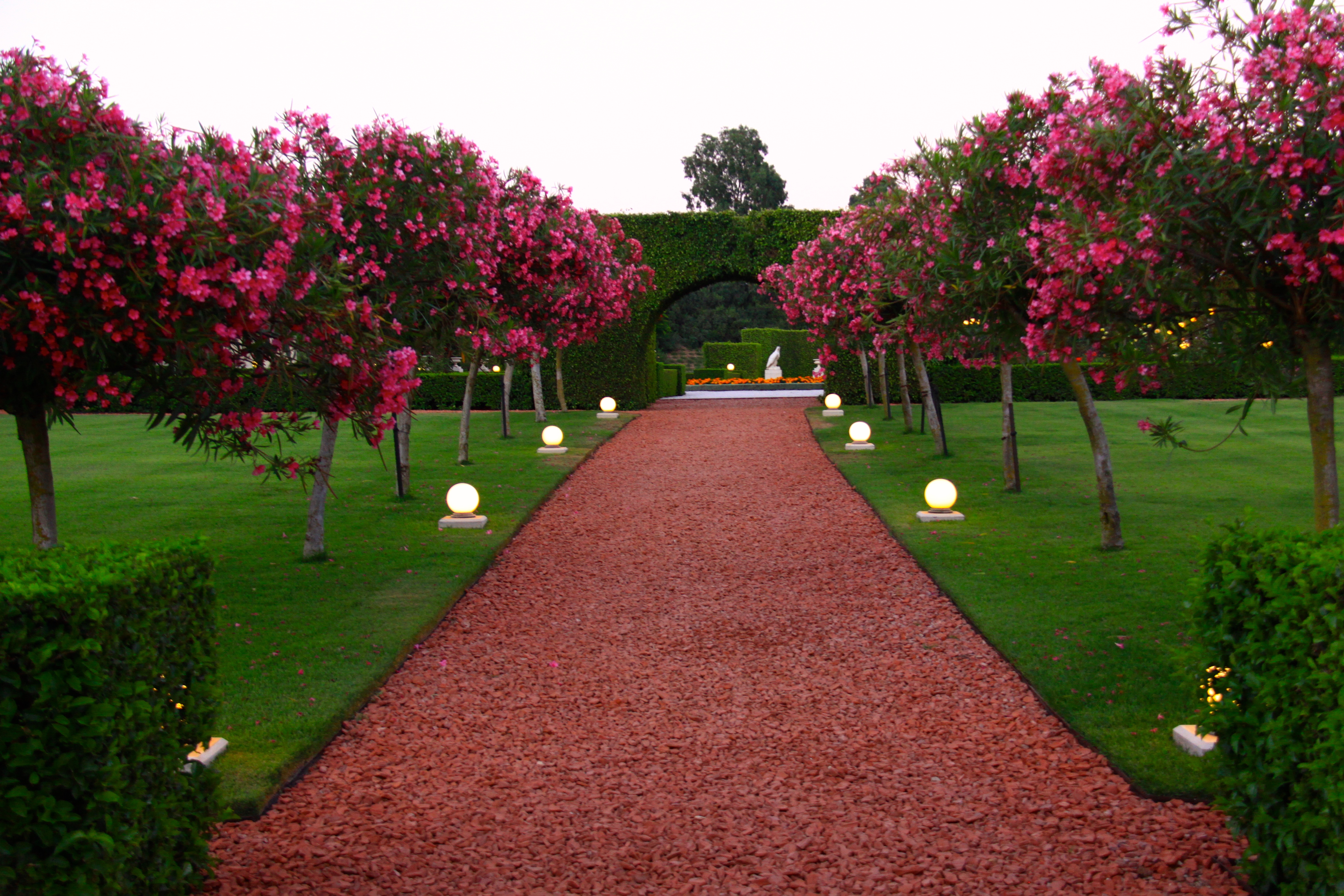
Path at Bahjí

Dailyat al-Karmel

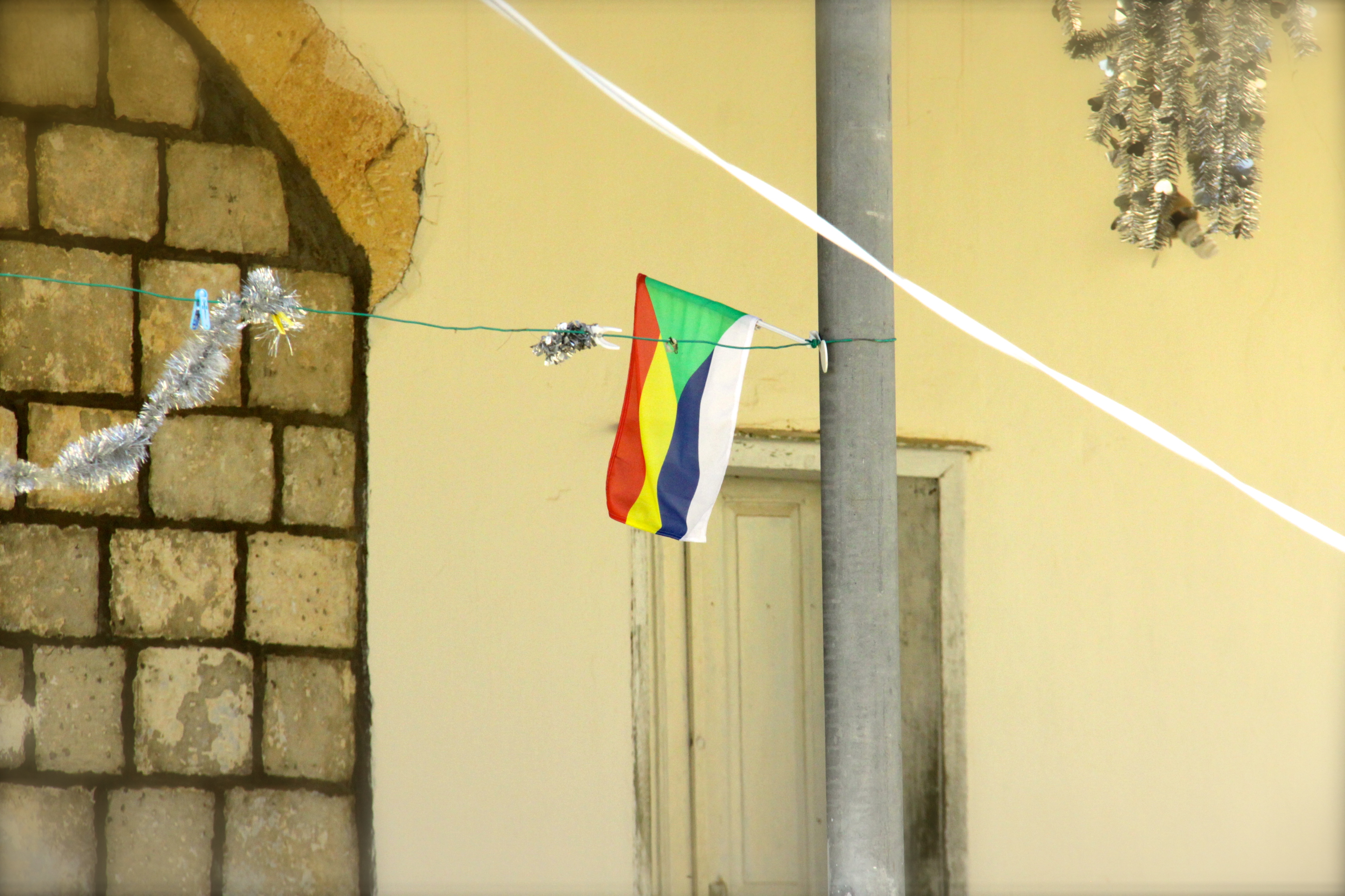
Druze five-color flag representing their five prophets.

Druze five-color flag representing their five prophets.

Frequently I hear reference to the “Druze village” on Mount Carmel, which summons a bunch of quaint huts in which the Druze peacefully paint pottery and bake their distinctive flatbread, which they serve topped with lebaneh (like sour cream cheese), tart zatar spice mix, olive oil, and fresh parsley. Driving through the sprawling “village” with its endless modern concrete apartments and houses, I realized my concept of a village didn’t quite match reality. We got off on the commercial strip, surrounded by souvenir shops and restaurants.

Dailyat al-Karmel is a town situated at the top of Mount Carmel, populated by Druze people. The Druze are a group that broke off from Islam over a thousand years ago to form their own syncretic religion. One of their tenets is obedience to and respect of the government wherever they reside, explaining why the Druze have fully participated in Israeli society, including serving in the military in the various wars. They are also known for their hospitality, which we experienced firsthand.

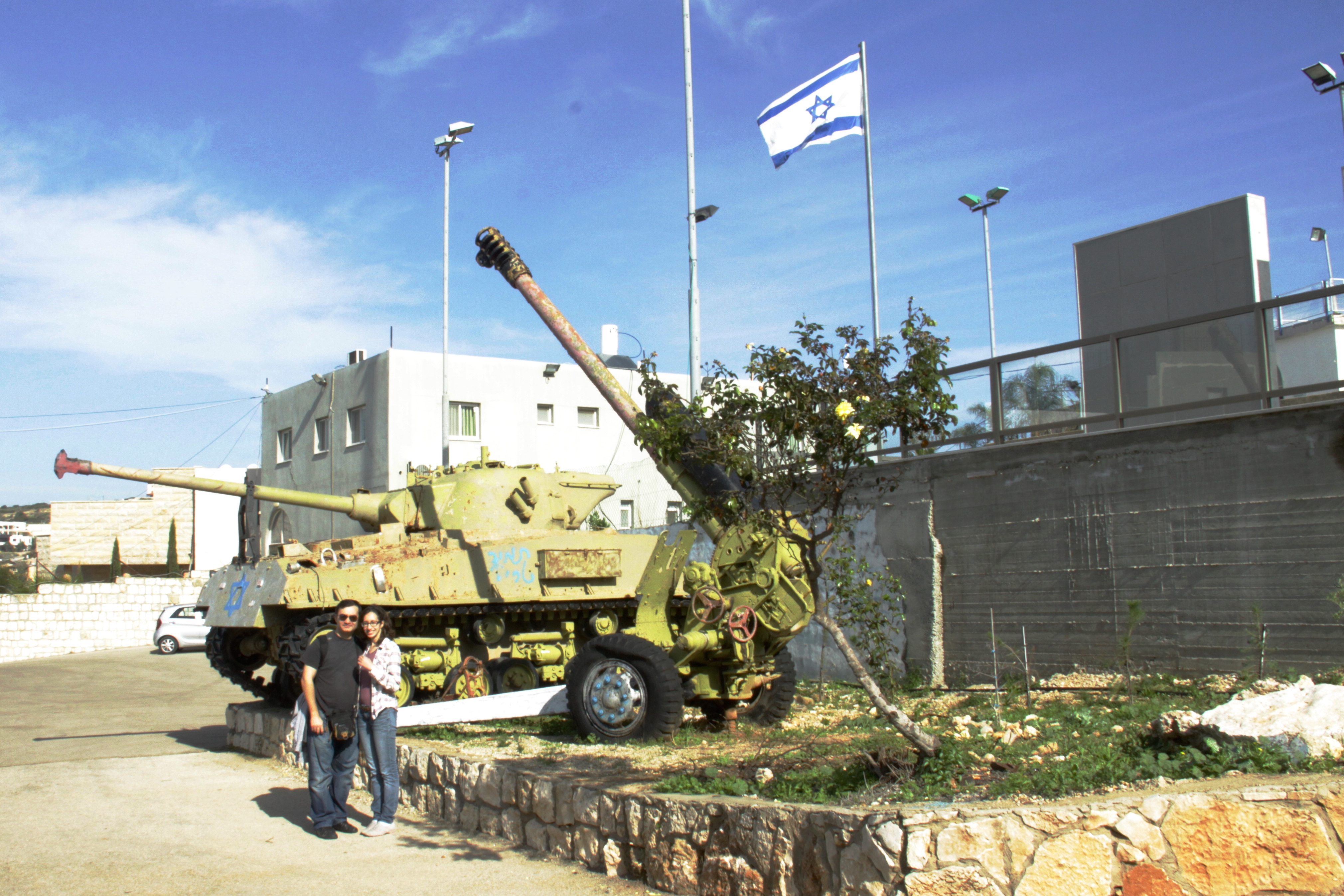
After walking up the commercial street, where you can find colorful textiles sold beside tacky statues (most notably a figurine of a seductively posed alien), we wandered onto a side street and found ourselves in front of a massive concrete domed structure. What was this place–a bomb shelter? A religious structure? No, it was a basketball court, as explained by the maintenance man who appeared to either guide us or shoo us off the property. Beside this odd dome were several tanks, apparently part of a war memorial. Sergey found this to be a romantic photo op.

Tanks near the giant dome

Tanks near the giant dome

Continuing our wanderings, I spotted a sign advertising Arabic coffee and we approached the building. To our surprise, rather than a café, we seemed to have stepped into someone’s living room. Sundry chairs stood around a large room, including stiff-backed chairs, armchairs, and couches. “Do you serve coffee?” we asked the man at the door, whose name was Zeedan. “Yes, yes,” he said, ushering us in. We sat down in some wicker armchairs and he poured us coffee in the usual miniature paper cups. Next came strawberries (in Israel, winter is strawberry season), and then baklava. Then he sat down beside us. This was unusual restaurant behavior, but he seemed to want to greet and talk to us. Unfortunately, the language barrier made conversation difficult beyond communicating where we were from, but at least we were able to write our names and notes in the gigantic guestbook he handed us, which had the notes of people from all over the world. It was strange to think that this sleepy town would be a crossroads for so many travelers, but nevertheless, the photographs cluttering the walls evidenced the acclaim of this town and this restaurant. One showed the president of Israel shaking Zeedan’s hand.

After some time chatting among ourselves, we decided to depart. When we asked for the bill, we were told it was all on the house. How very strange we felt not paying for our snack, and how charmed to be hosted so graciously, strangers as we were to Zeedan and his family! I guess that is wherein lies the secret to why this town can still be dubbed a “village”–despite the SUVs wending through its narrow lanes and the modernity all around, it retains a neighborly, hospitable culture.


Dearly beloved

I just had to share with you my latest and most hilarious bout of “lost in translation.”  I had told a friend about some flower shops in the commercial district, and he called me to ask about them.  Here is the conversation I thought we were having:

Sergey: Hello Layli, how are you doing?

Me: Good, good.  What’s up?

Sergey: [in his usual blithe tone] Well, I found out today that my uncle is dying, and I need to get some flowers–then maybe he will survive.

Me:  Oh!  I’m so sorry!

Him:  I remember you told me you knew some flower shops…

So I gave him directions in my most condoling manner.  Strange, I thought, that he hoped to remedy his uncle’s demise with flowers… Also, he sounded so nonchalant.  But cultural sensitivity is my aim, so I didn’t question this odd mourning/offering custom.

Later I realized that when I heard “uncle,” he was saying “anthurium.”  According to my investigations, that’s a flowering ornamental plant, not the brother of Sergey’s parent.  You know, sometimes context clues just don’t cut it.

The home of the spider

There is a flâneur inside all of us.  If I recall my art history classes well enough, once Paris was Haussmanized–many of the charming little streets were converted into wide, orderly boulevards–a new species of pedestrian emerged: the flâneur.  The flâneur was a window shopper, an idler, an urban vagrant who did not necessarily set out with a destination in mind; he walked around to see the city and maybe stop for a croissant every once in a while.

My flâneurism (which sounds like a dangerous combination of flan and aneurysm) manifested in some exploration of the Hadar, a commercial and residential district which, according to the map, my street borders.  I can’t tell you how much time I’ve spent examining maps of Haifa in a fairly futile attempt to commit the general layout of the city to memory.  There’s the tourist map I keep in my purse at all times, and the one on my bulletin board at home, and there’s even one up in the office.   So I had my route planned out, and I successfully found the main shopping street with its endless noisy clothing stores and the department store wherein I found this happy couple.  Please take a moment to note his rakishly angled spectacles and her receding hairline.  Aren’t they cozy.

They do say love is blind...

They do say love is blind…

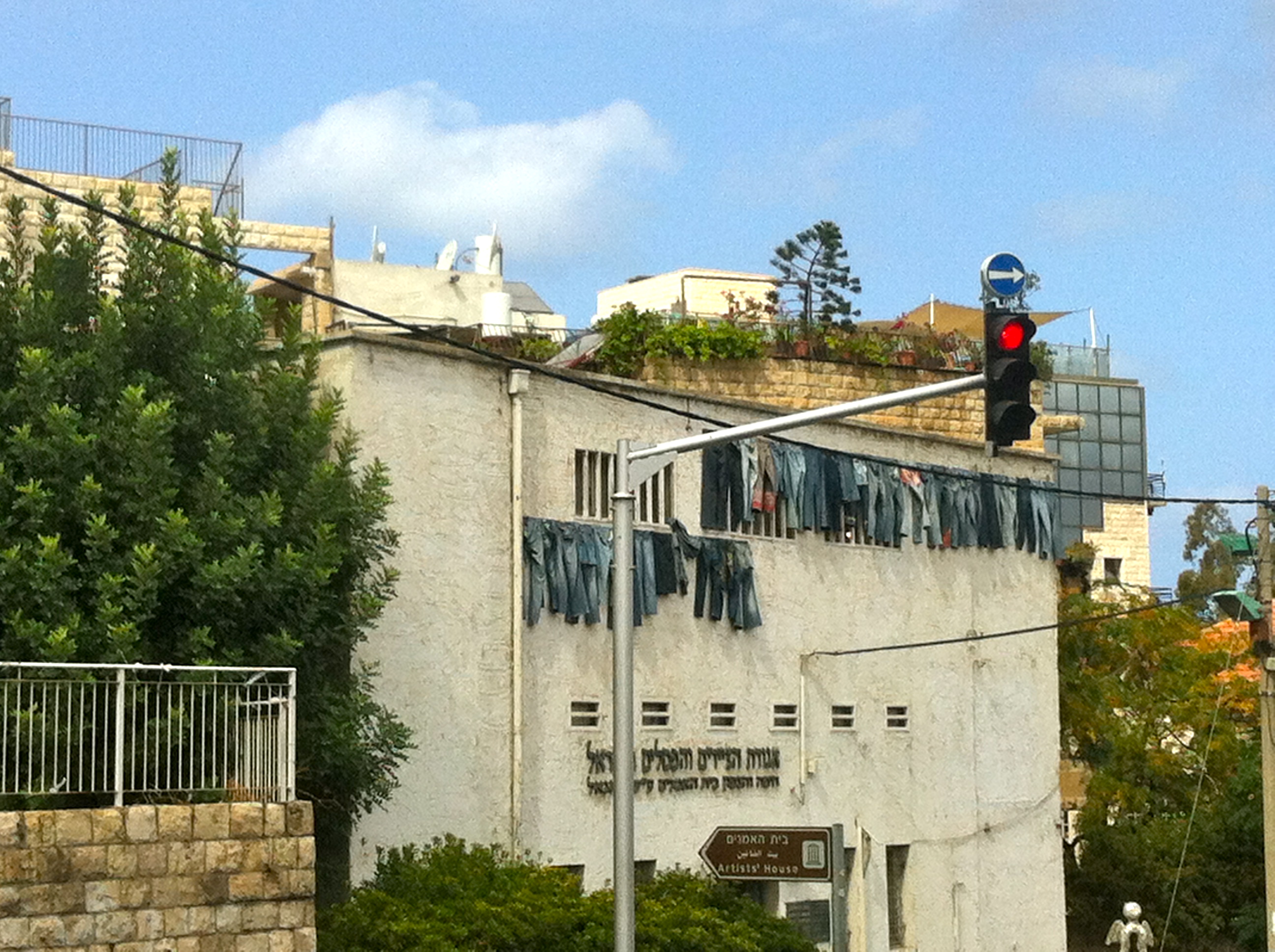
And this–jeans as art, or maybe the dryer broke:

Artist's house

Artists’ house

Once I had procured some houseplants and a muffin tin, I decided to retrace my route.  If I could accomplish that, I figured that would mean I actually knew the Hadar.

I did not accomplish that.

I suppose I was distracted by the unusually cool weather, the streets damp with rain, or maybe it was the dead cat in the street.  Anyway, I forget to take a turn and found myself in an unfamiliar area.  Unwisely, I decided to keep walking.  I suppose I hoped my “intuition” would lead me aright and my apartment building would suddenly appear in front of me.  Eventually, I swallowed my pride and found the friendliest looking person around (not a particularly easy task–Haifans are not the smiliest bunch) and asked for help.

“English?” I asked.  Over the course of the morning, I had gotten accustomed to the answer to this question being a shake of the head.  But it turned out she spoke very good English.  After she explained where I needed to go, she pointed at my map and asked, “Does it help?”  Good question.  As soon as I pull it out, I mark myself as an outsider, a foreigner.  But when I try to navigate without it, I end up seeing more of Haifa than intended.  Perhaps trying to make me feel better about my orienteering failure, she said, “The streets in Haifa are like the home of a spider.”  A very messy spider, I might add, the kind who eschews neat webs in favor of tangled nests where he stores his victims, including young women carrying Tourist Board maps.

Equinox

I was told that on Yom Kippur, the streets would be absolutely desolate.  The Day of Atonement is a very solemn Holy Day for Jews, who keep a 25 hour fast.  Yet, a few cars pass by.  Kids shriek as they play on their bikes and toy cars.  And there are a lot of firecrackers.  When I first arrived, I was unsure what to make of the sounds of explosions that punctuated the evening.  I mean, it didn’t exactly reassure me about the security situation here.  It turns out that the people here use a lot of fireworks to celebrate engagements, which, given how many fireworks get set off, means that there must be hordes of fiances filling this city.  But Yom Kippur and fireworks don’t go together so well.  Two theories were circulating about why the day was so noisy.  (1) The Arabs were trying to annoy the Jews or (2) the Jews were celebrating their atonement.  Somehow I find the latter a bit less likely…

***

Even though I spend most of my time under fluorescent lights in an air conditioned office, I can tell the air is changing.  I no longer fully thaw out on my walk home.  The highs are only in the low eighties.  Yesterday, some clouds hung over Mount Carmel, promising rain with their gray underbellies.  Nothing yet.  When I was walking across the Arc at sunset, I paused to take in the thunderheads poised above the bay, edged with pink.  I wasn’t the only one impressed; I passed two others who pulled out their camera phones to record the sky.  I gave up on using the camera in my phone as it blurs everything, so I try to capture the vista in my mind.

Yesterday I stood on grass for the first time in a while.  It was a small patch of lawn in front of an apartment building.  I rarely have the opportunity to leave the pavement or the gravel paths I take through the gardens to my office.  I need to find a quiet city park and just lie in the grass for a while like I sometimes do, close to the dirt and the bugs and the earth.  Humility, from humus, soil.  Getting close to the soil.  Walt Whitman knew the sanctity of those leaves underfoot:

A child said, What is the grass? fetching it to me with full hands;
How could I answer the child?. . . .I do not know what it is any more than he.
 
I guess it must be the flag of my disposition, out of hopeful green stuff woven.
 
Or I guess it is the handkerchief of the Lord,
A scented gift and remembrancer designedly dropped,
Bearing the owner’s name someway in the corners, that we may see and remark, and say Whose?
 
Or I guess the grass is itself a child. . . .the produced babe of the vegetation.
 
Or I guess it is a uniform hieroglyphic…
 
Read more!

Taking candy.

After lunch, I bump into two of my friends, Isabelle and Diana.  I love these eighteen-year-olds, who exude energy even when they’re clearly exhausted.  One of them, Isabelle, who is from Eastern Europe, offers me a hard candy.  I don’t really like hard candy–while my sweet tooth is tusk-sized, it prefers dark chocolate and homemade baked goods (preferably involving chocolate)–but I accept.  It’s a Mentos, one of those fruity flavors that tastes nothing like fruit.

Isabelle watches me chew on the candy.  “What do you think of the–” she pauses, contemplates, then mimes sucking on a candy by pushing her tongue into her cheek.

“Mm, it’s nice,” I say.

She doesn’t seem satisfied, and turns to my other friend.  “How do you say–” Then she points to her tooth.

Great.   I must have some embarrassingly giant herb wedged between my teeth.  I need to start carrying floss.

“Um, is there something in my teeth?”

“No no no!”  She says something to Diana, who is attempting to translate.

“An ulcer?” Diana offers.

No.  Please no.  I arrived in Israel with two open cold sores on my lips, which didn’t help with my natural self-consciousness.  I felt like I should have worn leper bells.  Had they recurred already?

“I have an ulcer on my face???” I ask.

“No no no!”  After another moment of consultation, she arrives at the word: flavor.

“Do you like the flavor?”  she asks.

“Mm, it’s nice,” I say.  Then I head out to check my teeth/cold sore situation.

Huh?

Lost

A very friendly woman asked me to get lunch with her, and I’m hoping (still on the friend hunt) to make a good impression.  We set our trays down on a table and she notices there is no salt shaker.

“I’m going to get one from another table,” she says.

I smile, and somehow manage to come up with an impossible tongue twister in response.  What I wanted to say was, “There seems to be salt shaker shortage.”  What I actually say is more like, “There seems to be a shalt saker sortage–shalt shake–salt sake sort–”

She remains unruffled, smiling through my stumbling, and agrees that there was indeed a shortage.  Despite my tongue being in a hopeless twist of sibilance, our lunch goes well after that.

***

I’m in a study group that meets once a week to discuss the Kitáb-i-Iqán, the Book of Certitude, which is one of the most holy books for Bahá’ís.  For whatever reason, the majority of the group is IT guys.  It’s a funny group.  I have to confess that my stereotype of programmers involves social awkwardness and thick glasses.  While there are some thick glasses in our party (mine), these guys are surprisingly chatty and even constantly wisecracking.  Like, constantly.  And with computer science allusions galore.  The facilitator studied computer science so she picks up on their references.  Me, on the other hand–I know a few HTML <b>codes</b>, but when it comes to real programming, I haven’t got a clue.  I console myself by thinking that if these men were to find themselves seated in a college English seminar, they’d be as lost as I usually am with them.

This particular day, we’re discussing progressive revelation, which Bahá’u’lláh explains with an analogy involving the sun.  There’s the concept that all the Manifestations (Abraham, Jesus, Moses, Muhammad, Krishna, etc) are the same, yet distinct.  He explains that it’s like the sun–I could say that today’s sun is the same as yesterday’s, or I could say it’s different.  Either statement would be true.  The sun is fundamentally the same sun, but it’s undergone changes since yesterday, so it’s also new.

“It’s kind of like object oriented programming,” one of the guys says.  Everyone laughs and agrees–“That’s a great comparison!  Progressive revelation and object oriented programming!”–while I lean back in my chair.  Well that clarifies things, I think, letting my mind wander back towards the humanities.

***

He’s on a ladder in the women’s restroom, and I am peering up at him.  I’m the contact person for problems in the building, including this case of the restroom door shutting too loudly.  It really is quite thunderous, but that’s mostly due to the acoustics of marble floors and bare walls.

So this young repairman/engineer is here.  I let him in and explained the issue to him, and now he’s set up to work on the hinges.

“Is there anything else I can do for you?” I ask.

“I need you to get out,” he says flatly.

I stare for a moment, my friendly admin smile still on my face, wondering why my presence is so obnoxious to this friendly guy.  Then I realize: “I need you to get out” means “I need you to help me get out.”  My building has limited access and lots of locked doors.  I laughed, explained my interpretation, we laughed together, and then there was nothing left to do–I got out.