
From the rural heartland to the populous coasts, American Bahá’í communities are building and maintaining archives, preserving the legacies of spiritual ancestors for present-day and future learning.
Iowa Bahá’í History Project
The Iowa Bahá’í History Project takes a unique approach: it encompasses materials from across the entire state, and it lives online. In 2022, a group of friends decided to create a repository of stories, interviews, newspaper articles and photographs to trace the growth of the Bahá’í Faith in Iowa.
Diane Findlay became a Bahá’í in Cedar Rapids in 1976. She now serves as one of the project’s coordinators, along with the webmaster Mike Moum and four other collaborators. She envisions the collection building history with “a focus on individual stories told in many voices.” To launch the project, she first used social media to solicit materials. “Results were encouraging. People were eager to remember, share, and be inspired by the creative responses of Iowa Baha’is to serve the Faith based on their individual circumstances and realities,” recounts Findlay.
The team organized the submitted materials and created a website at iowabahaihistory.org. A timeline on the website stretches back to the mid-1800s, when the first references to the Bab appeared in Iowa newspapers. A visitor to the site will also find stories of individual Bahá’ís, including personal narratives of how Iowans found Baha’u’llah, as well as photos and news clippings documenting Baha’i activities dating to the 1940s. As the team looks toward the future, they are seeking additional collaborators to maintain the website and add to its collection.
San Francisco Bahá’í Archives
Since the late 1800s, San Francisco has been home to devoted Baha’is, and one of the first was Ella Goodall Cooper. According to the community’s current archivist, Barbara Klingsporn, Cooper had an archival mindset, recognizing how precious the artifacts of the early Bahá’í community would be to posterity. Cooper meticulously collected records of Abdu’l-Baha’s 1912 visit and, over the decades, other community activities. After her passing in 1951, the archives moved among various locations, growing as community members contributed pertinent personal papers, photos of activities, and the like. Today, the sizable collection resides in an office suite donated by community members.
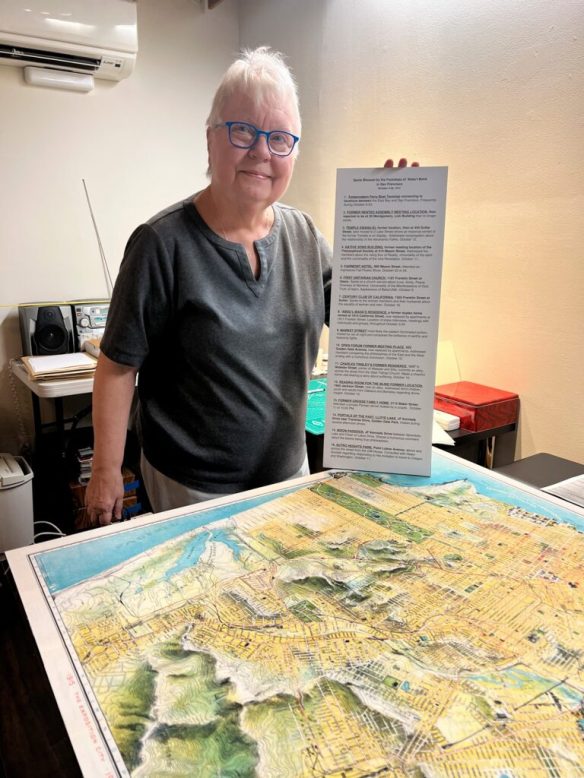
Klingsporn shares that succession and maintenance are key to preserving the archives for future generations. As she prepares to retire from her 15 years of service as archivist, two new archivists are in training. According to incoming archivist Ceci Mostaghim, “taking the Wilmette Institute course [Bahá’í Archives: How to Collect, Arrange, Maintain and Promote Bahá’í Archives] was essential, as I’d never done archiving before. And an interest in history is key. I enjoy preserving history, so that’s motivated me to take on this role.” Adds Klingsporn, “The more you get into it, the more fascinating it is. The more time you spend in the archives, the more you realize how much you don’t know.”
The archives team brings the collection to the community by creating historical exhibits at the Bahá’í Center. They encourage community members to send in materials, emphasizing the service to future researchers of labeling and preserving digital images of current activities. You can reach the team at archives@sfbahai.org.
Atlanta Bahá’í Archives
Like Ella Goodall Cooper in San Francisco, two early Baha’is in Atlanta, Olga Finke and Doris Ebbert, had the foresight to document the activities of the young community. The archival materials testify to the interracial unity of the Atlanta Bahá’ís despite Jim Crow segregation. Materials from that era show the Black and White Baha’is collaborating on community efforts, like the construction of the Baha’i Center, completed in 1950 and still in use today. To shed light on this early history, current archivist Leila Kashani drew materials from the archives to put on a recent exhibit at the Center about the first Local Spiritual Assembly, elected in 1941. “We used it as an opportunity during Ridvan to deepen the community on the election process,” she says.
The community has striven to maintain and grow the archives despite challenges. The hot, humid climate of the South threatens papers, so after years of migrating between homes of Baha’is, the archives were moved to a climate-controlled storage facility near the Center. Another challenge faced by all archives has been the move to digital files, which has necessitated rethinking retention. Now, in addition to stewarding the physical collection, Kashani maintains a digital collection in an online shared drive.
Kashani finds that through archiving, she discovers stories that link the past and present Atlanta Baha’i communities. For instance, after repeatedly encountering Olga Finke’s handiwork while sorting papers, she wanted to visit her gravesite. Thanks to the work of Baha’i history sleuths on the website Find a Grave, she found the burial location—but no headstone. After she raised the matter with the cemetery caretakers, they discovered the stone had been buried by storm runoff, and they unearthed it. Mud coated the inscription, rendering it illegible. Kashani recounts, “As a service project, a group of youth cleaned the stone. We can see the archives leading to other opportunities for service and connecting with our spiritual ancestors.”
This article originally appeared in The American Bahá’í (vol. 56, no. 5, Sep/Oct 2025, pp. 16-17), and on bahai.us.

