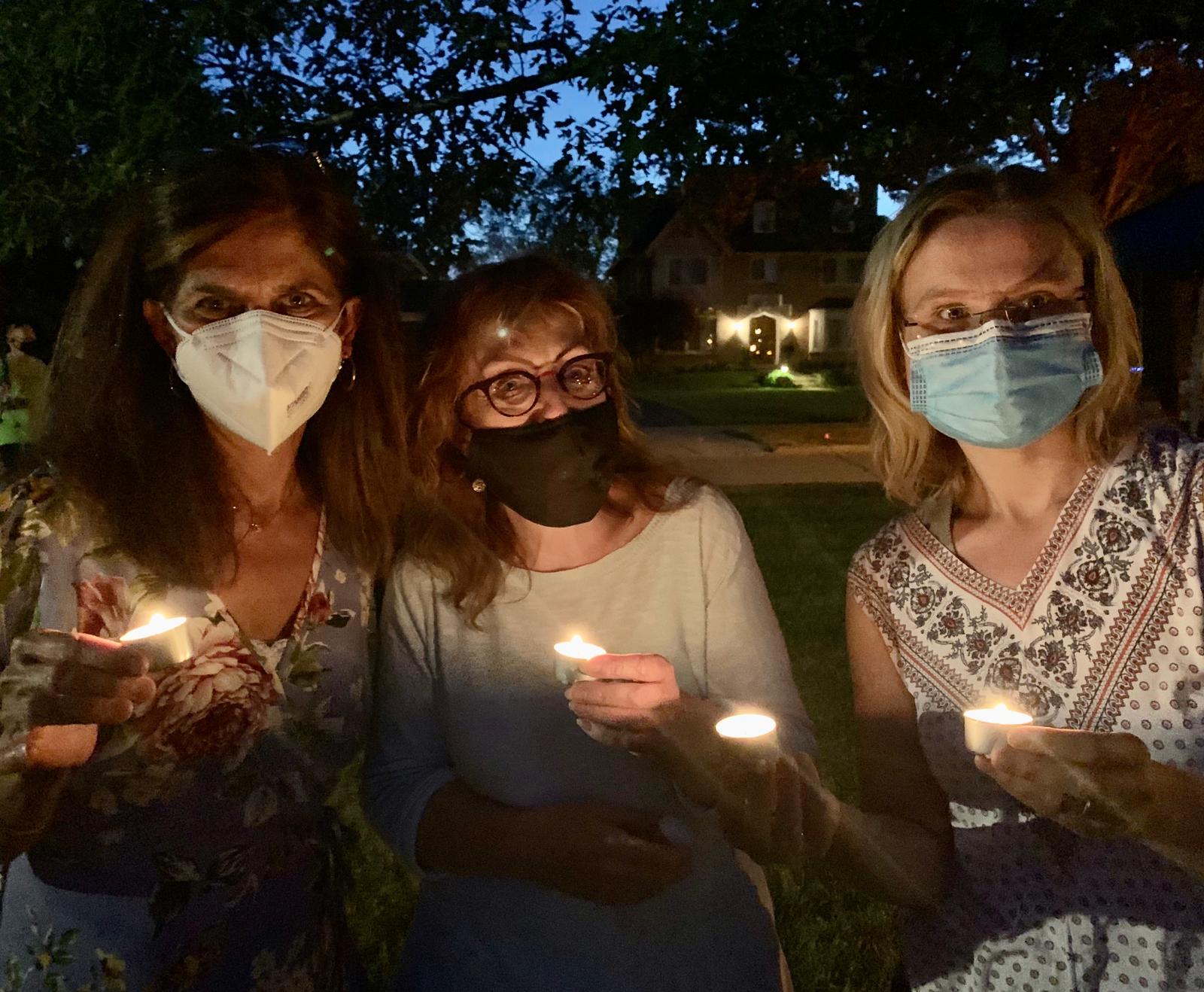

A few of the 100 or so people who attended the “Light up the Night” event in Fort Wayne. Photo courtesy of the Harrison Hill Neighborhood Association.
Harrison Hill is a historic residential neighborhood in Fort Wayne, Indiana. It is home to people of diverse ancestries — and for many that’s a cause for celebration. The decades-long marriage of two of the neighborhood’s residents, Gayle and Akinlana (“Akin”) Bevill-DaDa, exemplifies the possibilities for interracial relationships. Gayle is white and Akin is Black.
As the Baha’i world prepares to commemorate the centenary of Abdu’l-Baha’s ascension and anticipates the construction of His shrine and final resting place, the time is ripe to review His talks and writings (which you can find online here at the Baha’i Reference Library). One of His most important writings is the Will and Testament, in which He appoints a successor and provides instructions on the administration of the global Baha’i community. To aid in the study of this crucial document, this article discusses its significance, its historical context, and its main themes.
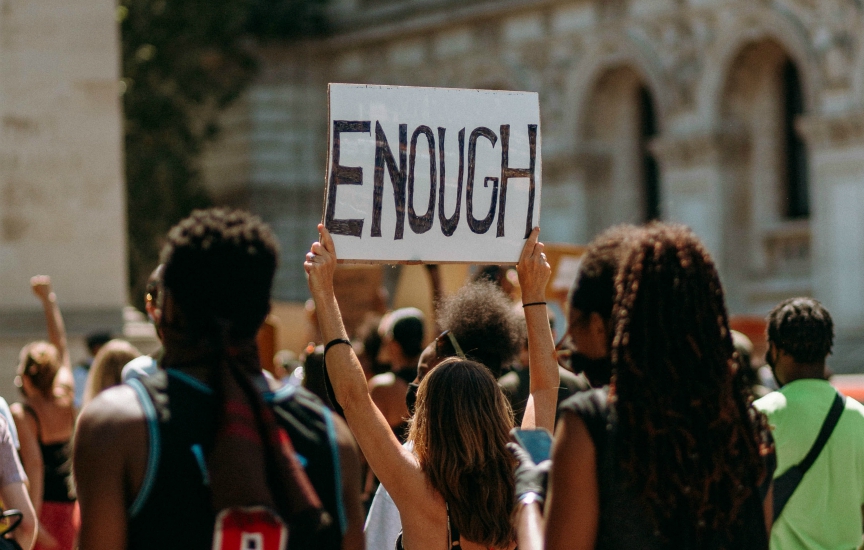
Summer 2020 will long be remembered for protests against racial injustice that filled the streets of many U.S. cities. Young people have been at the forefront of this movement, impatient with the nation’s status quo — a feeling no doubt shared by many young Baha’is.
The Midwest Youth Conference, July 18–19, sought to develop a response to this social reality. Held via online videoconference, it attracted 75 participants from Indiana, Michigan and Ohio.
Atlanta-area youth camp participants take part in one-on-one study. Photo courtesy of Jasmine Miller-Kleinhenz
Many U.S. Baha’i communities have moved nearly all activities that would usually take place indoors to online platforms since the pandemic broke out earlier this year.
Yet not everyone has access to reliable devices, digital literacy, a stable Internet connection, quiet space or other resources that make online engagement possible, as the team coordinating activities in the Indian Creek neighborhood of Stone Mountain, Georgia, discovered.
A few years ago, I was having a conversation with a renowned professor of communication arts. He posed this question to me: “Why do the English translations of Baha’i Writings use such elevated language? Does it pose an obstacle to understanding for some people?”
In The Advent of Divine Justice, Shoghi Effendi laid out a path for the U.S. and Canadian Baha’i communities to contribute to the transformation of their societies, as summarized in introduction to the Advent of Divine Justice. Addressing the United States in particular, he identified “racial prejudice” as “the most vital and challenging issue confronting the Baha’i community,” for this issue permeated the entire nation, which he called “a prey to one of the most virulent and long-standing forms of racial prejudice.”
Baha’u’llah proclaimed to humanity that “these great oppressions that have befallen the world are preparing it for the advent of the Most Great Justice.”1 His teachings lay out a blueprint for establishing a just world civilization founded on international cooperation, and the paramount task of His successors has been to give people around the world access to this blueprint.
Inks:The Journal of the Comics Studies Society, vol. 4, no. 1, Spring 2020, pp. 44–65.
Abstract:Thi Bui’s The Best We Could Do, a graphic memoir centering on her family’s experience with war in Vietnam and with resettlement in the United States,earned critical acclaim upon publication in 2017. It touched a nerve with U.S. readers attuned to their country’s rising xenophobia, eliciting praise for humanizing refugees. Her comic certainly stirs compassion with its fusion of emotive drawings and text—but it does more. Bui subtly encourages readers to not only see refugees as human but to realize that no polity exists apart from migrancy. Situating her book in recent postcolonial theory, I read it as a commentary on the shifting nature of history and nation. Bui presents no singular homeland, past or present, implicitly calling into question Americans’ desire for a walled nation and bounded culture.
Full Text: You can download the article by clicking the link below.
Journal of Bahá’í Studies, vol. 30, no. 1–2, 2020, pp. 19–44.
Abstract: Scholars have wrestled with the question of how people can be persuaded to extend feelings of kinship beyond their own ethnic or national groups. This article identifies spiritual cosmopolitanism, whose principles of universal love and harmony can be found in the teachings of the Bahá’í Faith, as key to such borderless solidarity. Drawing on data gathered from interviews with Iranian refugees who have settled in the United States, the article demonstrates how cosmopolitan principles shape the worldviews of Bahá’ís. Through this case study, spiritual cosmopolitanism’s potential to enrich public arguments for the inclusion of Others such as immigrants becomes apparent.
Reframing Immigration through Religious Advocacy: Rhetoric, Cosmopolitanism, and the Divine. 2020. Penn State U, PhD dissertation.
Multimedia Abstract:
Please turn on closed captioning if desired.
Textual Abstract:
In the United States, nativist rhetoric is propelling increasingly violent attacks on immigrants[1] and other minority populations. Conversely, discourse taking a more cosmopolitan approach—positing border-transcending obligations to all humanity, unlimited by national or ethnic group—struggles to elicit a comparably passionate following, as I explain in the introduction (chapter one). Perhaps cosmopolitan rhetoric can gain persuasive power by joining forces with religion. In the realm of faith-based immigration advocacy, cosmopolitan arguments leverage appeals to divine, rather than merely manmade, imperatives toward love and fellowship. For many potential audiences in this country, the divine plays a potent role in their lives, as over 75% of Americans belong to a religion—a statistic that suggests the influence of religious rhetoric. What resources can religious rhetoric provide to pro-immigrant arguments? By responding to this question, my project addresses a gap in studies of immigration rhetoric, which have hitherto overlooked the border-crossing potential of religious advocacy. The project also addresses a gap in studies of religious rhetoric, which have predominantly focused on Protestant Christianity, by drawing attention to the contributions of rhetors adhering to other religions.
Every world religion offers some cosmopolitan principles, and many also feature sacred stories of migration, as chapter two demonstrates. To elucidate how these elements invigorate arguments for hospitality toward immigrants, I analyze the rhetoric of Bahá’í, Catholic, and Islamic advocacy organizations through the lens of religious cosmopolitanism (a theory that chapter two elucidates). In each organization’s advocacy, I find a model for reframing immigration rhetoric. In chapter three, I demonstrate how the Tahirih Justice Center uses the Bahá’í principle of nonpartisanship to enlist support across the aisles for its work on behalf of immigrant women. In chapter four, I survey the Kino Border Initiative’s rhetoric of journeying, which draws from Catholic traditions to spiritualize undocumented migration. Chapter five presents Hijabis of New York, a social media campaign that claims public space for a much-maligned immigrant group, U.S. Muslim women.
All three of these organizations mobilize religious tenets that mandate universal justice and compassion. Through their arguments for border-transcending policies and dispositions, these organizations reframe the commonplaces of immigration, replacing the xenophobia that dominates discourse today with recognition of migrants’ humanity and spirituality. This dissertation’s discovery of innovative strategies in cosmopolitan rhetoric has several implications for research and teaching, as I point out in the conclusion (chapter six). In the arena of rhetorical research, my project shows that religion can contribute to arguments that we should welcome them—or, more radically, that there is no them, just a global us. It also implies the need for much more research in cosmopolitan theory even—and especially—in the face of rising xenophobia. The project also offers some practical takeaways for pedagogy, recommending anti-nativist teaching strategies. Overall, by bringing to light advocacy rhetorics that refuse to operate on nativism’s terms, it offers the reader hope for humane responses to those who have come across borders.